
Conservationists fault Gov't over contradictory push to plant 15 billion trees while 'clearing' forests

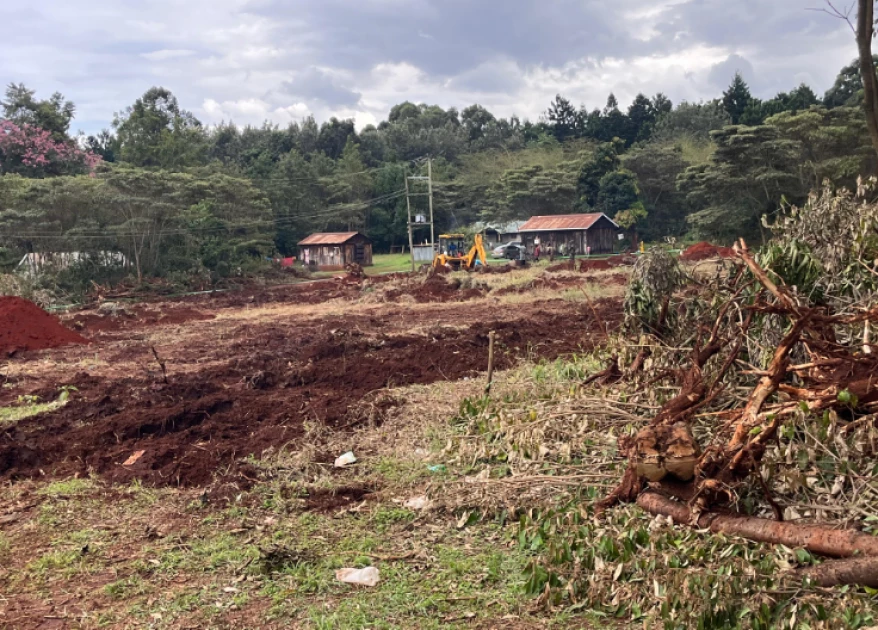
File image of works at Karura Forest.

Audio By Vocalize
A coalition of environmental organisations has accused the
government of undermining its ambitious plan to plant 15 billion trees by 2032
through the continued destruction of existing forests and public green spaces
for infrastructure and commercial developments.
In a joint statement issued on Thursday, the groups said Kenya
cannot claim to be restoring forests while simultaneously allowing mature
indigenous ecosystems to be fragmented, arguing that such habitats cannot
simply be replaced by planting seedlings elsewhere.
"We cannot plant billions of trees while destroying the
forests we already have," said the organisations – under the umbrella of
Friends of Nairobi’s Forests and Green Spaces - warning that the contradiction
threatens the country's climate commitments and biodiversity conservation
efforts.
The organisations accused the government of sacrificing critical
environmental assets despite Kenya's commitments under international climate
agreements, including the Paris Agreement, the Convention on Biological
Diversity, the African Forest Landscape Restoration Initiative and the Bonn
Challenge.
The coalition singled out Ngong Road Forest as one of
Nairobi's most threatened indigenous forests, citing multiple ongoing and
proposed developments within the protected area.
According to the lobby groups, the projects include a proposed
luxury tented camp, the Riruta-Ngong Town Meter Gauge Railway line, a road
linking Talanta Stadium to the Bomas International Conference Centre, a
contractor's construction camp and the proposed Talanta Sports City.
The groups noted that although the government had previously
committed to halting the luxury tented camp project, construction activities
were still ongoing.
"Individually, each of these developments fragments the
forest ecosystem; collectively, they pose a serious threat to one of Nairobi's
most important ecological assets," the statement read.
The conservationists also raised concern over what they termed
as the gradual reduction of Nairobi National Park through repeated
infrastructure developments.
They opposed plans to construct a new Nairobi Animal Orphanage
and a 1,300-vehicle parking facility to serve the neighbouring Bomas of Kenya
International Conference Centre.
"Nairobi National Park is dying not in one fell swoop,
but rather through a thousand small cuts," they stated.
They also opposed the ongoing construction of an airstrip,
State Lodge and golf course within Upper Imenti Forest, warning that the
developments threaten one of Kenya's key water towers and biodiversity
hotspots.
The coalition further criticised plans to expand State House
Road, saying the project would result in the felling of mature trees along
State House Road and Dennis Pritt Road.
"Development and environmental protection are not
mutually exclusive. Engineering solutions exist that preserve mature trees
while improving transport infrastructure," they noted.
The groups went ahead to reject proposals to excise part of
Uhuru Park for the expansion of Uhuru Highway, saying the park remains a
national monument and symbol of Kenya's democratic struggle.
Referencing the late environmentalist Prof. Wangari Maathai's
campaign to protect the park, they warned that reducing its size would
dishonour her legacy.
On City Park, the organisations cited unresolved land
ownership disputes, weak governance and encroachment as key threats, calling
for a comprehensive rehabilitation and management plan.
The conservationists also expressed concern over what they
described as the continued disregard of court orders halting developments in
protected forests.
"We therefore demand that all government agencies, public
institutions, private developers and contractors immediately comply with all
court orders, cease any activities that contravene judicial directives and
uphold their constitutional obligation to protect public forests," read
the statement.
The coalition faulted the Ministry of Environment, Climate
Change and Forestry, the Ministry of Tourism and Wildlife, the Kenya Forest
Service (KFS), the Kenya Wildlife Service (KWS) and the National Environment
Management Authority (NEMA), accusing them of failing to safeguard Kenya's forests
and protected areas.
"The government cannot ask citizens to plant 15 billion
trees while the very institutions mandated to protect existing forests and
protected areas appear unable or unwilling to stop their destruction,"
they said.
The groups called on the government to halt all activities
resulting in the destruction or excision of public forests and green spaces
unless there is transparent public participation, comprehensive environmental
impact assessments and proof that no environmentally viable alternatives exist.
They also urged Parliament to strengthen legal protections for
forests and green spaces, while calling on development partners and the
international community to closely monitor Kenya's progress towards its climate
and biodiversity commitments.
"History will judge us not by how many seedlings we
planted, but by whether we had the wisdom to protect the forests we
inherited," they added.
Join the Discussion
Share your perspective with the Citizen Digital community.
No comments yet
This discussion is waiting for your voice. Be the first to share your thoughts!