
African leaders push to extend threatened AU mission to Somalia
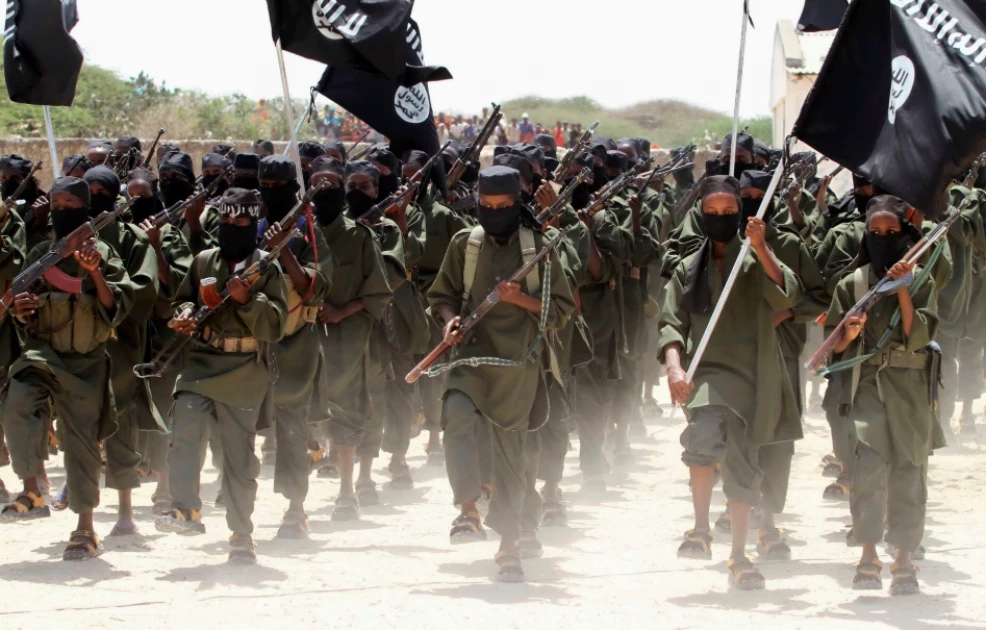
FILE PHOTO: New recruits of Somalia's al-Qaeda linked al Shabaab militia march during a passing out parade at a military training base in Afgoye, west of Mogadishu, Somalia February 17, 2011. REUTERS/Feisal Omar/File Photo

Audio By Vocalize
Leaders of countries making up an African Union military
mission in Somalia on Friday insisted they wanted to extend its mandate,
despite Washington ending political and critical financial support.
Somalia has battled Al-Shabaab insurgents for around two
decades, but the Islamist group still controls vast swathes of the country.
The African Union Support and Stabilisation Mission in
Somalia (AUSSOM) is the leading force supporting the Somali army, providing
roughly 12,000 troops.
But the United States has announced it will end support to
the UN Support Office in Somalia (UNSOS), which crucially provides logistics to
the mission, at the end of this year.
Washington -- the main financial contributor to UNSOS --
said it would also oppose any further UN logistical support to AUSSOM.
In a July 1 letter, Washington accused Somalia's government
of a lack of progress against Al-Shabaab and in addressing security and
governance challenges.
Leaders in the Ugandan capital Kampala stressed the need for
"an orderly, coordinated and phased exit of AUSSOM".
It should be supported by a UN Security Council-mandated
mechanism for up to two years during which security would gradually be handed
over to Somali forces, according to a statement read to reporters.
Analysts fear a similar scenario as in Afghanistan when US
troops pulled out in 2021. That could lead to the possible collapse of the
government in Mogadishu which for two decades has had AU backing against the
Islamist insurgency.
But analysts said the chances of the mission continuing were
slim given Washington's stance.
"I doubt that there is any viable possibility for
sustaining this mission without reversal of the US decision on UNSOS,"
Solomon Dersso, head of the Amani Africa think tank, said.
Washington's decision is "irreversible", a senior
diplomat to the AU told AFP on condition of anonymity.
It is part of a wider fatigue among donors and partners of
Somalia in the face of what the US described as constant "internal
rivalries and political infighting".
Somalia is deeply fragmented and currently in the midst of
another political crisis.
President Hassan Sheikh Mohamud had the constitution changed
earlier this year, extending his term by a year after it expired on May 15.
Opposition parties and regional governments rejected the
changes, leading to violent clashes in several parts of the country, including
Mogadishu.
The summit urged Mohamud to convene a conference of leaders
of the government, opposition and federal states.
The president responded that Somali political matters should
not feature in the summit statement and must not be
"internationalised".
Leaders in their statement also asked international partners
"to consider the provision of additional resources to address the
financial shortfalls" facing the AU mission.
UNSOS operational costs -- from troop rotation to food, fuel
and medical equipment -- were half a billion dollars this year, three times
more than AUSSOM's budget, the Balqiis think tank based in Mogadishu said in a
recent report.
The European Union, traditionally the biggest donor to
African missions in Somalia, has reduced its funding this year.
The AU "has no solution" and "now finds
itself in a situation where it has to make a decision" quickly, the
diplomat to the AU said.
"There's really no other choice than to end the AU
mission before UNSOS shuts down and we find ourselves unable to evacuate our
troops" from Somalia due to a lack of logistical resources, the diplomat
added.
"A complete exit... will have security consequences
that the Somalia government cannot handle," warned Meressa Kahsu Dessu, of
the Institute for Security Studies (ISS).
"If the exit is not carefully done, it can reproduce an
Afghan scenario where the Taliban took over, with the Shabaab," he added.
In comments on X, Abdisaid Muse Ali, former Somali security
advisor and ex-foreign minister, said the Kampala talks should force Somalia's
leaders to confront what follows an AU drawdown.
"In Kabul, leaders came to treat foreign troops, donor
money & diplomatic backing as permanent foundations of power," he
wrote.
"Patronage crowded out institution-building, corruption
drained public authority, & political factions fought over offices while
the security order weakened beneath them.
"Somalia now faces a similar danger," he
cautioned.
Join the Discussion
Share your perspective with the Citizen Digital community.
No comments yet
This discussion is waiting for your voice. Be the first to share your thoughts!