
New Nature-based wastewater treatment solution aims to restore ocean health in Mombasa
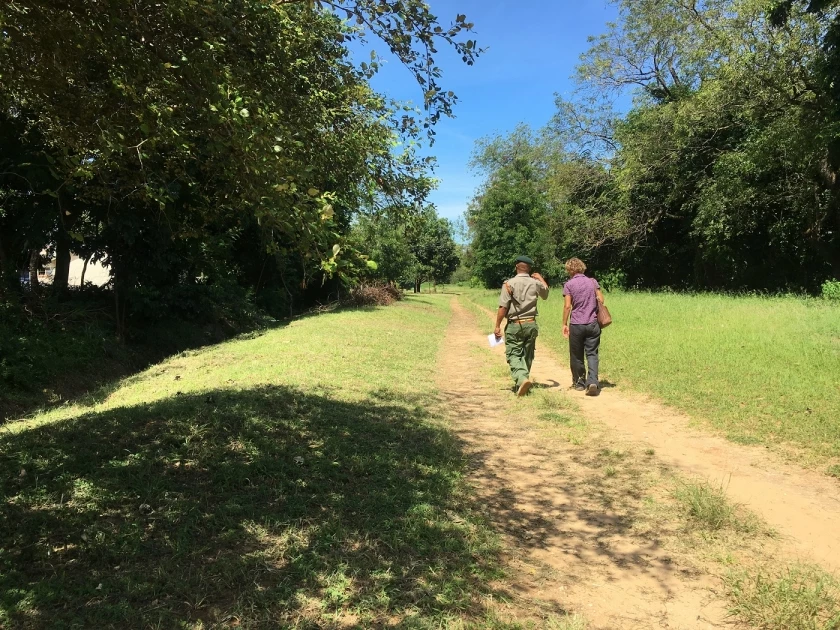
Prison management officer Kenrodgers Kyalo Mutemi and Sarah den Hering of GreenWater on the path connecting the prison to the constructed wetland area. FILE Photo by UNEP/Nairobi Convention

Audio By Vocalize
Launched on May 9 by the UN Environment Programme (UNEP) in partnership with the Kenya Marine and Fisheries Research Institute (KMFRI) and local community groups, the Mikindani Constructed Wetland will improve water quality and provide a sustainable solution to local wastewater management issues, enhancing community health and livelihoods.
This project is a key component of Go Blue, a four-year programme funded by the European Union that seeks to build a sustainable blue economy in coastal Kenya that generates environmental, social, and economic benefits for local communities. Go Blue Environment focuses on connecting people, cities, and the ocean through integrated, ecosystem-based land-sea planning and management, and is jointly implemented by UNEP and UN-Habitat.
Mikindani, a low-income residential area in Mombasa, has suffered persistent wastewater problems, with untreated effluent draining into Tudor Creek, a vital ecosystem that supports mangroves, marine life, and local farming. The new wetland uses locally available vegetation, including Typha grass, Cattail, and Vetiver grass, to filter and clean wastewater, effectively improving water quality and restoring coastal and marine ecosystems by reducing harmful pollution of Tudor Creek.
“A project of this magnitude does not happen in isolation. It takes vision, collaboration, and commitment. I would like to extend my deepest appreciation to the European Union for their critical financial support through the Go Blue Project, and to UNEP for providing technical expertise and ensuring that the project meets global environmental standards,” said Hassan Ali Joho, Cabinet Secretary for Mining, Blue Economy, and Maritime Affairs.
“This collaboration demonstrates what we can achieve when governments, research institutions, development partners, and communities come together to drive transformative change.”
This project builds on the success of a similar initiative by UNEP completed in 2023, the Shimo la Tewa Constructed Wetland, and is designed to be accessible to the Mikindani community, ensuring long-term environmental and social benefits.
“At UNEP, we are fully committed to addressing the triple planetary crisis of climate change, nature and biodiversity loss, and pollution, and waste,” said Sinikinesh Beyene, acting Head of the Marine and Freshwater Branch, UNEP Ecosystems Division.
“Projects like the Mikindani Constructed Wetland exemplify how innovative nature-based solutions can mitigate environmental challenges and restore vital ecosystems.” “Partnerships with national institutions such as KMFRI and local community groups are crucial in building capacity, ensuring the long-term success and sustainability of these initiatives, and empowering communities to lead in the fight against environmental degradation,” she added.
Henriette Geiger, EU Ambassador to Kenya, emphasized the European Union’s commitment to advancing Kenya’s blue economy: "Through the Go Blue programme, the European Union has invested significantly in concrete projects along Kenya’s coast, addressing both land and sea challenges. We believe there is no green without blue and no blue without green. By combining policy development with practical implementation and bringing in the expertise of UNEP and UN-Habitat, we have been able to achieve results that would not have been possible otherwise. These partnerships are key to advancing Kenya's blue economy and ensuring sustainable growth."
The Mikindani Constructed Wetland supports several key Sustainable Development Goals (SDGs), including SDG 3 (Good Health and Well-Being) by improving water quality and reducing waterborne diseases, SDG 6 (Clean Water and Sanitation) through sustainable wastewater treatment, SDG 13 (Climate Action) by enhancing ecosystem resilience with nature-based solutions, and SDG 14 (Life Below Water) by promoting the protection of marine ecosystems.
Join the Discussion
Share your perspective with the Citizen Digital community.
No comments yet
This discussion is waiting for your voice. Be the first to share your thoughts!