
Why financial literacy is essential for athletes, creatives in emerging global economies
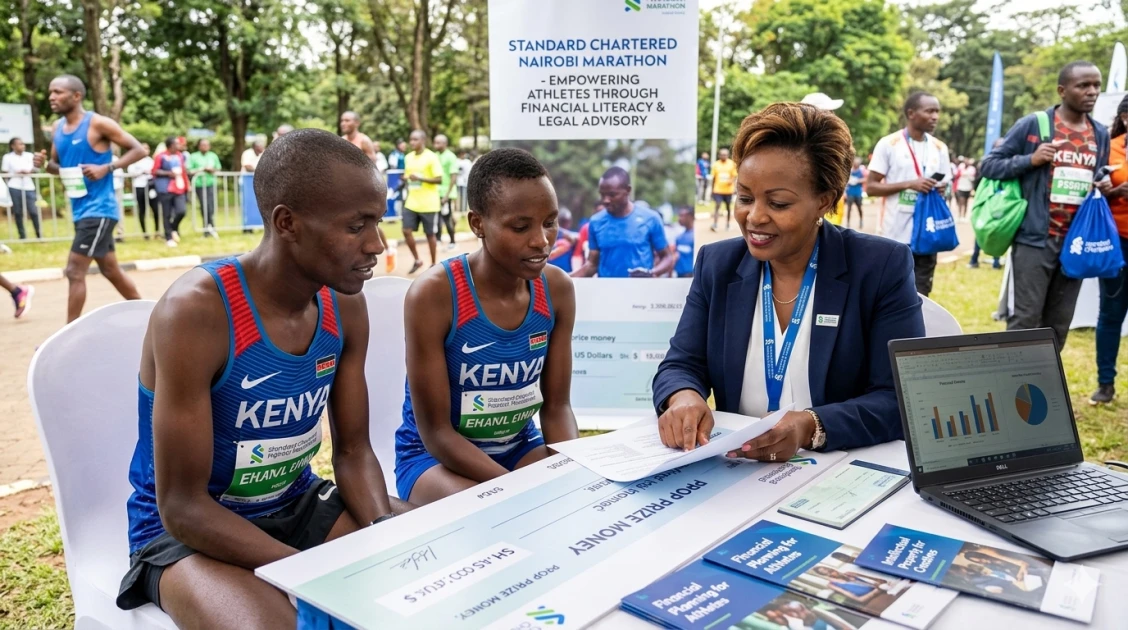
An AI generated image showing Athletes learning about their finances and investment. PHOTO | GEMINI

Audio By Vocalize
By Joyce Kibe
There is a
particular kind of heartbreak that follows financial ruin, not the ruin of
someone who never had anything, but of someone who had everything and did not
know how to hold it. Across African sport and the creative arts, this story
repeats itself with a provoking regularity.
Kenya's runners are among the most gifted human beings on the planet. Of the 100 fastest marathon times in history, 89 belong to runners from Kenya or Ethiopia. These are the product of sacrifice and a ferocious will to transcend challenges - from economic, to social and even mental wellness or stretching personal limits.
Over 33% of Kenyan runners cite financial success as their primary
reason for running. Running here is not merely a sport. It is an economic
strategy, a family business, and a generational project.
About 10% of Kenya's runners are true professionals competing in marquee international races with five- or six-figure prize money. Another 20% "survive race-to-race," pocketing USD$1,000 here or there, hoping years of training will produce a breakthrough.
For most, the peak earning window is
five to ten years. When it closes, it closes fast, and the landscape beyond has
been unkind.
Within
athletics federations, there are stories of delayed stipends, mismanagement,
and little to no planning for life after sport. When systems do not protect
athletes, athletes must protect themselves. And they cannot protect what they
do not understand.
In emerging economies, the financial literacy gap is not merely a personal setback; it is a structural crisis. Research shows that higher financial literacy correlates directly with increased savings, higher investment returns, and greater ability to manage economic shocks.
Conversely, low literacy enables exploitation:
predatory agents, fraudulent schemes, and the intense family pressure to
distribute sudden wealth prey on those without the knowledge to resist.
The
macroeconomic stakes are significant. Africa's sports market is currently worth
more than USD$12
billion and could reach over USD$20 billion by 2035. Whether that wealth stays in Africa and compounds
across generations, or evaporates in a single bad decision, depends
substantially on whether athletes have the knowledge to steward it.
The same dynamics play out at an even greater scale in the creative economy. According to the Africa Creator Economy Market, Africa's creator economy was valued at USD$5.10 billion in 2025 and is projected to reach USD$29.84 billion by 2032, a compound annual growth rate of 28.7%.
Music streaming alone is forecasted to generate USD$451 million in 2025, a fivefold increase since 2017. Yet the artists generating this value often see the least of it. African music artists received USD$59 million from Spotify in 2024, just 0.59% of the platform's USD$10 billion in global royalty payments, despite Africa's streaming market being among the fastest growing on earth.
Royalty systems remain opaque, contracts are poorly understood, and intellectual property rights are under-protected. Without
structural fixes, Africa risks fuelling a generation of "gig
creatives" who go viral but never see the money.
A marathon runner who turns professional at 22 and retires at 34 has approximately twelve years to earn what must sustain the next 50 years. The financial behaviours formed in those peak years, including saving rates, investment choices, contract terms, whether accepted or rejected, determine outcomes for decades afterwards.
Research shows that participants in financial education programs were 40% more
likely to engage in proactive behaviours such as saving for retirement and
building diversified portfolios. Those behaviours compound over time, and they
spread. The athlete who invests wisely at 26 is not only wealthier at 40 but
also a model for the next generation.
As the
organisers of the Standard Chartered Nairobi Marathon, which brings in
approximately 30,000 runners annually, we provide financial literacy and legal
advice to athletes with intentionality. Handing someone a cheque without
equipping them to manage it is an incomplete act. Prize money with financial education is an
investment in the athlete, their family, and the broader ecosystem of sport in
Kenya.
Financial
literacy is how a single generation's victory becomes a family's foundation and
a nation's proof of what is possible when talent meets knowledge.
The answer
lies not in patriotic appeals alone, but in building systems that nurture,
reward, and protect athletes. That door should not close the moment the prize money runs out.
Joyce
Kibe is Head of Corporate Affairs, Brand & Marketing, Kenya & Africa,
Standard Chartered.
Join the Discussion
Share your perspective with the Citizen Digital community.
No comments yet
This discussion is waiting for your voice. Be the first to share your thoughts!