
Who is Martin Kimani? The new UN Assistant Secretary-General for Africa
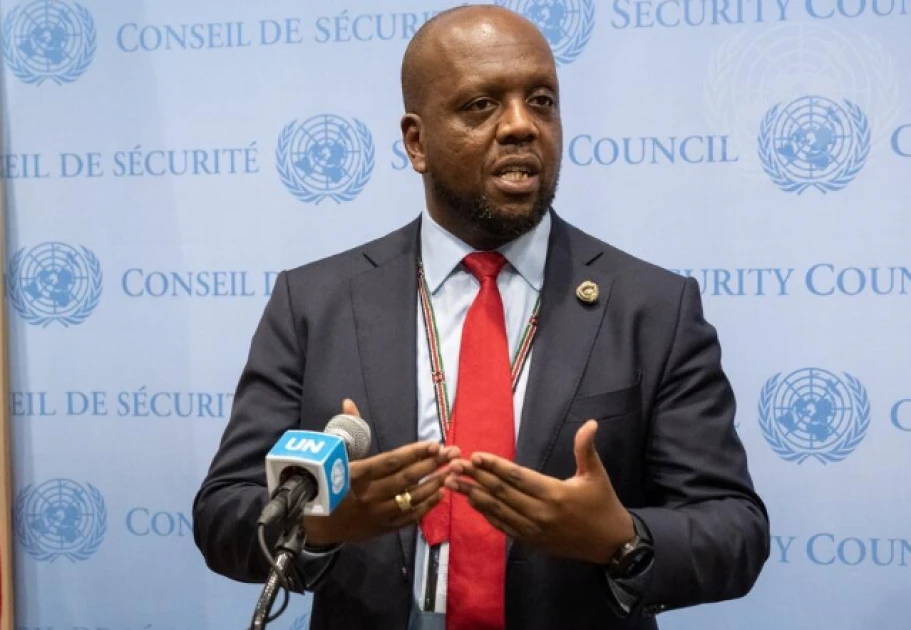
Ambassador Martin Kimani, the United Nations Assistant Secretary-General for Africa. Photo: UN

Audio By Vocalize
United Nations Secretary-General António Guterres said Kimani will head the Department of Political and Peacebuilding Affairs and Peace Operations (DPPA-DPO), where he will oversee the UN's political and peace operations work in Africa.
In his new role, he will advise SG Guterres on developments in peace and security, political transitions and appropriate responses to emerging conflicts, lead efforts to prevent and resolve conflicts, and mediate early warning analysis aimed at addressing crises before they worsen.
He will also oversee and support special political missions and peacekeeping operations, and work with the African Union (AU), the Intergovernmental Authority on Development (IGAD) and other regional bodies to respond to matters affecting peace and security.
The diplomat, born in Mombasa in 1971, has maintained the poise of being a staunch supporter of African development, sovereignty, and participatory democracy.
With over 25 years of experience in international relations, he has repeatedly, during his formal and non-formal addresses, advocated for African solutions to African problems.
"I am a culmination of a lot of people's efforts," he once said in an interview while crediting his mother and other instrumental individuals who have shaped his journey.
He secured a bachelor's degree in philosophy from the University of New Hampshire, United States, in 1996 and later earned a master's degree (2003) and a PhD (2013) in War Studies from King's College London, University of London.
He wrote his Master's thesis on oil marketing in Kenya, while his PhD thesis was on the role of Christian symbolism, the Catholic Church, and racism in the 1994 Rwandan genocide.
Through his remarkable educational journey, he aimed to be on the front lines of championing change in Africa and positively contribute to its growth.
"For a long time I did not know where my path lay. I had a broad intentionality and instinct that I wanted to do something and change, or at least affect, what felt to me like a very humiliating imbalance of power that the African people have to endure," he said in the same interview.
Professional career
Diplomat Kimani continued his work in Nairobi, Addis Ababa, and New York City.
His career began in New York in the 1990s working on a currency hedge fund, followed by time in London advising underwriters on political risk—experiences that provided foundational insights into global financial markets and their intersection with political dynamics.
He served as the Director of the Intergovernmental Authority on Development’s Conflict Early Warning and Response Mechanism in Ethiopia (2011-2012) and later became the Permanent Representative to the UN Environment Programme and UN-Habitat (2012-2015).
Kimani was later appointed the Director of Kenya’s National Counter Terrorism Centre and the President’s Special Envoy for Countering Violent Extremism (2015-2020).
In 2016, former President Uhuru Kenyatta awarded him the Elder of the Order of the Burning Spear (EBS) alongside the higher rank of Chief of the Order of the Burning Spear (CBS) for his extensive public service.
Owing to his stellar career, Mr. Kenyatta appointed him Secretary of Strategic Initiatives within the Executive Office of the President in 2018.
He rose the professional ladder in 2020 when he was appointed the Permanent Representative of Kenya to the United Nations in New York, a role he served until 2024.
He simultaneously served as President of the Security Council in October 2021, when Kenya was a non-permanent member of the Security Council from 2021 to 2022.
During the period, Kimani chaired its Ad Hoc Working Group on Conflict Prevention and Resolution in Africa, and co-chaired its Informal Expert Group on Climate and Security in 2022.
In 2023, he became the President of the Executive Board of the United Nations Development Programme, the United Nations Population Fund and the United Nations Office for Project Services.
Culture, arts and sports enthusiast
Aside from the diplomatic corridors, Kimani is the President and CEO of The Africa Center in New York City, a nonprofit institution that serves as a cultural, policy, and business hub connecting Africa and its diaspora.
Kimani believes museums and the arts play a key role in fostering transformative dialogue on reimagining Africa's relationship with itself and the world.
He has contributed to cultural institutions like the Paul Klee Museum in Bern and Frankfurt's Weltkulturen Museum.
He has also written on Africa's evolving global role, and the publications have appeared in leading literary journals such as Granta and Kwani?, platforms which partnered to connect East African literature to the global stage through shared editors, collaborative workshops, and iconic essays.
His works have also appeared in Farafina Magazine, and Chimurenga Magazine, the New York Times, Frankfurter Allgemeine Zeitung, and The Guardian.
He was awarded the German Africa Foundation’s Honorary Award in 2022 and is also a member of the Aspen Global Leadership Network.
He is a Carnegie Distinguished Fellow 2024-2025 at Columbia University's School of International and Public Affairs' Institute of Global Politics, a Distinguished Fellow at New York University's Center on International Cooperation (in which he was Executive Director briefly in 2024), and serves on the Board of the International Rescue Committee.
Ambassador Kimani also shares his passion for sports, mostly basketball and tennis, making fan commentaries on the New York Knicks via social media.
He has expressed his ambitious vision for Africa once saying: "Not sure the world quite understands that, for the next 20 years, the face of victory in almost every field and endeavour dominated by young people will be African."
The diplomat's reputable career stems from a deeply rooted culture instilled by her mother, who worked as a nurse and an entrepreneur.
"The great power of my mother was to do. Everything she has ever wanted me to do, she's just done, and I have grown up with that as the way you do things," he once said.
Join the Discussion
Share your perspective with the Citizen Digital community.
No comments yet
This discussion is waiting for your voice. Be the first to share your thoughts!