
What women’s marathon participation says about social progress
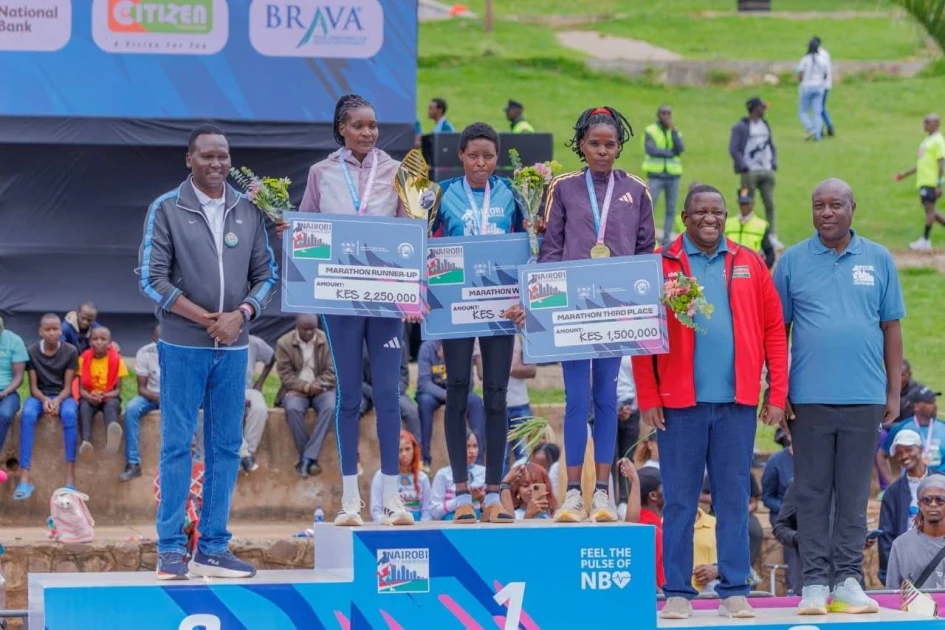
Sports CS Salim Mvurya (2nd right ) during Nairobi Marathon's award ceremony for women winners on June 7, 2026 at the Uhuru Park Grounds. Photo/Citizen Digital.

Audio By Vocalize
At every marathon start line, a city briefly gathers in one
place: elite athletes, first-time runners, corporate teams, families,
wheelchair athletes and walkers. Increasingly, one of the most powerful
features of that scene is the number of women who choose to show up.
Kenya often celebrates women in distance running through
excellence. Female athletes have shaped global marathon history. But the next
story is not only about women winning races; it is about women entering them.
Mass participation may be the more revealing measure of how sport changes
society.
Globally, marathon running is still male-dominated.
RunRepeat’s analysis of 19.6 million individual marathon finish records from
more than 32,000 races found that women accounted for 31.92 per cent of
marathon participants in 2018, although their participation grew faster than
men’s over the preceding decade. A broader RunRepeat and World Athletics study
of 107.9 million race results also found that, across all running distances,
women slightly outnumbered men for the first time in 2018, at 50.24 per cent.
The direction is clear: running is becoming more democratic, social and
intergenerational.
That matters in Africa, where women’s access to recreational
sport has often lagged behind achievement. A 2021 peer-reviewed Rutgers-led
study of women in rural Kenya found that those in a recreational soccer
programme had 67 per cent greater odds of reporting good or excellent health
than non-participants. When women are given accessible opportunities to move,
the gains are physical, psychological and social.
This is the deeper significance of the annual Standard
Chartered Nairobi Marathon. Since 2003, it has attracted more than 330,000
participants, drawing 30,602 participants from 92 nationalities in 2025. Women
accounted for 49 per cent of the field. That is close to parity, well above the
global marathon average.
The category data is even more telling. Women outnumbered
men in the 10km individual race, with 2,053 female runners against 1,349 men,
and in the 5km Family Fun Run, with 1,001 women against 570 men. Team entries
also show scale: 4,453 women in the team 10km and 3,133 in the team 5km. The
marathon is becoming a route through which women participate in public life as
athletes, colleagues, mothers, friends and community leaders.
For brands, this is where sponsorship must mature. It cannot
remain a logo on a vest or banner at the finish line. The most valuable
sponsorships help institutions earn relevance in people’s lives. Trust is built
less by what a brand says and more by the role it plays in moments that matter.
Women’s participation gives the marathon that relevance. It
connects elite sport to everyday health, family life, workplace culture,
safety, confidence and opportunity. It also asks a harder question: are public
sporting spaces designed for women’s realities, or merely open to women in
theory?
Inclusion is not achieved by counting entries alone.
Mothers’ rooms, nursing stations, accessible facilities, safer logistics,
medical support and family-friendly race categories may appear operational. In
reality, they signal who the event is built for.
The economic case is also strengthening. Major marathons
have become engines of tourism, media value, health promotion and charitable
giving. Nairobi can build the same logic: a marathon becomes a city asset when
it combines participation, purpose and place.
The community case is equally compelling. Over its history,
the Nairobi Marathon has raised more than Ksh.520 million through participant
registrations. These proceeds have supported more than 55,000 young people,
reached over 12,000 youth through employability pathways, secured 372 jobs and
helped create more than 1,387 microbusiness jobs, with women accounting for 88
per cent of beneficiaries.
This is where the women’s running story becomes bigger than
wellness. When proceeds support skills and enterprise pathways, the race
becomes a bridge between movement and mobility — from running bib to
livelihood, inclusion and economic confidence.
The opportunity now is to make women’s participation more
intentional: better data on who enters, finishes and returns; safer routes into
running clubs, school sport and community fitness; and more women as
organisers, coaches, suppliers, storytellers and decision-makers.
The marathon is a useful metaphor because progress is paced.
Participation grows through habit, confidence and repeated invitation. The more
women see other women on the road, the easier it becomes for the next woman to
imagine herself there. That is how culture changes: in visible proof.
Kenya’s marathon story has long been about speed. It should
now also be about scale, access and shared benefit. Because when women run,
they do not only cross finish lines. They move families, workplaces,
communities and futures forward.
The writer is Standard Chartered’s Head of Corporate
Affairs, Brand & Marketing (CABM) for Kenya & Africa.
Join the Discussion
Share your perspective with the Citizen Digital community.
No comments yet
This discussion is waiting for your voice. Be the first to share your thoughts!