
Wananchi Opinion: It’s only a matter of time before Africa fully adopts electric vehicles
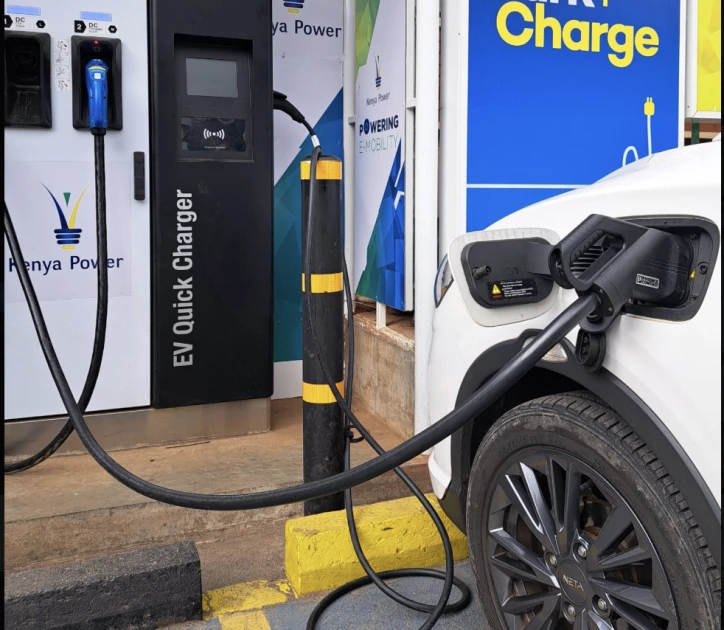
An electric vehicle at an EV charging station in Nairobi. Photo I File

Audio By Vocalize
For years, electric vehicles have been framed as a luxury of wealthy countries — sleek cars gliding through cities with stable power grids and generous subsidies.
In much of Africa, where electricity can be unreliable and petrol vehicles dominate the roads, the idea of mass electric mobility has often seemed distant, even unrealistic.
This long held assumption is slowly changing, and new research suggests that E-Mobility in Africa may come sooner than many expected.
A study led by researchers at ETH Zurich and the Paul Scherrer Institute PSI, in collaboration with African partners from Makerere University, University of Port Harcourt and Stellenbosch University, recently published in Nature Energy, finds that electric vehicles (EVs) in Africa could become economically competitive much sooner than expected — in some cases well before 2040.
By pairing electric vehicles with off-grid solar power and battery storage, the researchers argue that African countries could bypass some of the biggest barriers to electric mobility — expensive fuel imports, unreliable grids, and rising transport costs — and chart their own path toward cleaner transport.
For countries like Kenya, where urban congestion, air pollution and fuel prices are daily concerns, the findings offer a glimpse of a different future — one that may already be closer than it appears.
Rethinking the cost of electric vehicles
One of the most common objections to electric vehicles in Africa is simple: they are too expensive. While EVs are often cheaper to run than petrol or diesel vehicles, their upfront purchase price remains higher — a major hurdle in countries where access to affordable credit is limited.
The ETH Zurich study tackles this issue by looking beyond sticker prices. Instead, it focuses on the “total cost of ownership” — a measure that includes not just the cost of buying a vehicle, but also fuel, maintenance, and operating expenses over its entire lifetime.
Using detailed modelling across 52 African countries, the researchers compared internal combustion engine vehicles with battery electric alternatives under different scenarios.
Crucially, they examined what happens when EVs are charged not from the national grid, but from dedicated off-grid solar PV systems paired with battery storage.
The result is striking. In many African contexts, especially where fuel prices are high and solar energy is cheap, electric vehicles can already approach cost parity with petrol vehicles — and in some segments, particularly smaller vehicles, they could become the cheaper option well before 2040.
This finding challenges the idea that Africa must first build large, stable national grids before electric mobility can take off.
Instead, it suggests that decentralized energy — already common in rural electrification strategies in many African countries — could play an important role in the continent’s clean transport future.
Why solar power changes the equation
Charging infrastructure is often cited as the biggest obstacle to electric vehicles in Africa.
Many countries struggle with unreliable power supply, frequent outages, or limited grid coverage outside major cities. Under these conditions, relying on grid-based EV charging seems impractical.
Solar power offers an alternative
Across much of Africa, solar radiation levels are among the highest in the world.
Over the past decade, the cost of solar panels and battery storage has fallen dramatically, making small-scale solar systems increasingly affordable.
In many communities, solar power is already used to light homes, pump water, and charge phones — even where the grid does not reach.
The study shows that dedicated solar-plus-storage systems can provide a reliable, low-cost source of electricity for charging electric vehicles.
Because the energy comes from the sun, operating costs remain stable and predictable, shielding users from volatile fuel prices and currency fluctuations.
For vehicle owners, this matters. Fuel costs often make up a large share of transport expenses, especially for commercial drivers such as taxi operators or delivery riders.
Solar-powered charging can significantly reduce these costs over time, making electric vehicles more attractive not just environmentally, but economically.
Two wheelers are where electric mobility may take off fastest
While much of the global conversation around EVs focuses on cars, the researchers point out that Africa’s electric transition is more likely to begin on two or three wheels.
Motorcycles, scooters and tuk-tuks dominate urban transport across much of the continent.
In Kenya alone, boda bodas are a lifeline for many — providing affordable transport and livelihoods, while also contributing to congestion, noise and air pollution.
These smaller vehicles are particularly well-suited to electrification. They require smaller batteries, use less energy, and can be charged using relatively modest solar installations.
According to the study, electric two-wheelers could reach cost competitiveness earlier than electric cars in many African countries and is a reality that is already playing out today in many African markets.
For riders, the benefits could be immediate. Electric motorcycles are cheaper to maintain, with fewer moving parts and no need for oil changes.
Charging costs are often far lower than daily fuel expenses. Over time, this could translate into higher take-home income for riders — a powerful incentive in a sector where margins are often thin.
Several African startups are already experimenting with electric motorcycles, battery swapping stations, and pay-as-you-go models.
The research suggests that these early efforts are not just pilot projects, but signals of a broader shift that could accelerate rapidly under the right conditions.
The financing barrier: A critical missing piece
Despite its optimistic conclusions, the study is careful to highlight a major obstacle: financing.
Even when electric vehicles are cheaper over their lifetime, their higher upfront cost remains a challenge. In many African countries, interest rates are high, loan tenures are short, and access to vehicle financing is limited — especially for informal workers and small businesses.
This financing gap can prevent consumers from taking advantage of long-term savings.
A boda boda rider may save money over five years with an electric motorcycle, but if they cannot afford the initial purchase or secure affordable credit, the switch remains out of reach.
The researchers argue that addressing this issue is just as important as improving the technology ecosystem surrounding E-Mobility.
Solutions could include government-backed loan guarantees, partnerships with microfinance institutions, or innovative payment models that spread costs over time — similar to how solar home systems have been financed across rural Africa.
In Kenya, where mobile money platforms and fintech innovation are already reshaping financial services, such models may be particularly promising.
One continent, many pathways
Another key message of the research is that Africa is not a single market. Conditions vary widely from country to country — from fuel prices and financing costs to policy environments and import regulations.
Countries with relatively stable financial systems and lower borrowing costs may see electric vehicles become competitive sooner.
Others may need targeted policy interventions to unlock adoption. What works in South Africa or Morocco may not apply directly to Kenya, Uganda or Tanzania.
This diversity, however, also creates opportunity. Rather than waiting for a one-size-fits-all solution, countries can tailor electric mobility strategies to their own strengths — whether that is solar resources, urban transport patterns, or digital finance ecosystems.
What this means for Kenya
For Kenya, the implications are significant The country already generates a large share of its electricity from renewable sources, particularly geothermal and wind.
Solar power is expanding rapidly, both on-grid and off-grid. At the same time, fuel imports place a heavy burden on foreign exchange reserves, and transport emissions continue to rise.
Electric mobility — especially for motorcycles, public transport, and commercial fleets — could help address all three challenges at once. But the study makes clear that technology alone will not deliver this transition.
Clear policies, supportive regulations, and accessible financing will be essential. Import duties, vehicle standards, charging regulations and urban planning decisions made today will shape whether electric vehicles remain niche products or become mainstream over the next two decades.
A different kind of leapfrogging
Africa’s development story is often framed around leapfrogging — skipping landlines straight to mobile phones, or bypassing traditional banks through mobile money. Electric vehicles, powered by the sun, could represent another such leap.
Rather than locking in decades of fossil-fuel dependence, African countries have an opportunity to build transport systems that are cleaner, quieter and more resilient from the outset.
The ETH Zurich study does not claim this transition will be easy — but it shows that it is economically plausible, and sooner than many expect.
As cities grow and transport demand rises, the choices made now will matter. The road ahead may still be bumpy, but it is no longer a dead end.
For African countries committed to climate goals, the results of the study provide strong justification for setting more ambitious transport sector climate targets.
Join the Discussion
Share your perspective with the Citizen Digital community.
No comments yet
This discussion is waiting for your voice. Be the first to share your thoughts!