
The elephant in the room as Kenya charts Vision 2060
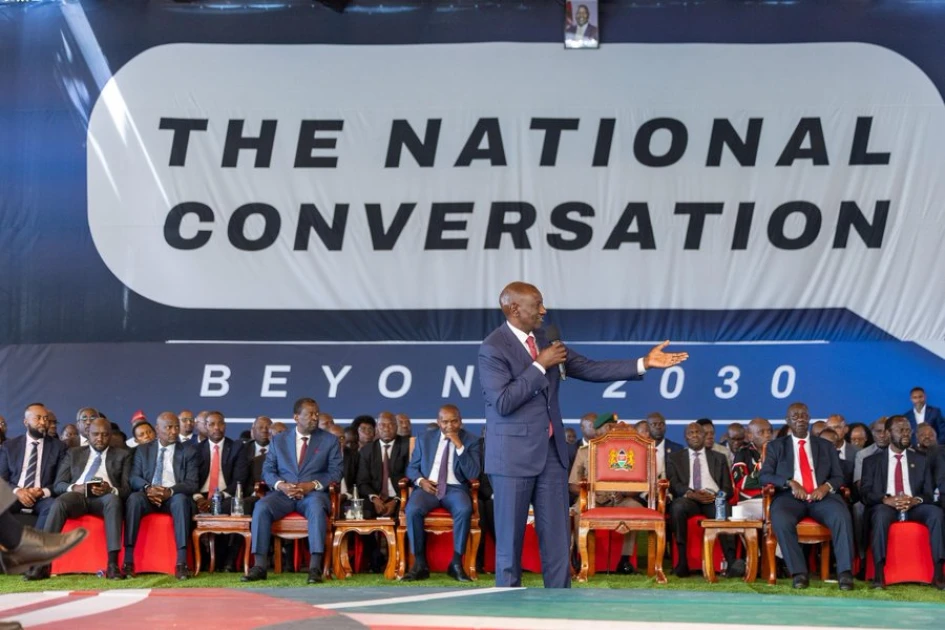
President Ruto speaks at the National Conversation on Beyond Vision 2030, held at the Kenyatta International Convention Centre in Nairobi. Photo: PCS

Audio By Vocalize
It took two economists President William Ruto commissioned to design the new blueprint to say it out loud, and the silence that followed may be the most telling data point yet on whether Kenya is ready to confront the problem that has quietly eaten into every development plan since independence.
Ruto enlisted a team of prominent scholars, among them, Professor Hiroyuki Hino, Professor Anyang' Nyong'o, Professor Michael Chege and Professor Peter Wanyande, to draw up Vision 2060.
The initiative has already drawn sharp criticism from sections of the public who see it as premature at best and, at worst, a diversion engineered to distract Kenyans from the economic hardship many are currently living through.
It was against this backdrop that Prof. Hino delivered an unusually blunt warning at a recent meeting: wastage and corruption, he said, will hold the country back from Vision 2060's goals unless something fundamentally changes. Prof. Nyong'o echoed the sentiment.
Nairobi Senator Edwin Sifuna captured the moment memorably online, remarking that the near-silence in the room as the two professors spoke of corruption confirmed that "the chickens were preaching salvation to the hawks."
A Blueprint Still Unfinished
Before Kenya can credibly talk about 2060, it has to reckon with how far short it has fallen on 2030.
The government's own scorecard puts implementation of Vision 2030 at 66 per cent, a figure that, on its face, might look respectable but which conceals wide disparities between the plan's three pillars: social, political and economic.
Vision 2030 was launched 18 years ago with the promise of transforming Kenya into "a newly industrializing, middle-income country providing a high quality of life to all its citizens."
The social pillar, which covers education, healthcare, water, sanitation and housing, is at 59.5 per cent attainment, according to government figures. That is barely three-fifths of the way to a goal that was supposed to be substantially realized by now.
The political pillar tells a rosier story on paper, with the government claiming an 88.2 per cent achievement rate.
Vision 2030 chairperson Dr. Emmanuel Nzai attributes this largely to the implementation of the 2010 Constitution and the institutional and legal reforms that came with it.
It is a fair point. Kenya's constitutional order is unrecognizable from what it was two decades ago, but institutional reform on paper does not always translate into institutional integrity in practice, a gap that corruption thrives in.
It is the economic pillar, however, where the most uncomfortable numbers live. Vision 2030 set an audacious target: 10 per cent annual GDP growth sustained over 25 years.
Kenya National Bureau of Statistics data shows the economy has instead grown at 4 to 5 per cent a year since 2008, with occasional highs of 8 per cent in 2010 and 7.1 per cent in 2021, the latter largely a rebound from the COVID-19 pandemic's economic shock the year before.
Dr. Nzai concedes the target was simply too aggressive.
KNCCI President Erick Rutto, speaking for the private sector, put it more pointedly: businesses want growth that is real and investable, not growth pegged to targets divorced from the underlying wealth in the economy.
Flagship projects, the tangible, visible markers of Vision 2030's ambition, sit at 61 per cent completion, according to the State Department for Economic Planning.
ICT Principal Secretary John Tanui points to the LAPSET corridor and the emerging Lamu oil refinery investment as evidence the foundation has been laid. Yet the flagship project most Kenyans would recognize as a barometer of the Vision's economic pillar, the Konza Technopolis, once billed as Kenya's answer to Silicon Valley, remains a cautionary tale.
Eighteen years after Vision 2030 was launched, more land inside Konza sits uninvested than has attracted any investment at all. The Special Economic Zones that were meant to shift Kenya's exports from raw materials to finished goods, and to generate 17,000 jobs in the process, have similarly under-delivered against their promise.
Why the Numbers Understate the Problem
66 per cent completion can create a misleading sense of steady, if incomplete, progress. What they do not capture is why implementation stalled, and here is where corruption and wastage stop being an abstract accusation and become the load-bearing explanation.
Public procurement scandals, inflated contracts, ghost projects and diverted development funds have shadowed Vision 2030 for most of its life.
Money budgeted for roads, hospitals and technology parks has a well-documented tendency to arrive at its destination diminished, delayed, or not at all.
When Prof. Hino singled out wastage and corruption as the central threat to Vision 2060, he was not offering a novel insight so much as naming the mechanism that has quietly discounted Vision 2030's targets for nearly two decades.
This is precisely why the silence that met his remarks was so revealing. A room full of the officials and technocrats responsible for shepherding Kenya's development agenda had little to say when confronted with the one variable that has arguably done more to blunt the country's ambitions than any external shock, including the covid pandemic itself.
A Manifesto from the Public
Public frustration has translated into concrete demands. In a widely shared social media post, Lawyer and political commentator Donald B. Kipkorir laid out a-pointed programme he argues Kenya must implement before Vision 2060 is even worth presenting to the public. His list is worth taking seriously precisely because it targets the mechanics of corruption rather than merely condemning it in the abstract.
Kipkorir calls for an end to bribery at every level of public tendering and contract payment, arguing that no one should have to pay to secure a tender, be paid for delivered work, or even to access the President or senior officials.
He wants mandatory, publicly accessible wealth declarations for all public officials, from the President down to the most junior civil servant, with the source of every asset disclosed and cross-checked against known salaries.
Officials, he argues, should be barred from doing business with the government in any capacity, closing off the conflict-of-interest loophole that has enabled self-dealing at the highest levels.
On the human capital side, he proposes a minimum salary of Ksh.150,000 for police officers, teachers and doctors, arguing that competitive pay in these three sectors is essential to attracting Kenya's best talent into public service, and, implicitly, to reducing the petty corruption that chronically low wages tend to breed.
He calls for leaders to be held to a higher moral standard, invoking the old Roman standard that a leader, like Caesar's wife, must be beyond suspicion.
His remaining points focus on the developmental fundamentals a Vision 2060 would need to get right; an education system that rewards curiosity and integrity rather than rote memorization; infrastructure development distributed on the basis of need rather than political patronage; and food self-sufficiency, on the reasoning that a well-fed population is one with the bandwidth to build for the future rather than simply survive the present.
Whether or not one agrees with every specific figure in Kipkorir's manifesto, the underlying argument is difficult to dismiss; without addressing corruption and wastage as structural features of Kenya's governance, not incidental scandals, no development vision, however well-researched or ambitiously costed, will outperform Vision 2030's mixed record.
The Road to 2060
Kenya now has roughly three and a half years left on the Vision 2030 clock. The government insists the flagship projects still in the pipeline, Lamu port, the LAPSET corridor, continued investment around Konza, will eventually bear fruit, closing some of the gap between ambition and delivery.
Officials argue the political and social groundwork laid over the past 18 years, however uneven, gives Kenya a stronger platform to build on than it had in 2008.
But the credibility of any successor vision will rest less on the sophistication of its targets than on whether the government is willing to treat corruption and wastage as the central obstacle Prof. Hino and Prof. Nyong'o named them to be, rather than as an uncomfortable footnote to be raised once and then quietly set aside.
Kenya has, after all, been here before: ambitious blueprints, credible economists, confident growth targets, and a persistent, well-documented gap between what is promised and what is delivered, a gap that corruption and wastage have done more than perhaps any other single factor to widen.
If Vision 2060 is to avoid becoming Vision 2030 with a new coat of paint, the silence in that room will need to become the starting point of the conversation, not its ending.
Until Kenyans see tender processes cleaned up, public wealth genuinely made transparent, and officials held to the standard of accountability critics like Kipkorir are demanding, skepticism that the new Vision is more diversion than destination will remain difficult to dislodge.
Join the Discussion
Share your perspective with the Citizen Digital community.
No comments yet
This discussion is waiting for your voice. Be the first to share your thoughts!