
Tenwek Hospital performs historic keyhole surgery on newborn with rare congenital condition

Audio By Vocalize
The groundbreaking thoracoscopic surgery was carried out on six-day-old Baby Carline Bett, who was born with esophageal atresia with tracheoesophageal fistula (EA/TEF), a life-threatening birth defect that prevents normal feeding because the esophagus does not connect properly to the stomach.
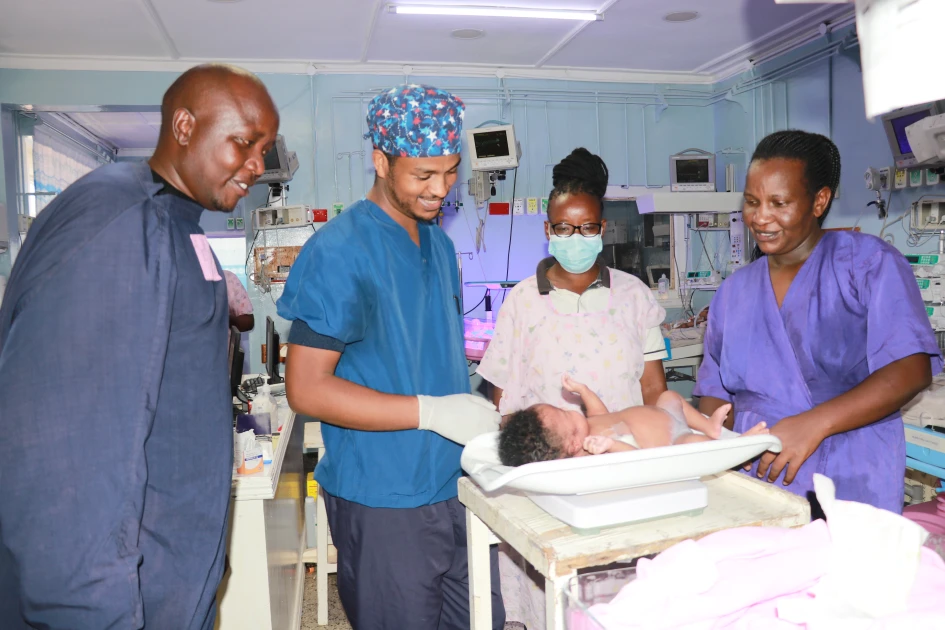
The infant has since made a full recovery and was discharged from hospital this week feeding normally, becoming the first patient in Kenya to benefit from the advanced keyhole procedure.
The operation was led by pediatric surgeon Dr. Daniel Tamirat Cherkos, who recently returned to Kenya after completing advanced fellowship training in thoracoscopic pediatric surgery at Wilhelmina Children's Hospital, UMC Utrecht, in the Netherlands.
Unlike conventional open surgery, the thoracoscopic procedure uses small keyhole incisions and specialized high-definition equipment to repair the defect without opening the chest. The technique is associated with reduced pain, less surgical trauma, shorter hospital stays and lower risks of long-term complications.
The successful operation positions Kenya among a growing number of countries capable of offering minimally invasive surgery for one of the most complex congenital conditions affecting newborns.
Baby Carline was born on June 4 in Kericho County to Violah and Hillary Bett. Shortly after birth, doctors discovered she had Type C esophageal atresia, a condition in which the upper part of the esophagus ends in a blind pouch while the lower section is abnormally connected to the windpipe.
Recognizing the medical emergency, clinicians at Kericho County referred the infant to AGC Tenwek Hospital for specialized treatment, where she was admitted on June 8.
Dr. Cherkos said the achievement reflected the combined efforts of an experienced multidisciplinary team rather than an individual accomplishment.
"This achievement is not about one surgeon. It reflects the strength of a dedicated multidisciplinary team committed to giving every child the best chance at life. It also demonstrates that Kenya can provide world-class, minimally invasive pediatric surgery close to home," he said.
The surgery involved pediatric surgeons, anesthetists, pediatricians, theatre personnel and neonatal intensive care nurses, whose coordinated care contributed to the infant's successful recovery.
For the Bett family, the procedure brought an end to days of uncertainty after their newborn was unable to feed.
"When we arrived, I was so afraid because my baby could not feed," said Violah Bett.
"The doctors, nurses and everyone who cared for us gave us hope. Today, seeing my daughter recovering is a miracle. We thank God and the AGC Tenwek Hospital team for giving our baby a second chance at life."
Her husband, Hillary Bett, praised the swift referral by doctors in Kericho and the specialized care offered at Tenwek Hospital.
"Immediately after our daughter was born in Kericho, the doctors referred us to AGC Tenwek Hospital because they knew she would receive the best care. Looking at our daughter today, we know they made the right decision. We are forever grateful to the entire Tenwek team."
The family's treatment costs were fully covered under the Social Health Authority (SHA) through the teachers' medical scheme.
The hospital also credited Wilhelmina Children's Hospital in the Netherlands for equipping Dr. Cherkos with the advanced skills that made the pioneering procedure possible.
The successful surgery represents a major step forward in Kenya's capacity to provide highly specialized pediatric surgical services locally, reducing the need for patients to seek complex treatment abroad while expanding access to advanced care for newborns with rare congenital conditions.
Join the Discussion
Share your perspective with the Citizen Digital community.
No comments yet
This discussion is waiting for your voice. Be the first to share your thoughts!