
Ruto’s bid to defend record and the hard questions left unanswered
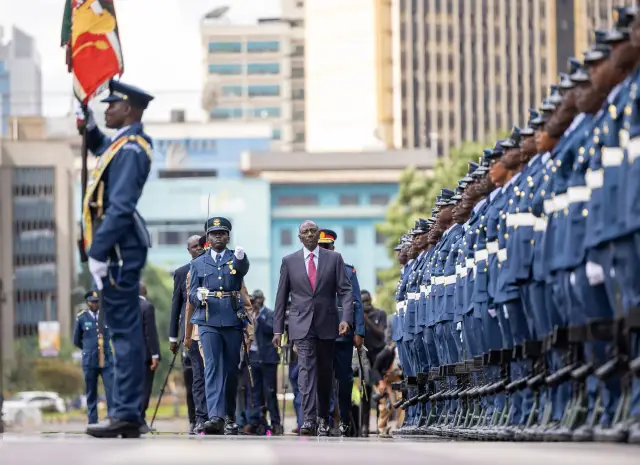
President William Ruto inspects a guard of honour at Parliament Buildings ahead of the 2026 State of the Nation Address. Photo: PCS

Audio By Vocalize
This is a bold assertion, made by no less than the President. The economy has recovered some strength, and some of the promises were delivered or are in the process of being delivered. However, the cost of living, jobs, debt, enforced disappearances and court orders are all areas where the evidence is less comfortable than the speech.
What worked from the 2025 promises?
Using data from official sources, it is apparent that several of the 2025 pledges were met, in full or in part.
A promise was made to kick off the Rironi–Mau Summit dual lanes and it got launched on November 28, 2025.
The target completion is June 2027, and the contractor on one section reported about 15 per cent progress in July, meanwhile the President said earlier this month that the road is 40 per cent done.
The two figures are at variance and on any scale are a progress towards the completion date of June 2027.
During the 2025 address, the President promised setting up the National Infrastructure Fund (NIF). It was made a legal body on March 25, 2026 and immediately seeded with proceeds from the Kenya Pipeline IPO and the sale of a 15% Safaricom stake.
Promised alongside the NIF was the Sovereign Wealth Fund (SWF). Its legal existence became effective on 8th July 2026.
The President promised to extend the Standard Gauge Railway (SGR). Construction on the SGR western line from Naivasha to Malaba (via Kisumu) officially began on July 1, 2026, from Narok County. This followed a groundbreaking launch on March 19, 2026.
Its financing is to come partly from securitizing the Railway Development Levy, with up to Ksh.390 billion expected.
Also promised in the 2025 address, was the growth of the economy from 5% to 5.8% in the period within 2026.
Although not quite there, the first-quarter growth was 5.3 per cent year-on-year and second-quarter growth was 5.1 per cent year-on-year.
The President’s speech in 2025 projected a movement towards more produce and income from agricultural items, some of which have held up.
Coffee export earnings rose to Ksh.52.1 billion from Ksh.38.4 billion within the year. Tea export earnings rose to KSh186.91 billion, up from Ksh.181.69 billion.
What did not work in 2025, and why
The President promised in 2025 to “sort out”
Kenya Airways’ challenges by 2026.
During the first half of 2016, it posted a pre-tax loss of Ksh.15.92 billion, and the search for investors continues.
The Cabinet has approved a further $350 million of government financing towards keeping it afloat. The 2026 “State of the Nation” speech completely ignored the airline, not a mention, not a whimper.
The 2025 speech promised 100 per cent medicine availability at KEMSA by March 2026. The Health Cabinet Secretary put the order fill rate at 92 per cent in April, with full capacity targeted for the end of the year.
That is a large improvement, but the promise was missed.
On matters touching on the Social Health Authority (SHA), the President’s 2026 speech celebrates 33.7 million SHA registered members. Parliament heard how SHA has covered kidney transplants and cancer treatment.
Hospitals tell a different story about payments. Facilities had submitted claims worth KSh181.9 billion by April 30, 2026.
The ministry reported a 74 per cent settlement rate. Private hospitals have twice suspended SHA services over unpaid claims. Registration, it seems, is not the same as reliable service.
When it came to the power sector, the President’s 2025 speech put firm capacity at 2,300 MW and called for 10,000 MW more within the coming seven years.
Peak power demand reached about 2,549 MW in July, and the reserve margin has shrunk to 3.3 per cent. Kenya imported record electricity in early 2026. The 2026 speech repeats the 10,000 MW goal but says only that investment is being mobilized.
Dam construction remains a firm favorite of the Kenya Kwanza government.
The 2026 speech repeats the target of 50 mega dams and 2.5 million acres of irrigation without reporting progress on new ones. Mwache Dam is reported to be over 90 per cent complete, and Thwake is due to start filling in January 2027. Both are much older projects.
On matters research, the 2025 pledge to lift research spending by the State from 0.8 to 2 per cent of GDP is not revisited and neither was progress or the lack thereof stated.
Debts are a sticky subject in Kenya. The reasons for the debt are both historical, to mean inherited, and the current borrowing spree.
Public debt reached Ksh.13.47 trillion by the end of August 2026, which the World Bank puts at 72.3 per cent of GDP, with interest absorbing about a third of revenue the government collects.
Big projects were announced before the financing was in place. Some, like the SGR, are now being financed by borrowing against future levy income.
Those Kenyans yet to be born owe for reasons best known to the current administration. Will the generation yet to come fancy using the old style diesel powered trains, maybe not, but pay , they will.
Numbers that do not line up
A look at the 2025 and 2026 State of the Nation speeches and the official data unveils certain issues. On the occasion of the 2025 address to the nation, the President speech was positively covered the important matter of inflation.
The fairly low 4.6 per cent inflation rate drew pride and positivity in the speech. In the 2026 speech, a limp statement on national inflation states that, “renewed food and energy pressures pushed inflation higher in October.”
The unmentioned October figure was 7.3 per cent, up from 6.8 per cent in September. That is the highest since July 2023. Inflation has climbed through the year from 4.4 per cent in January.
Within the tea sector, the 2025 speech said earnings rose from Ksh.138 billion to Ksh.215 billion. The 2026 speech says Ksh.163 billion in 2022 to Ksh.187 billion in 2025. The two are not contradictory, because they measure different things.
Ksh.215 billion was the total marketed value in 2024, not export earnings. The speeches switched measures without saying so.
Ugali is dear to Kenyans and flour is synonymous with Ugali. The 2026 speech cites an average of Ksh.152 for 2kg of sifted flour in September.
The same product was Ksh.148.79 in October 2025. The fall in price from 2022 is real, but prices have not fallen further this year. Ugali remains on the fringes of affordability for most families in Kenya.
Fertilizer is increasingly important to attaining good harvests in the country. The 2025 speech said 21 million bags had been distributed and promised 12.5 million more in 2026. The 2026 speech says 38.5 million.
The gap is larger than the pledge and this is not explained. It is confusing and so what will farmers tell of this conflicting figures.
It is not the first nor last time Kenyans are hearing of “Eurobond,” it has been around since the Uhuru Kenyatta Administration.
It is a concept which the 2026 speech says ‘Kenya “honored” the $2 billion bond.’ It was largely refinanced by a new bond issue and a World Bank loan, and not paid for from reserves.
One of the albeit thorny subject for the Kenya Kwanza government is housing, referred to in other circles as “affordable housing.”
The 2026 speech says 313,000 homes are “at various stages of construction” and that over 18,000 have been allocated.
The government has said it expects to complete 45,000 units by the end of 2026. The program faces a funding gap of KSh118 billion despite Ksh.205.7 billion collected through the levy.
The President said the program has generated more than 1.1 million jobs. These figures have largely remained unverifiable and secondly, construction employment is often short-term and pays low wages.
What Kenyans are worried about
Kenyans are worried about unemployment; good jobs are scarce and few between. The speech cites 350,000 digital jobs and 707,000 jobs took up abroad. Sadly, it says little about the all-important domestic labor market.
Kenya created about 822,100 jobs in 2025, and nearly nine in ten were informal. The government spokesman acknowledged that nine in ten new jobs were informal.
Critics argue the official 5 per cent unemployment rate understates the problem, because any income-earning activity counts as employment. Estimates of youth unemployment vary widely, from about 12 per cent officially to far higher in employer estimates.
Currently, the cost of living is among Kenyans’ highest concerns. The President’s speech gave its strongest call towards lower fertilizer, flour and credit costs. The statement, however, swept under the carpet the simmering tension within the energy sector.
There have been new tax relief proposals that remain mere suggestions, The PAYE exemption for Kenyans earning KSh32,333 or less would spare about 362,846 more workers. Earlier models put the annual cost of similar changes above KSh35 billion.
The sticky matter of corruption remains largely unattended and treated lightly. The speech points to digital procurement, the Conflict of Interest Act and the new law on public boards.
Those are real reforms. The outcome measures are poor. Kenya scored 30 out of 100 on the 2025 Corruption Perceptions Index, down two points. It ranks 130th of 182 countries.
Abductions and human rights continue to hog the limelight as some of the issues that the government has refused to face head-on.
Strangely, for the first time the President said police officers who break the law must face prosecution, last time he spoke to the police, it was about “shooting protestors in the leg.” President Ruto also mentioned that Ksh.1.2 billion has been paid to 1,476 victims of protest violence.
The speech does not mention abductions or enforced disappearances. The human rights commission says it documented 46 cases in 2026.
The Missing Voices coalition counted 19 so far this year, with six in 2025. The two groups gave different numbers, however, both show the problem has not ended.
In July Interior PS Raymond Omollo said Kenya had moved beyond abductions.
The police oversight authority is investigating abductions and brutality reported around the June 25 anniversary protests.
Concerning Deaths and accountability, the oversight authority enumerated 62 deaths in the 2024 protests and 65 in the 2025 anniversary protests.
Only three cases from 2024 and one from 2025 have reached court, and no officer has been convicted. The President’s speech names June 2024 but not the 2025 killings.
Concerning the rule of law, the Kenya Human Rights Commission accused police of defying a court order against unannounced road blocks on June 25.
Katiba Institute has filed a contempt application against the Inspector General. The President’s speech says security agencies must act within the law but does not address these findings.
Are the promises within the 2026 speech credible?
The credibility of the 2026 speech will depend on conditions it does not discuss. The strongest are those already in motion.
The Infrastructure Fund and Sovereign Wealth Fund exist in law. The Rironi–Mau Summit Road and the SGR extension have contractors on site.
Roads and funds are the sort of promise the government has shown are its preference.
The weakest promises are premised on funds that are not yet visible. Interestingly, public debt exceeds Parliament’s 55 per cent of GDP threshold.
The Fund’s pitch is that private capital will cover most costs, but that capital must still be found. Strangely, the Fund’s seed money was reported to be invested in government bonds.
A parliamentary committee has since said public hearings exposed gaps in the Fund that need fixing. The government says the SGR financing avoids direct borrowing, but securitized revenue is treated by some lenders as debt in disguise.
The election adds a second test. Promises announced in a pre-election season, with delivery dates after August 2027, are harder to hold anyone to.
Four years in, the best predictor is the record: launches usually happen, but on time and on budget project deliveries is another matter.
What would make the strongest speech now
With nine months to the vote, the speech that would earn the most trust would cover some of the highest concerns rolling off current polling surveys.
A scorecard on last year’s promises should have led the speech. A list of what was met, what was late and what was dropped, as the Kenya Airways and KEMSA examples show.
Promises should be time sensitive and issues such as a reduction in fuel prices, lower cost of purchasing food and the PAYE changes given an activation timeline.
The level of opacity concerning the Government-to-government (G-to-G) is still puzzling the public to date. If it concerns supply of fuel to the public, do they not deserve to know its details?
An honest account of jobs created and lost will not be asking for too much. A bi-annual report of both formal and informal jobs created might suffice.
It would do well to have the government drawing up a public debt and interest plan. Could the government explain how a KSh5 trillion program fits alongside debt service that already consumes most tax revenue.
The state of nation address should offer a timetable for accountability. Let it state how many police killings and disappearance cases have been investigated, how many officers face charges, and when families will get answers.
Let the State be the most law-abiding entity and be seen and be heard obeying court orders. In court case after court case senior state actors are found to have gone foul of the law and directions are given by the court demanding compliance, few if any are ever met.
The State should indicate corruption outcomes, not just systems. By reporting convictions and recoveries, and saying why prosecutions are being withdrawn so that clarity and integrity are maintained.
Would the State care to clearly indicate when the long pending SHA payments to faith-based hospitals and private hospitals will be cleared? That would merit being on the speech.
For a free and fair election, the electoral commission says it needs Ksh.67.07 billion but has only received Ksh.41.5 billion.
A pledge to fund it and keep security forces neutral would speak to every party’s supporter.
A "State of the Nation" address reports on a country's condition, outlines policy priorities, and fulfills a constitutional duty before the legislature.
In practice, it achieves more of political messaging, agenda-setting, and public accountability although critics often debate how closely those speeches match everyday realities.
In Kenya, Political Framing and Mobilization might the only reason that the administration uses the platform to defend their record, rally supporters, and frame the national narrative, especially ahead of elections.
Join the Discussion
Share your perspective with the Citizen Digital community.
No comments yet
This discussion is waiting for your voice. Be the first to share your thoughts!