
Kenya selects US consortium to develop Mrima Hill minerals project
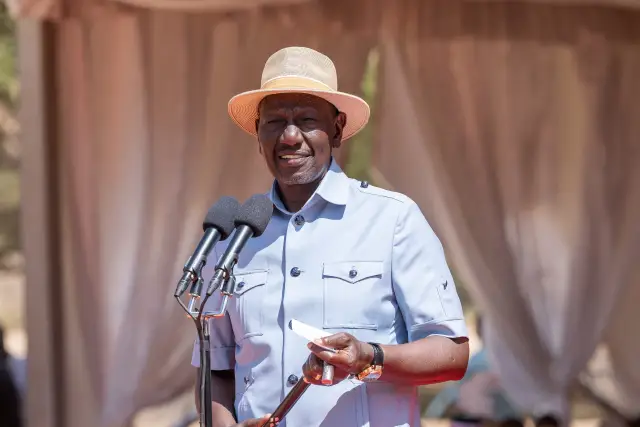
A file photo of President Ruto.

Audio By Vocalize
The United States has welcomed the selection, describing the decision as a step towards strengthening Kenya's mining sector and promoting local value addition.
In a statement posted on X on Friday evening, the US Department of State's Bureau of African Affairs congratulated Frontier Minerals on its selection to develop the rare earths and niobium project, saying the choice of an American consortium reflected the Kenyan government's commitment to transparent investment in the mining sector.
"Congratulations to Frontier Minerals for being selected to develop the Mrima Hill rare earths and niobium project in Kenya," the statement read.
The bureau said the partnership was expected to introduce market-leading innovation, support local mineral processing and create employment and economic opportunities for both Kenya and the United States.
The announcement follows the Kenyan government's selection of Frontier Minerals as the preferred developer of the highly contested project, which has attracted interest from international mining companies amid growing global competition for critical minerals.
Mrima Hill, located in Lunga Lunga, Kwale County, is believed to contain substantial deposits of rare earth elements and niobium, minerals used in advanced manufacturing, electronics, renewable energy technologies and aerospace applications.
Niobium is used in the production of specialised steel and alloys for applications including jet engines and pipelines, while rare earth elements are important components in electric vehicle technologies, high-performance magnets and other electronic devices.
The deposits have previously been estimated to be worth billions of dollars, with earlier assessments placing their potential value at approximately USD 62.4 billion (Ksh8.1 trillion).
President William Ruto has previously defended the government's approach to developing the mineral deposits, saying Kenya was pursuing a competitive process to attract investors capable of commercialising the resource.
During an interview on the sidelines of the G7 Summit in France in June, the President disclosed that the government had initiated a competitive tender for the project and that Kenya and the United States had reached a preliminary agreement on its development.
The President's remarks subsequently triggered questions about the terms of the proposed arrangement, the extent of public participation and the role of the local community in determining the future of the mineral-rich area.
In September, the President's administration also faced scrutiny over allegations that the government had already settled on an American investor before the conclusion of the competitive bidding process.
Former Deputy President Rigathi Gachagua was among those who questioned the process, alleging that President Ruto was seeking to facilitate the award of the mineral deposits to an American firm.
Speaking to Kenyans in Kansas City, United States, Gachagua claimed that the President's trip to New York for the United Nations General Assembly was partly intended to finalise arrangements for the exploitation of the deposits.
He further alleged that the deal would benefit individuals at the expense of Kenyans, threatening to pursue legal action to stop the proposed arrangement.
Gachagua later claimed that he had intervened to frustrate an earlier attempt to facilitate the mining deal, alleging that concerns over public participation had been raised with American officials.
Beyond the political contestation, the proposed mining project has raised concerns among residents and conservation groups over the potential impact on livelihoods, the environment and cultural heritage.
Mrima Hill is home to a sacred Kaya forest revered by the Digo and other Mijikenda communities, with concerns that mining activities could threaten ancestral sites, indigenous vegetation and the surrounding ecosystem.
In June 2026, the Centre for Litigation Trust moved to court seeking to stop the proposed Kenya-US mining arrangement, arguing that the government had failed to adequately involve local communities, the Kwale County Government and Parliament in the negotiations.
The lobby group also questioned the transparency of the proposed agreement, demanding disclosure of its terms, environmental assessments, ownership arrangements and benefit-sharing framework.
The petition further raised questions about the legality of mining activities in the area, noting that Mrima Hill is a gazetted National Monument and that the Mining Act contains restrictions on mining within protected areas.
Join the Discussion
Share your perspective with the Citizen Digital community.
No comments yet
This discussion is waiting for your voice. Be the first to share your thoughts!