
Koome reveals how Supreme Court land was grabbed as Judiciary gets title
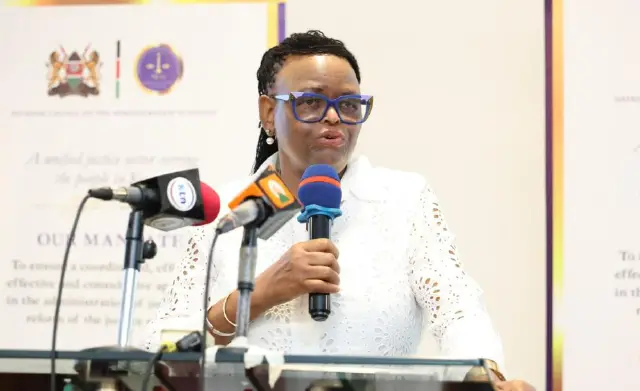
A file photo of Chief Justice Martha Koome.

Audio By Vocalize
Chief Justice Martha Koome has revealed that land belonging to the Judiciary had been grabbed by private individuals, with the Supreme Court previously operating without a title deed for the property on which it sits.
Koome said the land was eventually recovered last year following the intervention of President William Ruto, with the Judiciary now receiving title deeds for three parcels of land, including the Supreme Court premises.
Speaking during the launch of the 12th State of the Judiciary and Administration of Justice Annual Report for the 2025/2026 financial year, Koome said those who had taken over the land had challenged the Judiciary to seek legal redress.
"Some people have no shame. They had even grabbed our Supreme Court land and told us to go to court, asking us which court we would go to," Koome said.
She credited President Ruto with helping the Judiciary recover the property, saying it was returned last year.
"Today, we are here to celebrate the title deed for our plot, including the title deed for the Supreme Court, which previously had no title. That is why we have the CS for Lands, Wahome, here," she added.
Lands Cabinet Secretary Alice Wahome confirmed the handover of three title deeds, covering the Supreme Court premises, a parking lot and Kapsabet Courts.
Wahome said the parking lot had previously been used for commercial activities, including the operation of a parking business.
"There were people conducting business on that land, including operating a parking business. I am here to present three title deeds: one for the Supreme Court, another for the parking lot and the third for Kapsabet Courts. These titles will now be under your custody, Chief Justice," Wahome said.
She added that the government had been surprised to discover that the country's highest court did not have formal ownership documentation for its premises.
"We were shocked that the Supreme Court itself did not have a title deed for the land on which it sits," she said.
The development brings renewed attention to a longstanding land dispute involving property earmarked for the Judiciary.
In May 2015, former Chief Registrar of the Judiciary Anne Amadi told Parliament's Justice and Legal Affairs Committee that land next to the Supreme Court, which had been earmarked for the expansion of the apex court, had been grabbed and registered in the name of a private individual.
The parcel was reportedly being used by the Maasai Market. Amadi told MPs that previous attempts to recover the property had been unsuccessful.
The matter resurfaced in November 2025 when Deputy President Kithure Kindiki directed Wahome to ensure that the Judiciary received the title deed for the Supreme Court premises before Christmas, following concerns raised by Koome over the lack of formal ownership documentation.
Beyond the land developments, the annual report shows that the Judiciary resolved 576,702 cases against 561,580 cases filed during the 2025/2026 financial year, translating to a 103 per cent case clearance rate.
This marks the second consecutive year that the Judiciary has determined more cases than were filed, ending the reporting period with approximately 579,000 pending cases.
The Judiciary also recorded a 15.8 per cent reduction in cases that had been pending for more than one year under its backlog reduction initiative.
However, Koome cautioned that the improved case clearance rate did not mean the Judiciary had overcome its backlog challenges.
Approximately 341,000 cases, representing 59 per cent of the total pending caseload, remain unresolved.
The Judiciary is also grappling with staffing shortages, having only 66 per cent of its required workforce as of June 30, 2026.
Against an establishment requirement of 12,000 employees, the institution had approximately 8,000 staff members, a shortfall that continues to affect the delivery of judicial services.
Other challenges include the absence of witnesses, which contributes to delays and frequent adjournments.
The Judiciary has also been expanding its geographical reach, with two operational Court of Appeal stations established in Kakamega and Meru.
Five additional magistrates' courts have also been introduced, bringing the total number of such courts to 148, while two additional tribunals have increased the number to 28.
The launch will also coincide with the flag-off of Kenya's first mobile justice truck, an initiative aimed at taking judicial services closer to communities that face barriers accessing conventional court services.
The mobile justice truck is scheduled to begin operations in Nairobi on December 1, targeting densely populated, low-income neighbourhoods.
Chief Registrar of the Judiciary Winfridah Boyani Mokaya said the initiative is intended to bring services closer to the people while easing congestion in courts.
"We want to take justice beyond the courtroom and bring services closer to the people," Mokaya said.
Join the Discussion
Share your perspective with the Citizen Digital community.
No comments yet
This discussion is waiting for your voice. Be the first to share your thoughts!