
Sing’oei: Africa must change how it sees itself to unlock progress
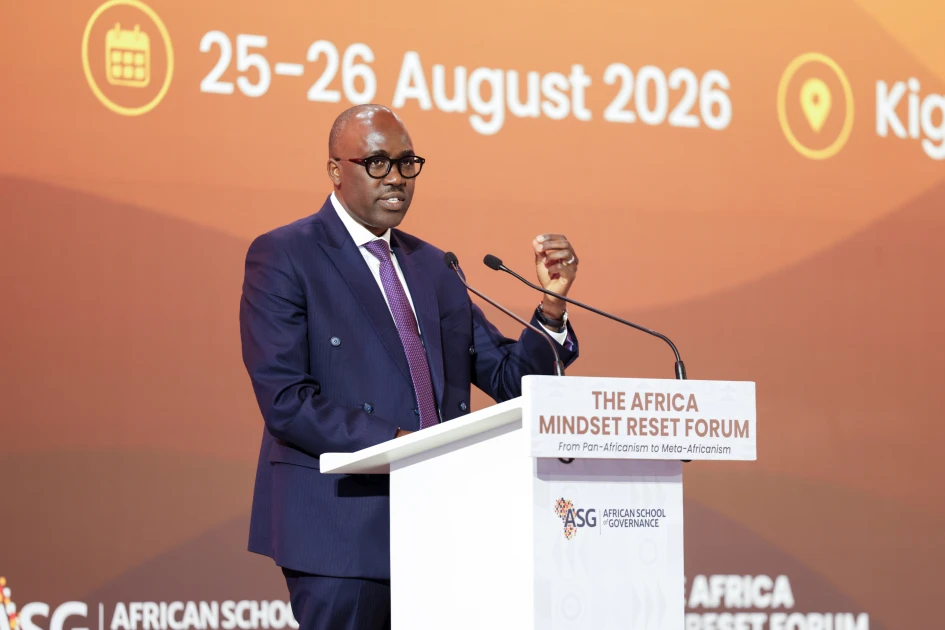
Photo caption: Dr. Korir Sing’oei, Principal Secretary in Kenya’s Ministry of Foreign and Diaspora Affairs, delivers remarks at the Africa Mindset Reset Conference, hosted by the Africa School of Governance under the leadership of H.E. Paul Kagame, President of Rwanda, and H.E. Hailemariam Desalegn, former Prime Minister of Ethiopia.

Audio By Vocalize
Speaking at the Africa Mindset Reset Conference recently hosted in Rwanda by President Paul Kagame, alongside Professor PLO Lumumba and other scholars, Sing’oei argued that Africa’s development challenges go beyond inadequate infrastructure, limited capital and weak policies.
He said the continent’s progress is also constrained by “mental barriers” that influence who is regarded as an ally, a partner or an outsider.
“We are always looking at physical barriers to entry,” Sing’oei told the conference. “But I think there are also conceptual, mental barriers to our engagement. Just like the physical barriers impede progress, my view is that the conceptual, the mental barriers are even a bigger impediment to progress.”
Sing’oei described these divisions as “binaries”, the tendency to view societies and countries through an “us versus them” lens.
“Binaries are mental and conceptual divisions in society that render cooperation impossible and collective action illusory. They weaken the social fabric and undermine the social contract,” he said.
For Sing’oei, these divisions are more than an abstract concept. They influence policies, institutions and relationships, often preventing countries and communities from recognising their shared interests.
He cited Kenya’s historical treatment of refugees as an example, noting that they have largely been viewed through a security lens, with many confined to camps and treated as outsiders.
“We have looked at refugees as others, outside our limits. And we have put them in camps,” he said.
Sing’oei argued that this approach requires a fundamental rethink, one reflected in the Shirika Plan, which seeks to integrate refugees into local economies and public services while strengthening their relationship with host communities.
"The reality is that Kenya has hosted about 800,000 refugees for nearly 30 years. But are these 800,000 people, most of them Africans, really “others”? Some have spent their entire lives growing up in these camps.
He also identified the divide between the Global North and Global South in international climate negotiations as another example of a binary that can hinder practical solutions.
The negotiations have often been framed around developed countries bearing much of the historical responsibility for greenhouse gas emissions, while developing countries seek financing to address the effects of climate change and pursue economic growth.
“This dichotomy doesn't help us in dealing with the problem of climate change,” Sing’oei said.
He pointed to the 2023 Africa Climate Summit in Nairobi as an example of African countries seeking to reshape that conversation.
The summit produced the Africa Green Industrialisation Initiative, which seeks to leverage Africa’s renewable energy resources, natural wealth and industrial potential to drive green economic growth.
Rather than positioning Africa solely as a recipient of climate finance, the initiative seeks to make the continent an active player in the global green economy.
Sing’oei also pointed to linguistic divisions as another example of how entrenched binaries can constrain African cooperation.
When Kenya was selected to host the France-Africa summit, dubbed Africa Forward, questions emerged over whether an Anglophone country could convene a meeting traditionally associated with Francophone Africa.
Sing’oei rejected the premise.
“There is no Francophone Africa, there is no Anglophone Africa. There is only one Africa, and we must destroy these binaries because they are the ones responsible for holding us back,” he said.
He linked Africa’s linguistic and historical divisions to the wider cost of doing business on the continent, arguing that inherited barriers contribute to the high cost of capital and limited economic integration.
But for Sing’oei, dismantling these binaries is only part of the challenge. The bigger unresolved issue, he said, is trust.
“You can sense the anxiety of young people because of trust. We must address ourselves to the trust, to the widening trust deficit,” he said.
The problem, he added, extends beyond individual countries, with mistrust between states contributing to Africa’s slow regional integration.
Sing’oei also linked the trust deficit to the wider multilateral system, arguing that a lack of confidence between countries is undermining international cooperation.
“The reason the multilateral system is failing today is because of a trust deficit,” he said.
To address this trust deficit, African leaders, institutions, academics, business leaders, civil society representatives and citizens will convene in Nairobi from October 21–23, 2026, for The Trust Summit (TTS), to explore how trust can be intentionally rebuilt in an increasingly fragmented world.
Join the Discussion
Share your perspective with the Citizen Digital community.
No comments yet
This discussion is waiting for your voice. Be the first to share your thoughts!