
Second petition filed to block implementation of NTSA's car inspection law
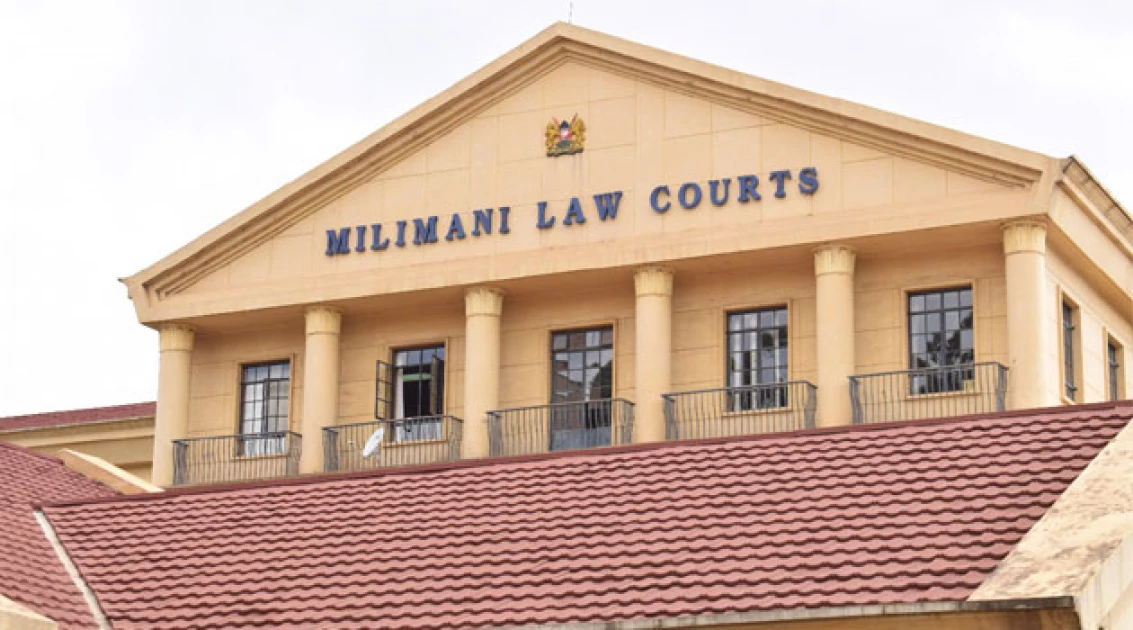
File image of the Milimani Law Courts in Nairobi. PHOTO| COURTESY

Audio By Vocalize
In a petition and an urgent application filed before the Constitutional and Human Rights Division of the High Court, Sheria Mtaani through advocate Shadrack Wambui is seeking orders suspending the enforcement of several provisions of the Traffic (Motor Vehicle Inspection) Rules, 2026, which are scheduled to come into force on July 1, 2026.
"The new regulations will immediately expose millions of Kenyan motorists to mandatory inspection requirements, substantial financial charges, criminal penalties and the risk of losing their vehicles through de-registration," Wambui states in his court papers.
According to court documents, the rules introduce, for the first time in Kenya, a compulsory annual inspection regime for all privately owned vehicles that are more than four years old from their date of manufacture. The petition states that Kenya has more than six million registered motor vehicles, the majority of which are imported second-hand vehicles and would therefore be captured by the new rules.
"The violations complained of are real, imminent and immediate," the petitioner says.
Wambui contends that the regulations will impose a significant financial burden on motorists through mandatory booking fees payable to the National Transport and Safety Authority (NTSA) and additional inspection fees payable to inspection centres.
"Implementation of the impugned regime is projected to generate billions annually from Kenyan motorists. Despite the magnitude of these collections, the respondents have not disclosed the legal and financial scheme governing the receipt, custody, management and ultimate application of these funds," he argues.
The petitioner further claims that the respondents failed to prepare a Regulatory Impact Statement, did not conduct meaningful public participation and have not demonstrated compliance with the provisions of the Statutory Instruments Act, 2013.
"The respondents have not produced any Regulatory Impact Statement, record of public consultation, or evidence of compliance with the Statutory Instruments Act, raising serious questions as to the validity of the entire instrument," the petition states.
The petition also challenges Rule 3(1), arguing that it imposes a blanket inspection requirement based solely on the age of a vehicle without considering factors such as the vehicle's condition, mileage, maintenance history or actual use.
"It is irrational to impose a mandatory inspection obligation triggered by chronological age alone without regard to the actual condition of the vehicle," Wambui argues.
Another provision under challenge is Rule 12(2), which allegedly allows an inspector to unilaterally classify a vehicle as unroadworthy, leading to its permanent de-registration without notice, a hearing, compensation or a right of appeal.
"The rule authorizes permanent de-registration without notice, hearing, appeal or compensation, contrary to the Constitution," the petitioner says.
The suit further contests Rule 30(1)(d), which criminalises any act intended to "circumvent" the rules.
"The provision is vague because it does not define the prohibited conduct by reference to any objective standard and therefore exposes motorists to arbitrary prosecution," Wambui argues.
The petitioner also claims that the regulations have a discriminatory effect on lower and middle-income earners.
"The four-year threshold functions, in practical terms, as a proxy for economic status because owners of older vehicles are overwhelmingly persons of modest means," he states.
In the application, Wambui points to a public notice issued by NTSA between June 26 and June 28, 2026, directing traffic officers not to enforce the mandatory inspection requirement against private motorists pending further communication.
"That public notice is a contemporaneous admission by the respondents themselves that the regime is not presently fit for enforcement," the petition states.
According to the application, unless the court intervenes before July 1, millions of private vehicle owners will immediately become liable to regulatory obligations, mandatory fees and criminal sanctions that cannot be reversed even if the petition eventually succeeds.
"It is in the public interest that subsidiary legislation of such broad and consequential reach be tested for constitutional and procedural validity before, rather than after, it is permitted to operate at scale against the citizenry," Wambui says.
The petitioner is seeking conservatory orders suspending the operation and enforcement of the impugned provisions of the Traffic (Motor Vehicle Inspection) Rules, 2026, insofar as they apply to private non-commercial vehicles, pending the hearing and determination of the constitutional petition.
Join the Discussion
Share your perspective with the Citizen Digital community.
No comments yet
This discussion is waiting for your voice. Be the first to share your thoughts!