
Samia Suluhu: How a nondescript VP morphed into Tanzania's most hardline ruler
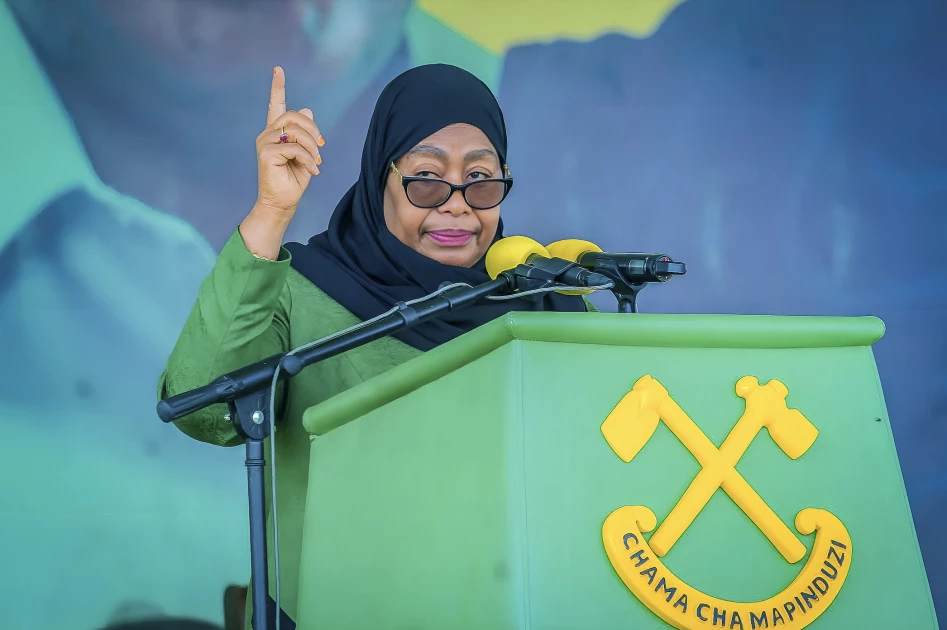
Tanzania’s ruling party Chama Cha Mapinduzi (CCM) presidential candidate and incumbent President Samia Suluhu Hassan delivers her remarks during the party's closing campaign rally in Mwanza on October 28, 2025. Photo by MICHAEL JAMSON / AFP

Audio By Vocalize
Suluhu, a relatively unknown political lightweight who during her predecessor's tenure operated in the State House backwaters, rarely appearing in public or influencing policy, was now the restive country's most powerful woman - and commander-in-chief.
Her elevation to the presidency would be widely celebrated, with many hailing her as Tanzania's shining star, especially after Magufuli's notoriously hard-handed reign, which saw him swoop hard on his rivals, dictate his way around, clamp down on the media and insert himself in every aspect of every average Tanzanian's life.
After a ubiquitous figure who towered over Bongoland like the African version of Kim Jong-un, Tanzania was ready for a velvet pair of hands.
Here was a woman. A Muslim woman, at that. She was poised, dignified, apathetic and unruffled. A woman with a steady countenance and a gracious air. A woman who spoke in an empathetic tone and measured candour.
As she addressed a grieving nation, dressed in a dotted dress, a black hijab, a pair of thick-framed eyeglasses and a near-whimpering voice, Suluhu announced the death of her former boss - and, at that moment, set the stage for what would be her devilishly turbulent plod into the presidency.
From that moment, that bleak Wednesday night on 17th March 2021, Tanzanians welcomed their new female ruler who whispered her way into power - and then gradually unleashed a beastly roar of untamable dimensions.
But first, she was a darling, a political sweetheart who charmed hearts and inspired hope.
On March 30, 2023, two years after she assumed power, then-U.S Vice President Kamala Harris toured Tanzania, speaking glowingly of Africa's only female head of State, and lavishing her with flowery praises, as they both spoke on the same podium, two women poised to lift their people from the yokes of despair.
While explaining that Washington would expand U.S.-Tanzania commercial engagements, Harris said: "Thanks to the progress of your administration, you have made a champion – you have been a champion of democratic reforms in this country and in that way have expanded our partnership."
But the woman who had been hailed as the "Champion of Democracy" would, just a year later, quickly scuttle the faith the world had in her, as she appeared to steadfastly and even mercilessly advance her predecessor's tactics - but this time, with even more ruthless cruelty.
As the electioneering period set in, Suluhu would bare her fangs, unfurl her claws and remind Tanzanians that the incumbent, as Magufuli had proved, was not to be easily toyed with - or cavalierly challenged.
Things quickly took a nightmarish turn as the neighbouring country's head of state unleashed her most lethal arsenal in a wicked plot to fire up repression, assert authority and cling onto power.
It all happened fast.
Media were banned, opposition parties were kneecapped, journalists were censored, activists were persecuted, and, at large, freedoms were infringed.
Freeman Mbowe was charged with terrorism offences and held for 226 days until his release in 2022. His successor, Tundu Lissu, charged with treason, has been detained since 9 April 2025, and Luhaga Mpina was prevented from submitting nomination forms to enter the presidential election as the candidate for Alliance for Change-Wazalendo.
Boldly, and certainly brashly, a new era of authoritarianism crystallised in Tanzania, with Suluhu at the helm, ensuring that dissents were muzzled, detractors were silenced, critics were crushed, and rivals were vanquished.
Writing in The Conversation, Dan Paget, a professor in politics at the University of Sussex, said: "Hassan has become, in key ways, more autocratic than Magufuli. She has crossed autocratic thresholds that have not been breached since Tanzania’s transition to multipartyism in 1992. Hassan has been crossing democratic red lines that Magufuli never did, even if he might have wanted to."
In Tanzania, to show support for Tindu Lissu at his sham trial, Kenya's Martha Karua, Boniface Mwangi, Hanifa Adan, Uganda's Agatha Atuhaire and others were quickly and ignominiously deported or detained, with Tanzania sparing their most unthinkably brutal treatment yet for Boniface Mwangi and his Ugandan counterpart.
After days in captivity, Mwangi would tearfully narrate how he was stripped naked, hung upside down, beaten on his feet and sexually assaulted while detained by Tanzanian authorities.
At around the same time, her administration would oversee the indefinite banning of social media platforms X, Clubhouse and Telegram. No reasonable explanation would be offered for that. And no one dared ask.
Suluhu's barefaced viciousness would perhaps be best encapsulated by the October 2025 polls, which saw her sink the calm nation into unprecedented horrors of blood-letting, massacres and grim terror.
As thousands fell by the barrel of a police man's gun, blood sweeping down the streets, many were arrested and detained, tortured and even forcibly disappeared.
Burning tyres blocked Dar es Salaam, shots rang out in Arusha and Mwanza, the body count climbed by the minute, families hid under curfew, neighbours turned on neighbours, and the country that prided itself on calm woke up broken.
And then the internet was shut, with the blackout lasting from October 29 to November 3, ultimately causing disruptions to mobile data, social media, and fixed-line services, restricting the work of journalists and human rights defenders and causing significant economic losses (over US$238 million).
It was ugly, gory, bloody and gruesomely horrific.
This was Samia Suluhu's Tanzania. The first female president, who spoke through tinted glasses and stern invocations, had now morphed into a dreaded viper.
At first, it was 'Mama Samia', an affectionate term, an endearing title to a woman who many hoped would wipe their wounds in motherly care... But the tenderness was no more, Mama's claws had now been sharpened, and she didn't appear to be in the mood for lullabies.
Just the other day, she looked her guest, President Ruto, right in the eye, scolded him in public and, at some juncture, even revealed that she had suggested to him that troublesome Gen Z should be 'whipped' and brought back to line.
She didn't mince her words. She didn't fake a smile. She didn't make it light. She didn't prevaricate. She was menacingly cold and forthright.
Speaking during a joint address at State House, Dar es Salaam on Monday, President Suluhu opined that youths in the East African bloc are becoming notorious for how they call for astute governance and should be tamed.
Suluhu maintained that the call for good governance is handled differently in different democracies, and those breaching the standards of conduct in Tanzania, despite their nationality, will be met with the full force of the law.
"We were discussing with President Ruto on how to deal with the notorious Gen Z, and they want to cause chaos in East Africa. They want to destroy their democracies," she said.
"I told him we have to stand firm on this. That if they come to Tanzania, I whip them, and when they come to Kenya, you whip them. With that, we will have countries with respectful people."
Join the Discussion
Share your perspective with the Citizen Digital community.
No comments yet
This discussion is waiting for your voice. Be the first to share your thoughts!