
Ruto calls for domestic financing and local production to strengthen Africa’s health systems
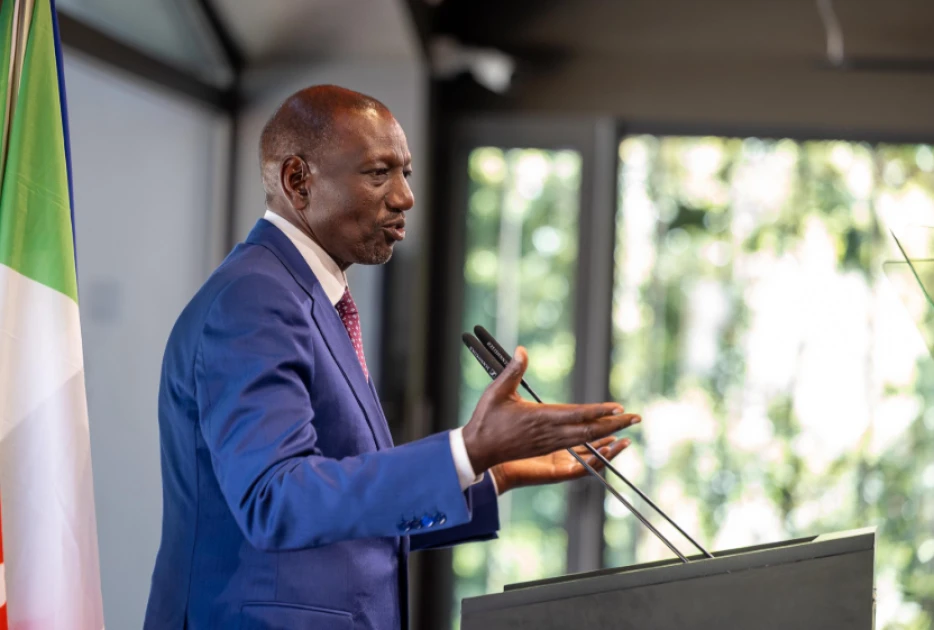
President William Ruto delivers a public lecture at the LUISS School of Government in Rome, Italy, on April 21, 2026. PHOTO | PCS

Audio By Vocalize
The President emphasised the need for Africa's health systems to be financed by both domestic and international capital, noting that self-reliance in medical commodities is critical especially at a time of disruption of global supply chains.
He called on Africa to move away from being a passive participant in global health into an active architect of its direction, priorities, and outcomes.
“The future of health policy, innovation, and delivery cannot be meaningfully advanced without Africa at the centre of both deliberation and implementation,” he said.
To realise this grand plan, President Ruto called for a radical shift in Africa’s health systems by placing emphasis on three key areas - policy leadership, technology, and mobilisation of domestic resources.
The President made the remarks when he addressed the World Health Summit Regional Meeting 2026 in Nairobi on Monday, bringing together more than 2,000 delegates from more than 40 countries.
“This summit is anchored on a clear and urgent imperative. It calls on us to reimagine Africa’s health systems through innovation, integration, and inter-dependence,” he noted.
Africa, he said, is at a critical point marked by both stark disparities and immense opportunity, pointing out that the continent carries more than 25 per cent of the global disease burden yet accounts for less than 3 per cent of global health expenditure.
He expressed disappointment that Africa remains heavily dependent on external supply chains for essential commodities such as medicines and vaccines, and produces less than 2 per cent of what the continent uses.
“Despite the dedication and resilience of our health workers, the density of our workforce remains significantly below global benchmarks,” he said.
Warning that this imbalance is neither sustainable nor tenable, President Ruto called for a radical shift from fragmented interventions to comprehensive and system-wide transformation anchored in coherent strategy.
The continent, he stated, possesses unique advantages, including an energetic and youthful population, rapidly expanding digital infrastructure, and a vibrant culture of innovation.
These attributes, he pointed out, position the continent as a source of scalable solutions rather than a repository of persistent challenges.
"Our responsibility, therefore, is not merely to recognise Africa’s potential, but to fully realise it through coordinated investments, policy alignment, and institutional strengthening that can deliver impact at scale and at speed,” he explained.
Kenya, he said, has put in place a transformative legislation that anchors universal healthcare on a solid foundation.
This, he added, would ensure reforms are not dependent on political cycles but underpinned by a legal framework, institutional continuity, and public accountability.
Reflecting on the two-year journey of the Social Health Authority (SHA), President Ruto said Kenya has implemented a unified financing model that expands risk pooling, reduces out-of-pocket expenditure, and ensures that access to quality healthcare is determined by need rather than income or geography.
He said close to 30.7 million Kenyans have registered under SHA, nearly four times more than the 8 million just two years ago under the National Health Insurance Fund (NHIF).
Additionally, the government has collected KSh169 billion ($1.3 billion) in the past two years in the Primary Healthcare Fund, the Social Health Insurance Fund, the Emergency, Chronic and Critical Illness Fund, and the Public Officers Medical Scheme Fund.
Further, KSh124 billion ($954 million) has been paid to hospitals for services provided.
President Ruto said primary healthcare, which has been strengthened under SHA, has expanded the community health system by deploying more than 100,000 community health promoters across the country.
He noted that this has enabled healthcare to reach households directly, ensuring early detection, prevention, and continuity of care as well as effective linkages with secondary and tertiary facilities.
Highlighting the role of technology in driving health reforms, the President said investment in digital systems is playing a significant role in integrating data, improving transparency, and enhancing decision-making.
“Effective health systems depend not only on infrastructure and personnel, but also on reliable, real-time information,” he said, adding that digitalisation enhances efficiency in service delivery while promoting fiscal accountability.
The President pointed out that Kenya’s admirable strides in health is a clear indication that political leadership is central in driving reforms in the sector.
“Initially salaried people were paying $3 (KSh390) monthly before it was graduated by up to $15 (KSh1,700),” the President said.
Two years ago, the government changed the payment model by introducing a 2.75 per cent contribution of income as health premiums.
“We have pooled these funds to pay for health and it has changed the landscape significantly," the President explained.
On insurance for teachers, President Ruto said reforms under SHA have led to savings and teachers are now accessing about 7,000 facilities, an increase from 900 hospitals previously when they were covered by private insurance.
Teachers, he said, are now receiving services from all Level 6 hospitals as opposed to one such facility.
“We were paying $200 million (KSh26 billion) to cover teachers under private insurance. Now we are parting with only $140 million (KSh18.2 billion), saving about $60 million (KSh7.8 billion),” he said.
Shifting his focus to the continental stage, President Ruto said the future of Africa’s health systems must be shaped through collective action that addresses both longstanding gaps and emerging pressures, including the rise of non-communicable diseases, the growing burden of mental health conditions, and the profound impact of climate change on health outcomes.
“This requires deliberate choices, including increasing domestic health financing in line with our commitments, strengthening local pharmaceutical manufacturing capacity, investing in the training and retention of health professionals, and ensuring that digital innovation serves as a tool for inclusion rather than exclusion,” he said.
President Ruto also drew the attention of the continent on the importance of institutionalising preparedness for future health emergencies by strengthening primary health care services, enhancing surveillance systems and improving regional coordination.
He added that institutions capable of responding effectively and rapidly to emerging public health threats need coordinated support.
In addition, he pointed out that Africa must position itself at the forefront of biotechnology and advanced research by investing in genomics, vaccine development, and local manufacturing, transitioning from a consumer of innovation to a producer of globally relevant solutions.
He emphasised the need for partnerships in mutual benefit that are in tandem with national priorities.
“The question before the international community is therefore not whether to invest in Africa, but how to do so in a manner that is strategic, sustainable, and transformative,” President Ruto said.
World Health Organisation (WHO) Regional Director Hans Kluge said global health challenges can only be addressed through cooperation as “diseases know no borders”.
Over the years, she said, remarkable strides have been made in health and fewer people are now dying from Aids, tuberculosis and malaria.
Dr Kluge called for reforms of the global health architecture to strengthen health security as a way of preventing pandemics, noting that lessons learnt during the Covid period are critical.
WHO Regional Director for Africa Mohamed Janabi said health solutions should be sought collectively, noting that disruptions are the main hindrance to robust health systems in Africa.
“Failure in one place sends shockwaves across the world as witnessed during the Covid pandemic, ” Dr Mohammed said. “We rise together and we fall together.”
Pandemic preparedness, he said, relies heavily on strong primary healthcare as well as adoption of technology in fostering health reforms.
Africa Centre for Disease Control Director-General Jean Kaseya expressed disappointment on the high number of children and mothers still dying during birth.
Africa’s maternal mortality rates, he said, are too many compared to other countries.
To reverse this depressing trend, Dr Kaseya advised African countries to be bold in their vision and decisions in order to deliver desired health results.
Join the Discussion
Share your perspective with the Citizen Digital community.
No comments yet
This discussion is waiting for your voice. Be the first to share your thoughts!