
President Ruto announces further Ksh.10 cut on diesel prices in next fuel review

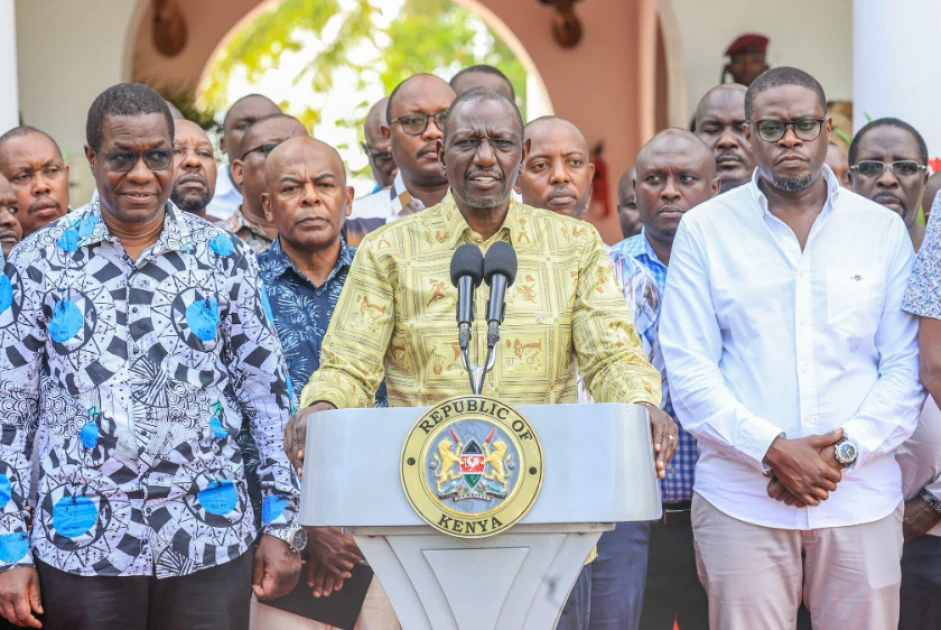
President William Ruto addresses the press at State House Mombasa on May 22, 2026. He is flanked by Energy CS Opiyo Wandayi (Left), Nairobi Governor Johnson Sakaja (Right) and transport sector stakeholders. PHOTO | PCS

Audio By Vocalize
President William Ruto has announced a further reduction in
diesel prices beginning the June/July fuel pricing cycle, as the government
moves to cushion Kenyans from the effects of the global fuel crisis.
Speaking during a live press address from State House in
Mombasa on Friday, President Ruto said the government will lower the price of
diesel by Ksh.10 per litre following consultations with leaders in the
transport sector.
The President said the move is aimed at stabilizing pump
prices and easing pressure on consumers grappling with the rising cost of
living.
“I have directed that in the next pricing cycle, we’re going
to further reduce the price of Diesel by a further Ksh.10 for the June/July cycle
to help stabilize pump prices and provide additional relief to consumers,” said
Ruto.
Ruto attributed the current fuel price crisis to global market
disruptions triggered by the escalating conflict involving Iran since February
28, 2026, which he said had severely affected oil supply routes through the
Strait of Hormuz.
According to the President, the crisis has caused sharp
increases in global fuel prices, with diesel prices rising by 118 per cent
internationally.
He noted that Kenya, which imports all its fuel from the Gulf
region, has inevitably felt the impact of the global supply shock.
The President defended the government’s fuel stabilization
measures, saying the State had spent Ksh.28.19 billion across the April/May and
May/June 2026 pricing cycles to cushion consumers through direct subsidies and
tax relief interventions.
Ruto said the government had also reduced Value Added Tax
(VAT) on petroleum products from 16 per cent to 8 per cent, foregoing Ksh.14.4
billion in tax revenue to ease the burden on households and businesses.
According to the President, without the government
interventions, diesel prices would currently retail at Ksh.277.75 per litre
instead of the current Ksh.232.86.
He further defended the government-to-government fuel import framework,
saying it had helped guarantee stable fuel supplies and protected the Kenya
shilling from further pressure during the ongoing crisis.
"Through the government-to-government (G2G) fuel supply
framework, we have secured guaranteed fuel supplies despite global supply chain
disruptions, ensuring uninterrupted fuel supply availability across the
country. The arrangement has stabilized fuel pricing compared to the old sport
market system, where prices fluctuated sharply every month," he said.
"Before the G2G arrangement was introduced in 2023, oil
importers faced intense pressure to secure US dollars within short timelines,
driving rapid depreciation of the Kenya shilling and threatening fuel supply
stability. By easing pressure on foreign exchange demand and ensuring
predictable supply terms, the framework has protected the economy during the
crisis as the one we have now. Without it, the country’s situation would be
much worse.”
The Energy and
Petroleum Regulatory Authority (EPRA) earlier this week lowered the pump price of diesel by Ksh.10.06 per litre while raising kerosene by Ksh38.60 in a
mid-cycle review announced after a day of protests and a transport shutdown by
PSV operators over high fuel costs.
EPRA said it
recalculated the maximum pump prices to be in force from May 19, 2026 to June
14, 2026 following a petition by public transport operators, citing the need to
minimise the risk of fuel adulteration arising from the price difference
between diesel and kerosene.
Under the new prices,
Super Petrol, Diesel and Kerosene now retail at Ksh.214.25, Ksh.232.86 and Ksh.191.38
per litre, respectively.
The
move came a day after matatu operators and other transport stakeholders called
a nationwide strike, disrupting movement in several towns as they demanded tax
cuts and other interventions to lower pump prices.
Join the Discussion
Share your perspective with the Citizen Digital community.
No comments yet
This discussion is waiting for your voice. Be the first to share your thoughts!