
Planning PS Muhati: Ksh.300B budget cut is inevitable, there’s room for more revenue collection
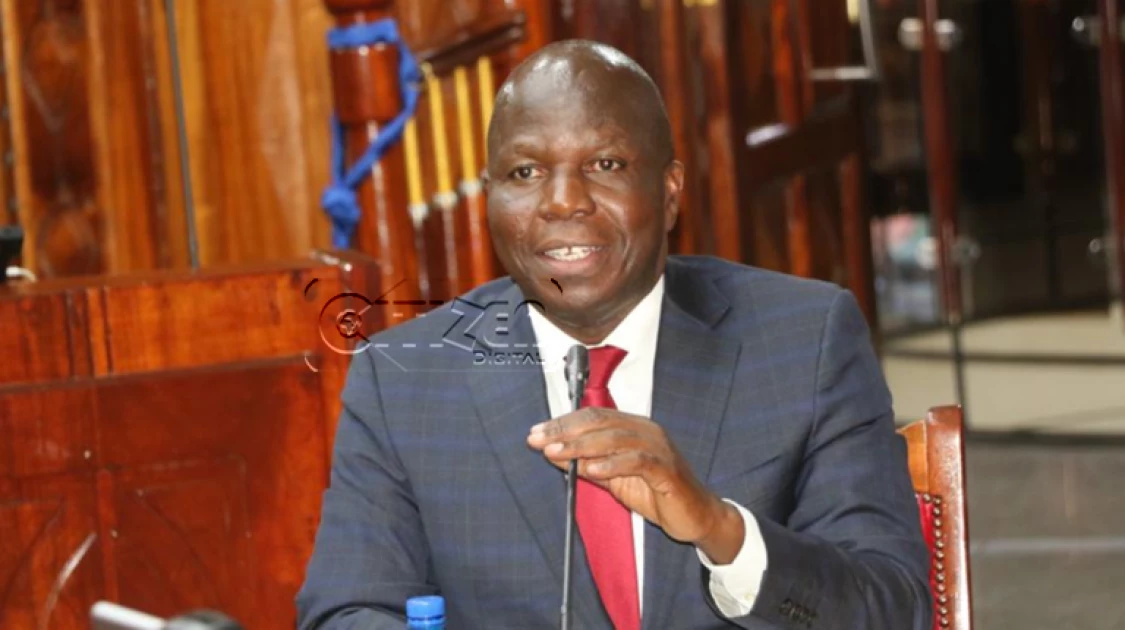
National Treasury and Planning PS James Muhati stresses a point. PHOTO/Citizen Digital/Chrispinus Juma

Audio By Vocalize
Had you met Economic Planning Principal Secretary James Muhati two months ago, probably he would be maintaining an ICT system. A tech-savvy professional, Mr Muhati has held many jobs, including a two-year stint at Huduma Centre, and the most recent being at the troubled Independent Electoral and Boundaries Commission (IEBC) where he served as an ICT director before being tapped to take over a plum, yet high-pressure job central to government operations. In fact since his swearing-in as a PS in early December 2022, he has found a new home in the Ministry of Treasury and National Planning, being the go-to man on matters planning and analyses of all the data that comes with it. He says he’s “found an amazing team and system” as he leads them in calming the storm of high cost of living, missed taxman’s revenue targets and the political jargon which borders overdraft facility vis-a-vis a loan-for-business Hustler Fund.
From being an ICT Director at the IEBC tasked with overseeing the results transmission during the 2017 general elections and now you are at the heart of planning for President William Ruto. How have you been reconciling these two?
I am a mathematician who specialized in statistics and
computer science. I hold a postgraduate diploma in Computer Science. This is
how I found myself at the IEBC. But the IEBC story is a sad one. Nevertheless,
you must appreciate that ICT is the driver of most operations at the moment. So
I found it necessary to have. My area, however, is statistics; but would you
refuse to use computer systems to aid in planning? That said, ICT is not an end
in problem-solving, but a means to problem-solving. So I need technology in
planning.
You are taking up this role at a time when the Kenyan economy is
troubled. How are we walking out of this challenge as a nation?
It will take us all. It is not about Muhati, or the
president. We are all needed. I am glad the president has taken a cue and we
follow in bringing down the cost of living and stabilizing the economy. Looking
around there are several interventions meant to, for example, bring down the
cost of food such as subsiding agricultural production. So the turnaround may
take time but we are steadfast in improving the situation.
You are in a Ministry that has been tasked with fast-tracking austerity
measures and in it we have the magic number of Sh300 billion off the 2023/2024
budget estimates. Which sectors are expected to be hit by this plan?
Austerity measures means that we are prioritizing projects.
Out of 10 projects you are running, you may want to pause and ask yourself
which are critical, maybe just three and spread the remaining seven in a longer
period. That way, you ease the burden. So in itself, it is not a bedrest of
development. The affected areas would be issues like a meeting where instead of
holding it in a high-end hotel, we may encourage use of boardrooms, where
travel expenses for meetings are high, a State entity may be advised to resort
to holding online meetings, all in the process of cutting costs.
Treasury CS Prof Njuguna Ndung’u is painting a grim picture of Kenya’s
economy for 2023. What word are you giving Kenyans regarding the proverbial tighten
your belts?
I think the papers misquoted the cabinet secretary. What we
intend to do as a government, as are in the context of the region, and the
world. So what is happening around the world economically, can in one way or
another affect us. So this equally affects us, even in our planning. So we must
re-adjust accordingly.
Kenya may just be losing her shine as the economic powerhouse of East
Africa. What do you attribute this to?
That report is misleading. We are still holding up other
economies in the region. But if
anything, we have data from the World Bank that still puts Kenya on top.
Are you concerned that increasing taxes could either scare investors or
have more negative impacts than those intended as we see with a rise in PAYE?
This country has the potential for more revenue collection.
So the measures being put in place are a result of wider consultations. I am
not certain tax collection would be counterproductive for the economy. I am
confident that it is the only tax that will help us grow, as opposed to a
scenario where just a handful is paying taxes.
So then what explains a scenario where employed graduates who are
subjected to PAYE have a lesser ability to buy assets as opposed to the
uneducated in the JuaKali sector as suggested by KNBS data?
I would tend to leave this issue to investment experts, but
it has nothing to do with PAYE. I believe that this is more of a behavioral
issue with financial management. Sometimes people are running loans that are
not easy to service, so when PAYE comes in, they are not left with disposable
income to plan for.
Let’s talk about the recent Nanyuki retreat. You attended. Were there
any new targets set per ministry and what are the timelines?
Our focus was on various sectors including agriculture,
SMEs, and digital highway among other issues of President Ruto’s agenda. We
came together to be able to have synergy between the county and national
government in terms of operations on these issues. In fact, after the meeting,
some of my colleagues have started targeted meetings with the county staff.
Kenya is importing more food than we produce. As a statistician and a
planning PS, do you think this is a good direction for a developing country
like Kenya?
Food production in our country is not where it is supposed
to be. Had we had enough, we would not import. I like referring to the
economics of producing maize in rural areas. We have a challenge in rural
areas. First, we must be able to feed the families at the grassroots level
before we feed the nation. So the ongoing importation, in my view, is more of
cushioning Kenyans for the short term and is not a direction any country,
including Kenya, would take.
So what is the most viable turnaround on imports, maybe in the next six
months; and how will this impact us as a country?
We must deal with the cost of production. If the costs are
lowered, we in the planning department can project the outcome. For now, we
have 3.6 million farmers registered. This data, for example, will help us in
planning for the available resources in terms of land. We have also been
affected by the fluctuating Kenya shilling against the dollar. So at least at
the moment, the cost of food is slowly coming down.
You are in a somewhat new office. I am certain you may have experienced
challenges, or you have some opportunities therein. What has it been like?
We have come in to continue the work that is already
ongoing. I have gotten support from the president and his deputy. I would say for
me, we have numerous opportunities and we are in the cockpit, actually, we have
taken off.
Streamlining Hustler Fund is squarely at your doorstep. Was it legal?
Was it properly conceptualized? The opposition, for example, feels this is more
of a government overdraft and illegal?
I want Kenyans to stop listening to what does not help them.
There will be hurdles. I want to ask Kenyans to borrow and help themselves. So,
yes the fund is legal and due process was followed, including efforts to anchor
it into law.
The docket you hold is critical in shaping the economy. So what are the
key projections of Hustler Fund, especially in rural development, say three
years from today?
We are looking into a future whereby having this fund, more
opportunities will be available to the youth in rural areas. So this is to be
viewed as seed capital. This will spur the economy, open up new markets and
give Kenyans an opportunity to be able to do what they can do to improve their
livelihoods.
The author is a news reader at Mulembe FM, the leading radio station among
the Luhya speaking nation, and one of 13 radio stations under RMS stable.
Join the Discussion
Share your perspective with the Citizen Digital community.
No comments yet
This discussion is waiting for your voice. Be the first to share your thoughts!