
Over 80K travellers screened, 56 samples test negative as Gov't steps up Ebola preparedness

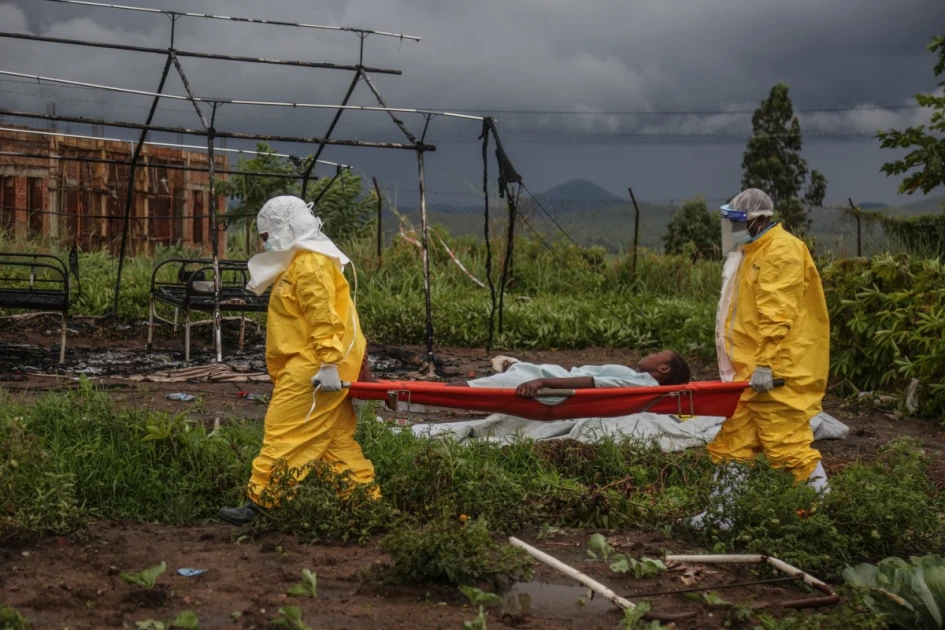
Medical staff wearing personal protective equipment (PPE) carry a patient on a stretcher at the hospital in Rwampara on May 21, 2026. Photo by SEROS MUYISA / AFP

Audio By Vocalize
Kenya has intensified nationwide surveillance and emergency preparedness measures in response to the ongoing Ebola Virus Disease (EVD) outbreak affecting parts of the Democratic Republic of Congo (DRC) and Uganda, even as the government reassured the public that no confirmed case has been reported in the country.
In a press
statement issued on Friday, Health Cabinet Secretary Aden Duale said Kenya
remains at an elevated risk of disease importation due to its close regional
connectivity through trade, transport and population movement.
“I wish to
reassure all Kenyans that, as of 5 June 2026, Kenya has not reported any
confirmed case of Ebola Virus Disease,” Duale said.
The Health CS said
the government has activated the National Incident Management System and
enhanced surveillance at all points of entry as part of efforts to prevent the
disease from entering the country.
According to the
ministry, more than 80,000 travellers have so far been screened for Ebola at
various border points and entry stations across the country. Of these, 3,969
travellers were screened within the last 24 hours alone.
The ministry
further disclosed that 56 samples collected from individuals flagged through
surveillance systems, including travellers with recent travel history to the
DRC and Uganda, have been tested for Ebola, with all results returning
negative.
Duale said Kenya
has designated four laboratories to conduct Ebola testing: the National Public
Health Laboratory, KEMRI Nairobi, KEMRI Kisumu and a mobile laboratory
stationed at the Busia One-Stop Border Post.
The government has
also identified 25 high-risk counties, placed 347 rapid response personnel on
standby and trained more than 1,759 national and county healthcare workers on
Ebola preparedness and response.
“The country
continues to maintain and strengthen preparedness measures in response to the
ongoing EVD outbreak in the region,” the CS stated, adding that simulation
exercises are ongoing in high-risk counties to test the country's outbreak
response capacity.
The ministry said
enhanced risk-based screening, traveller assessment, monitoring and rapid
response measures are being implemented in line with International Health
Regulations (IHR) and guidance from the World Health Organization (WHO).
Public awareness
campaigns have also been scaled up, targeting border communities, healthcare
workers, transport operators and other vulnerable populations.
The ministry urged
members of the public to remain vigilant and seek immediate medical attention
if they develop symptoms associated with Ebola, particularly after travelling
to affected areas in Uganda or the DRC.
These symptoms
include fever, chills, headache, joint pain, muscle pain, nausea, vomiting,
diarrhoea, fatigue and skin rash.
Kenyans have also
been advised to maintain high standards of personal hygiene, avoid contact with
bodily fluids of sick persons, refrain from handling sick or dead animals and
rely only on official information issued by the Ministry of Health, the Kenya National
Public Health Institute (KNPHI), WHO and Africa CDC.
Duale cautioned
the public against spreading unverified information that could trigger
unnecessary panic, noting that the government continues to closely monitor
developments in the region.
“The ministry
remains committed to playing its role as a responsible regional and global
partner in advancing health security,” he said.
Join the Discussion
Share your perspective with the Citizen Digital community.
No comments yet
This discussion is waiting for your voice. Be the first to share your thoughts!