
OPINION: How Kenya's housing has been quietly reshaping childhood
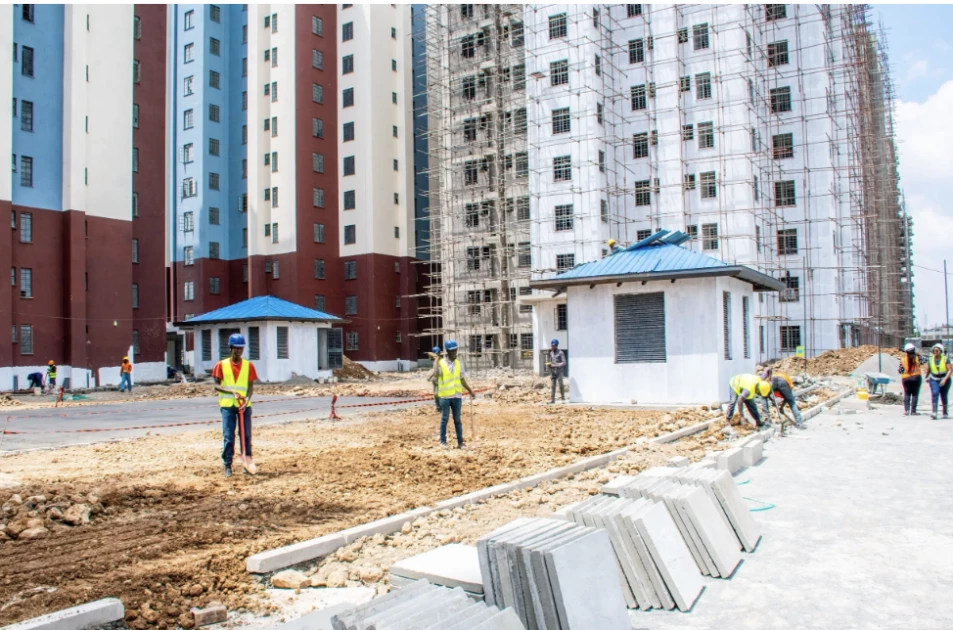
A file image of Mukuru Kwa Njenga Affordable Housing project. Photo: Handout

Audio By Vocalize
As Kenya's housing boom reshapes its cities, researchers and child development experts are raising an uncomfortable question: what is the built environment doing to the children growing up inside it?
According to the Kenya National Bureau of Statistics, approximately 1.5 million children in Nairobi wake up and go to school every morning.
Before any teacher has said a word, these children have already spent eight to ten hours inside homes that, according to a growing body of developmental research, may be quietly undermining the very learning they are about to attempt.
This is the story of how Kenya's housing stock, built fast, built dense and built "affordably", is colliding with child neuroscience in ways that urban planners, developers and policymakers are only beginning to grapple with. The crisis is not a simple story.
The housing deficit is staggering. The demand is urgent. The trade-offs are brutal. Yet, buried within this complexity lies a question that the data is making increasingly difficult to sidestep: As a nation builds at scale, who ultimately pays the price for poor design and quality of construction?
What the noise is doing
In parts of Kangemi, ambient noise regularly reaches 94 decibels, a level comparable to standing near a running lawnmower, and nearly three times the 35 decibel residential limit set by Kenya's National Environment Management Authority.
The cause is the compounded reality of dense urban living: thin walls, shared corridors, street traffic and informal commerce operating at the front door.
The World Health Organization classifies environmental noise as the second most harmful public health hazard after air pollution.
In children specifically, chronic noise exposure has been linked to delayed language acquisition, impaired reading comprehension, disrupted sleep architecture and elevated cortisol levels - the stress hormone that, when chronically elevated in early childhood, affects how the brain develops.
A landmark 2013 study in Psychological Science tracked children living near high noise environments and found measurable differences in reading and memory scores compared to peers in quieter settings after controlling for socioeconomic variables. The noise, independent of poverty, carried its own effect.
Developers point to a countervailing reality: acoustic insulation adds cost. In a market where affordability is the primary mandate, every additional specification narrows an already thin margin. "You cannot ask developers to solve a public infrastructure problem through private construction budgets," one Nairobi based quantity surveyor said. It is a tension the data alone does not resolve.
If acoustic and environmental standards are not incorporated in the law, a developer who builds a "healthy" house is unfairly penalized by higher costs while the "unhealthy" builder is rewarded with higher margins.
Nairobi's public open space stands at 6.56 square metres per person, well below the WHO's recommended nine.
A study in the Journal of Sustainability, Environment and Peace found that 77.6% of visitors to Karura Forest came from affluent neighbourhoods. Just 1% came from Huruma, a neighborhood less than eight kilometers away but a two-hour journey from the forest.
For children in most high density residential zones, unstructured outdoor play is functionally unavailable.
They live on upper floors with no communal courtyards. The nearest park, where one exists, requires transport. Play happens inside, or not at all.
Developmental psychologists distinguish between structured play and self-directed play, the unsupervised, child-led space where children negotiate rules, take physical risks, resolve conflicts and build what researchers call executive function: the cognitive skills governing planning, impulse control and decision making.
A 2018 review in Current Biology found consistent associations between access to unstructured outdoor play and stronger working memory, attention and emotional regulation. It is not built in classrooms. It is built in the messy, unscheduled spaces between them.
The construction industry's counterargument has weight. Nairobi's housing deficit stands at an estimated 2 million units, with 61% of the city's population living in informal settlements according to the Kenya National Bureau of Statistics.
Communal play areas, the argument goes, belong in the second phase after the first phase of getting families out of single mud-floored rooms. Whether that sequencing is prudent, or whether it simply defers one crisis by deepening another, is genuinely contested.
Harvard's Center on the Developing Child has documented what it calls toxic stress, the chronic activation of a child's stress response through persistent environmental adversity, including overcrowding, noise and spatial unpredictability.
Unlike manageable stress, which is part of healthy development, toxic stress in early childhood has been shown to physically alter brain architecture: slowing development of the prefrontal cortex, which governs reasoning and self-regulation, while overactivating the amygdala, the brain's threat processor.
This shows up in classrooms. The 2024 Kenya National Assessment Centre report found that only 37% of Standard 3 pupils met expected literacy benchmarks.
The gap draws extensive focus on curriculum and teacher training, both legitimate interventions. What receives considerably less attention is what happens to a child's developing brain in the eight hours before school begins.
A 2019 study in the Proceedings of the National Academy of Sciences, tracking over 3,500 children across Europe, found that those raised with greater access to green space had significantly lower rates of depression, anxiety and substance use in adulthood.
The effect size was comparable to household income. In Lagos, which allocates less than 4% of its urban area to green space, or in Accra's informal settlements where maintained parks are effectively absent, the implications of that finding are not comfortably distant.
While the recently gazetted National Building Code 2024 marks a milestone in structural safety, it remains silent on the 'cognitive safety' of the Kenyan child.
Our laws require that a wall be strong enough to hold a roof, but they do not require it to be thick enough to hold a sanctuary, that is enabling for a child's development.
By failing to mandate acoustic insulation and visual horizons, our building standards treat the psychological health of the next generation as an 'optional upgrade' rather than a fundamental right.
What is being built differently
Not all developers are indifferent to these concerns. A discernible shift has emerged among a segment of Kenya's real estate market, particularly companies focused on family housing in the mid-to-premium bracket, toward incorporating what the industry calls amenity design: communal green areas, acoustic considerations in material specification, transition spaces between private units and common areas. GulfCap Real Estate, among others operating in this space, has positioned family-centred design as central to its development philosophy, treating features like play areas and spatial buffers not as add-ons but as structural commitments.
Rwanda's Kigali offers a reference point from within the region. The city's 2020 Master Plan mandated 15 square metres of accessible open space per resident as a condition of planning approval for new developments.
Singapore's Housing Development Board, building for a population with even less land to work with than Nairobi, embedded acoustic buffers and children's play infrastructure into public housing blocks as standard requirements, a policy dating to the 1970s that helped lay the foundation for the country's consistent performance in global education rankings.
Neither example maps directly onto Kenya's political economy or fiscal constraints, and those who caution against facile comparisons are not wrong.
These global precedents prove that design standards for human development are not inherently incompatible with the mandates of density and affordability.
They require, primarily, a policy decision that child development is an infrastructure concern, one that belongs in a building code, and not a premium brochure.
The writer, Taheera Jabeen is a HR Manager at GulfCap Real Estate
Join the Discussion
Share your perspective with the Citizen Digital community.
No comments yet
This discussion is waiting for your voice. Be the first to share your thoughts!