
OPINION: Gender-Based Violence: A nation cannot prosper while women live in fear
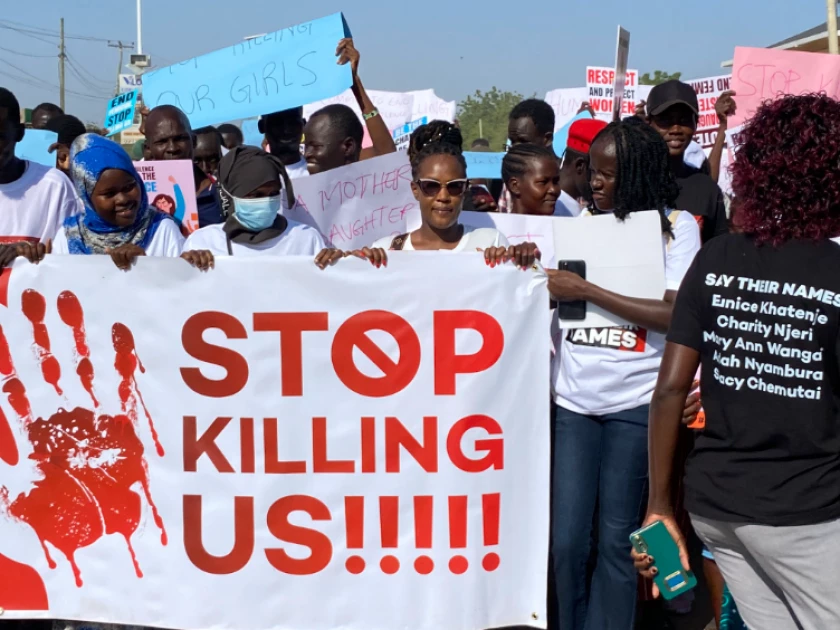
Anti-femicide protests in Turkana on December 10, 2024. PHOTO | COURTESY

Audio By Vocalize
No woman should lose her life simply because she is a woman. Yet for far too many Kenyan women and girls, violence remains a daily threat, and femicide an ever-present reality.
The growing cases of gender-based violence (GBV) and femicide have forced us to confront an uncomfortable truth: despite the progress we have made in advancing women's rights, too many women continue to live without the safety, dignity, and protection they deserve. Public outrage over recent cases reflects a nation in mourning, but outrage alone will not end this crisis. What is required now is decisive action, sustained investment, and collective responsibility.
The scale of the challenge is deeply concerning. An estimated 34 percent of women in Kenya have experienced physical violence during their lifetime, while 13 percent have experienced sexual violence. Between 2022 and 2024, Kenya recorded 1,639 femicide cases, representing a troubling increase over the period. Women aged between 30 and 44 years are the most affected, while cases involving adolescent girls aged 15 to 17 are also rising. In nearly eight out of ten cases, perpetrators are known to the victim, and intimate partners account for approximately 40 percent of reported femicide cases.
These figures are not merely statistics. They represent mothers, daughters, sisters, colleagues, and friends whose lives have been cut short. Every woman lost to violence is a reminder that our work remains unfinished. Behind every case is a grieving family, traumatized children, and a community left struggling to understand a tragedy that should never have occurred.
The Constitution of Kenya guarantees every person the right to life, dignity, equality, freedom, and security. Gender-based violence and femicide strike at the very heart of these constitutional promises. They are not only crimes against individuals; they are an assault on the values we hold as a nation.
The crisis is not evenly distributed. Counties such as Nairobi, Kiambu, Nakuru, and Meru continue to record high incidences of femicide. Risks are particularly elevated in urban informal settlements, public transport systems, coastal tourism zones, and during critical transition periods for young girls. These patterns remind us that femicide is not random—it is driven by identifiable social, economic, and institutional factors that demand targeted interventions.
At its core, gender-based violence is fueled by deeply entrenched inequalities. Patriarchal attitudes, harmful social norms, victim-blaming, and practices such as child marriage and female genital mutilation continue to undermine the rights and safety of women and girls. Poverty and economic dependence further compound vulnerability, trapping many women in abusive situations and limiting their ability to seek help or escape violence.
At the same time, new threats are emerging. Technology-facilitated gender-based violence—including cyberstalking, online harassment, digital intimidation, and image-based abuse—has grown significantly in recent years. Women leaders, journalists, professionals, and young girls are increasingly targeted in online spaces, creating new barriers to participation, leadership, and freedom of expression.
The consequences extend far beyond individual victims. Gender-based violence costs Kenya an estimated KSh 46 billion annually, equivalent to approximately 1.1 percent of GDP. These losses are reflected in healthcare costs, reduced productivity, lost income, weakened workforce participation, and increased demand for social support services. Violence against women is not only a human rights crisis; it is also a development challenge that undermines our economic growth and national prosperity.
Yet despite the scale of the problem, critical gaps remain. Kenya does not yet recognize femicide as a distinct offence. Survivor support services remain fragmented and unevenly distributed. Family and community interference often obstruct justice processes, while weak digital accountability mechanisms continue to enable online abuse. Inadequate data systems, underfunding, and poor coordination further undermine prevention and response efforts.
The Government of Kenya is clear: gender-based violence and femicide will not be tolerated. There can be no justification for violence against women and girls, whether it occurs in homes, workplaces, schools, public spaces, or online platforms. Those who commit these crimes must know that they will face the full force of the law. Survivors, in turn, must know that the state stands firmly on their side.
This moment demands more than reaction. It demands a comprehensive national response.
First, we must treat GBV and femicide as a national crisis requiring coordinated action across government, civil society, the private sector, faith-based organizations, communities, and families. Public awareness campaigns must challenge harmful norms, strengthen prevention efforts, and encourage reporting.
Second, legal reforms must be accelerated. We must strengthen existing GBV laws, fast-track court processes, improve accountability, and consider recognizing femicide as a distinct offence. Justice delayed or denied only reinforces impunity.
Third, survivor support systems must be strengthened. Every county should have accessible One-Stop GBV Recovery Centres that provide medical care, psychosocial support, legal assistance, and referral services. Survivors should not have to navigate multiple institutions in their search for help and justice.
Fourth, we must recognize that women's economic empowerment is not only a development priority—it is a prevention strategy. A woman with access to income, assets, markets, employment opportunities, and financial resources is often better positioned to escape abusive situations, make independent decisions, and build a secure future for herself and her children. Expanding women's access to finance, entrepreneurship opportunities, land ownership, value chains, and leadership positions is one of the most effective long-term investments we can make in reducing vulnerability to violence.
Fifth, we must strengthen digital governance, improve data systems, and ensure sustainable financing. A centralized national GBV database, regular national surveys, and a dedicated femicide observatory would improve evidence-based policymaking. Equally important is the establishment of sustainable funding mechanisms, including dedicated support for prevention programmes, survivor services, and community-based interventions.
Men and boys must also be part of the solution. Ending violence against women cannot be the responsibility of women alone. It requires a collective rejection of harmful norms and a shared commitment to respect, equality, accountability, and dignity.
The growing national conversation around femicide demonstrates that Kenyans are no longer willing to accept violence against women as inevitable. That shift in public consciousness is important. But awareness without action will not save lives.
As Government, we reaffirm our commitment to ending gender-based violence and femicide through stronger laws, better coordination, survivor-centred services, economic empowerment, and sustained public awareness. We will continue working with communities, civil society, development partners, the private sector, and all arms of government to ensure that violence against women is met not with silence, but with decisive action.
The true measure of any society is how it treats its women and girls. When women are unsafe, society itself is diminished.
Kenya has overcome great challenges before, and we can overcome this one too. By standing together—as government, communities, families, and citizens—we can build a future where every woman and girl lives in safety, dignity, and opportunity.
The time for outrage has passed. The time for action is now.
Hon. Harriette Chiggai
President's Advisor on Women's Rights

Join the Discussion
Share your perspective with the Citizen Digital community.
No comments yet
This discussion is waiting for your voice. Be the first to share your thoughts!