
OPINION: After Kirembe, ODM faces its moment of truth
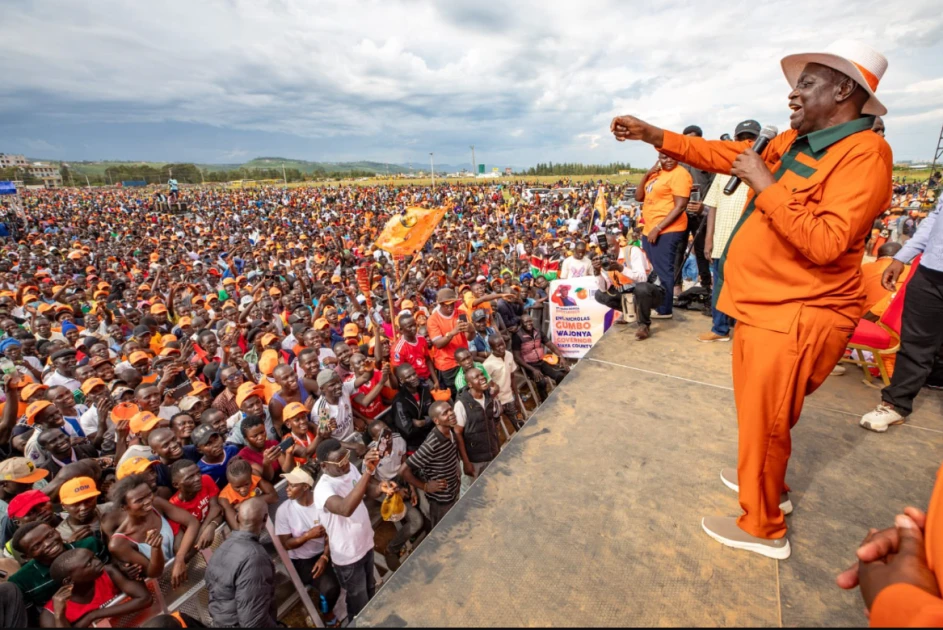
ODM leader Dr. Oburu Oginga addresses party supporters at Kirembe grounds in Kisumu on May 31. 2026. PHOTO | COURTESY

Audio By Vocalize
By Austine Arnold Omondi
The Orange Democratic Movement (ODM) party is undergoing great turmoil because of the death of its party supremo, Raila Odinga, on October 15, 2025. For a party that recently celebrated 20 years of dominating Kenyan politics, one would have imagined that the party has spent that period building the much-needed structures that would outlive its founders and dominate even in their absence. The recent happenings in the party, however, prove that it was wishful thinking to imagine that the late Odinga’s party would morph into something other than a personal legacy after his sudden demise.
It is easy to forget the long journey that the party has trekked. In 2005, after a very long and bloody clamor for a new Constitution, Kenya had embarked on a constitution-making process borrowing lessons from the failed Constitution of Kenya Review Commission (CKRC) process that had unraveled after the political agitation of the 1990s. One of the main contentions in the referendum had been the issue of presidential powers which seemed to pit the then-President Mwai Kibaki against his Roads Minister Raila Odinga, who had preferred a hybrid system that would have the President as the Head of State and a Prime Minister as the Head of Government, responsible to Parliament.
The origins of ODM are thus inseparable from the political turbulence of that 2005 constitutional referendum. The then electoral commission chair, the late Samuel Kivuitu, had designated two different ballot cards in which a 'Yes' vote was represented by a banana and a 'No' vote by an orange. The Orange coalition won and this energised them to transform from a formidable campaign movement into a formal political party. It did not help that members of the Orange coalition had been fired almost overnight by the then President.
In a strange twist however, an excitable little-known lawyer known as Mugambi Imanyara had cobbled up a small team and registered ODM as a party while the members of the Orange coalition were still in a celebratory mood. The ousted faction thus had to settle for the ODM-Kenya banner for two years before Raila Odinga and Kalonzo Musyoka split up over the presidential ticket in the 2007 elections and Raila and his comrades bought off ODM from Mugambi Imanyara. From then on, ODM rebranded into a social democratic political party with emphasis on devolution, social justice, human rights and equitable development as its core principles.
Despite losing out in the disputed 2007 elections, ODM has indeed remained one of Kenya's central political formations and actively contested in the subsequent elections through the coalitions CORD (2013), NASA (2017) and Azimio la Umoja (2022), and has continued to define the contours of Kenyan opposition politics through its party spearhead whom the inimitable political scientist Babafemi Badejo christened ‘an enigma in Kenyan politics’.
To say Odinga has, like a colossus, towered over Kenyan politics for the last two decades is only half the story. Tinga, as he was popularly known, influenced the broader dynamics of Kenyan politics which has always been characterized by personality-driven alliances, ethnic coalition-building and the enduring tension between reform aspirations and political opportunism. Odinga always stood tall as a reformer but joined the gravy train as well whenever it suited him. The handshake arrangement comes to mind. He was a man of great complexities, and yet the truth was that he was always the darling of the masses despite failing to capture power in three decades. The death of Odinga in 2025 thus threw his party in disarray, exposing the hollow infrastructure that lay beneath.
It needs not be gainsaid that one of the key problems with ODM was that it was merely a personality-driven movement where full reliance was placed on Odinga’s personal brand, rather than it being an institutionally grounded political movement. This is not to deny that Tinga was always able to dexterously mobilize voters through a combination of charm, historical grievance and mystery - and this is, without a doubt, a monumental task to inherit. On his demise, a few transactional leaders cobbled up a meeting with the Head of State and handed the party to Odinga’s brother, the hitherto lackluster Dr. Oburu Oginga.
He runs the show now: but with a large chunk of the party on their way out led by the erstwhile revolutionary James Orengo and his sidekicks Edwin Sifuna, Babu Owino and Geoffrey Osotsi. Other external actors now view the party as up for grabs. Despite once being considered as the unassailable bastion of opposition politics in Kenya, it now goes without saying that the party now grapples with an identity crisis that threatens to erode its foundational principles of social justice, inclusivity and even grassroots empowerment.
It is for this reason that I was quite interested in the Kirembe meeting held by the party on Sunday, May 31, 2026. I was interested in hearing the leaders step up with a clear and unified message for the Luo polity. Moving forward, the Luo community deserves more than rhetoric, it needs a post-Raila direction, and I had hoped to come away with a coherent answer to one really critical question at the moment: “What does the Luo community stand to gain in a post-2027 Kenya, with an unhinged William Samoei Ruto (WSR) at the helm?”
Despite its current fragmentations,
the Kirembe meeting essentially demonstrated that ODM remains the dominant
political force within the Kavirondo. On the surface, the turnout was great and
the optics were deeply impressive as thousands of supporters poured into the
grounds to confirm ODM still has an active pulse. For a party that has faced
serious disintegration concerns since Raila's passing, that turnout matters.
The deeper problem, however, is that most of its leadership carries no coherent vision for where the Luo community goes from here. It was clear that ODM wanted to show that it remains a united party and that it remains the favored party of choice in Raila Odinga’s ethnic heartland. This, however, remains a bold claim given that the rival Linda Mwananchi movement had held its own successful Kisumu rally just weeks prior, headed by Sifuna, Babu Owino, and the indefatigable Nyatieng’ (Orengo). The Kirembe meeting was ultimately a show of force in a region where ODM should not need to show force or hold a meeting to counter the splinter faction.
The ODM “experts” in government – John Mbadi (Treasury) and Opiyo Wandayi (Energy) - are, frankly, disappointing as they are more clownish than consequential. Mbadi has made it his mission to remind ODM that "Baba is no more. This is the post-Raila era". In his mind, he is the best thing to have happened to ODM now since the win of the 2005 referendum. I do not deny that there is a kernel of legitimate grievance in Mbadi’s position as regards Uhuru Kenyatta and the 2022 elections, but his bastardizing of an entire community misses the mark.
It is grossly immoral to conflate Uhuru Kenyatta's individual political miscalculations with the Kikuyu community as a whole because that is both intellectually lazy and politically reckless. On Sunday, he announced that he is ready to become the first ODM/Luo President, yet he continued in the same speech to publicly antagonize the very community whose support ODM will need if it ever wants to escape its regional Nyanza stronghold and mount a credible national presidential bid in 2032 or beyond. The less said about Opiyo Wandayi the better.
On the flip side, ODM Chair Gladys Wanga and Dr. Oburu are dyed-in-the-wool transactionalists; their politics begin and end at the negotiating table. They are relying on borrowed political capital and seem to have made a clear choice to have the party stay in the broad-based arrangement, extract as much development dividends from Nyanza and negotiate around the post-2027 political chessboard. The two incumbents have been emphatic that the party would not lead its people "to the streets or to the opposition,” and lyrically repeated the same on Sunday.
Dr. Oburu may lack the skin-in-the-game urgency that drives the 2027 race but he compensates for this by having loyal attack dogs in most of the current ODM incumbents. His elevation to party leader was more about plugging a hole because ODM did not want to confront Raila succession head on. Sooner or later, they will have no option. For now, Oburu serves as the legitimate party leader with the Special Delegates Conference having ratified him, the party NEC backing him and the Parliamentary group largely aligned on this.
From the speeches on Sunday at Kirembe though, it is clear that only Prof. Anyang’ Nyong’o understands what needs to be done, but lacks the spine to confront the current ODM politburo and force the issue. The disarray is latent with Raila’s absence and the founders of the party like Prof. Nyong’o must now step up from the shadows to do more for an emotionally volatile and ideologically restless support base. Credit where it is due; proper resolutions did come out of the Sunday rally, as read out by Governor Gladys Wanga, and that is not nothing. But resolutions on paper are only as good as the structures built to enforce them.
What remains to be seen, and what will ultimately define whether Kirembe means anything at all, is whether any credible follow-up mechanism is put in place to achieve the aspirations of the Kavirondo.
Join the Discussion
Share your perspective with the Citizen Digital community.
No comments yet
This discussion is waiting for your voice. Be the first to share your thoughts!