
'Never forget!' Kenyans online revisit 2007/08 Post Election Violence as political tensions escalate
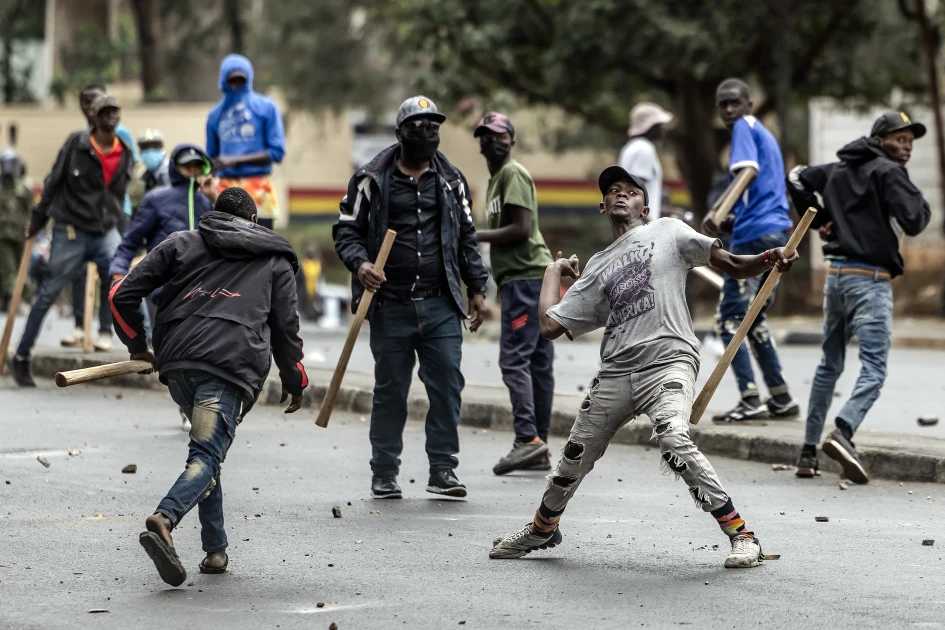
Men armed with whips, sticks and clubs grab throw stones to protesters in downtown Nairobi on June 17, 2025. Photo by LUIS TATO / AFP

Audio By Vocalize
“We need to re-run videos from 2007/2008 post-election violence. We have forgotten what violence can do to a country. What is going on in this country, if not stopped, will burn it to the ground,” began one of the conversations on the X platform.
It sparked off a flurry of contributions, with many young Kenyans expressing shock at not having known how deeply this episode of violence and anarchy affected the country.
What followed were images and videos of the 2007/8 post-election violence, with several comments warning against a repeat of the same.
Scroll through Kenyan X, TikTok, and Instagram, and a grim pattern emerges.
Alongside videos of hooded young men on motorbikes storming a rally in Gilgil, or armed youths forcing their way into a church service in Kisumu, are old photographs and grainy videos.
The smouldering Kiambaa church in Eldoret, machete-wielding mobs in Naivasha, rows of the dead lined up outside Nairobi mortuaries. The captions rarely need elaboration. "We have been here before." "Not again." "Who is arming these goons?"
The resurfacing of 2007/8 post-election violence (PEV) imagery is not nostalgia. It is a warning shared by people who lived through, or lost relatives in, the worst episode of internal bloodletting in Kenya's post-independence history.
These people now watch in disbelief as organised gangs disrupt opposition forums, attack churches from Nairobi to Kisumu, Kisii and Ol Kalou, and operate with troubling impunity.
The comparisons are not perfect. But the anxiety they reveal, about a state either unable or unwilling to rein in politically sponsored violence, is rooted in a trauma Kenya has never fully processed.
A familiar playbook, a new election cycle.
In recent months, the pattern has become difficult to ignore.
On June 12, armed groups on motorbikes disrupted a civic forum on the national budget at All Saints Cathedral in Nairobi, robbing clergy and civil society leaders inside the church itself.
In Othaya, Nyeri County, thugs or police officers fired teargas and stormed a Sunday service on January 25 at a rural Anglican church, terrifying congregants, including young children.
On April 8, Vihiga Senator Godfrey Osotsi was ambushed and beaten by hoodlums in Kisumu as he sat in a restaurant.
An opposition rally in Kisii was overrun by armed men, leaving one person dead on July 3.
Roads have been barricaded, and violence has been meted out to opposition groups in Kikuyu and Gilgil.
Former Deputy President Rigathi Gachagua says he has been attacked at churches more than two dozen times since his 2024 impeachment.
This too has been the fate of the ODM breakaway group, “Linda Mwananchi” leaders, comprising Nairobi Senator Edwin Sifuna, Embakasi East MP Babu Owino and Siaya Governor James Orengo, with goons threatening to attack them at almost every public meeting.
Interior Cabinet Secretary Kipchumba Murkomen has acknowledged to a parliamentary committee that these networks have evolved from disorganised street gangs into sophisticated, decentralised operations.
Police spokesperson Michael Muchiri has dismissed allegations of official collusion as "preposterous," attributing incidents where uniformed officers were filmed alongside armed gangs to "rogue officers" now under investigation.
Yet a growing chorus, church leaders, opposition politicians, rights groups and ordinary Kenyans documenting these events on their phones, argue the pattern is too consistent, too geographically widespread, and too tightly timed to political events to be coincidental.
The ‘Goonland’
A report released by OdipoDev and Tribeless Youth on money and violence in the political exploitation of young Kenyan men documented what an informal "goon rate card" looks like: roughly Ksh.500 (about $4) a day to work for a local Member of County Assembly (MCA), rising to Ksh.1,000 for a Member of Parliament.
Archbishop Maurice Muhatia Makumba of Kisumu, and chairman of the Kenya Conference of Catholic Bishops, has posed the question many Kenyans are now asking of their government: is there real political will to end "goonism," or is it serving the interests of the political elite?
The National Council of Churches of Kenya has gone further, demanding that police pursue not just the young men executing the violence but "the wealthy political architects financing and coordinating the chaos from the shadows."
This is precisely the anxiety animating the social media storm: that what looks like scattered criminality is, in fact, a return of the machinery that produced Kenya's darkest post-independence chapter.
Memories of 2007/8
The scale of that earlier catastrophe is difficult to overstate.
When the Electoral Commission of Kenya declared President Mwai Kibaki the winner of the December 27, 2007, election, after a vote count widely viewed by international observers, including the European Union and the Carter Centre, as opaque and manipulated, the country erupted.
Late opposition leader Raila Odinga's supporters, convinced the presidency had been stolen from them, took to the streets.
What began as a protest quickly curdled into targeted ethnic violence, most infamously the 2008 New Year's Day massacre in which more than 30 people, mostly women and children sheltering in a church at Kiambaa near Eldoret, were burned alive.
It morphed into over two months of violence. Estimates of the death toll range between about 1,100 and 1,500 people, with figures compiled by Human Rights Watch, the Centre for Strategic and International Studies and other monitors clustering around 1,100 to 1,300 confirmed deaths.
Displacement estimates vary similarly, from roughly 350,000 to over 600,000 people forced from their homes, with the United Nations citing figures at the higher end.
Well over 1,000 women are believed to have been raped during the chaos, and more than 117,000 private properties were destroyed.
Years later, tens of thousands of Kenyans remained in internally displaced persons’ camps, many never adequately compensated or resettled, a wound that, for many communities in the Rift Valley in particular, has never fully closed.
The crisis was only halted by an African Union-backed mediation led by former UN Secretary-General, the late Kofi Annan, which produced the National Accord, a power-sharing government with Kibaki as president and Odinga as prime minister, and, crucially, set in motion two commissions of inquiry whose findings still hang over Kenyan politics today.
The ICC case that collapsed
Unable to secure Kenyan agreement on a domestic tribunal to try those most responsible, Annan handed a sealed envelope containing the names of key suspects to the International Criminal Court in The Hague.
In 2011, ICC prosecutors indicted six Kenyans, dubbed the "Ocampo Six" after chief prosecutor Luis Moreno-Ocampo, on charges of crimes against humanity.
Ocampo six included former president Uhuru Kenyatta, incumbent President William Ruto, former minister Francis Muthaura, former Minister Henry Kosgey, radio executive Joshua Arap Sang, and former police chief Mohammed Hussein Ali.
Charges against Kosgey and Ali were dropped before trial
Kenyatta and Ruto, running as a joint ticket in the 2013 election in what many observers described as a de facto alliance forged partly by their shared ICC predicament, won the presidency and deputy presidency, making Kenyatta only the second sitting head of state, after Sudan's Omar al-Bashir, to face an active ICC indictment.
Charges against Muthaura were withdrawn in 2013 after witnesses died or withdrew, and prosecutors said Kenya had failed to hand over crucial evidence.
In December 2014, prosecutors withdrew the case against Kenyatta himself, again citing government non-cooperation and the loss or intimidation of witnesses.
The final case, against Ruto and Sang, collapsed in April 2016 when ICC judges vacated the charges, similarly citing witness interference and an "unprecedented" level of political meddling, though without formally acquitting the pair. Separately, the ICC later charged intermediaries, including lawyer Paul Gicheru, with witness tampering.
For victims and rights groups, the collapse of the Ocampo Six cases was less a legal vindication than a demonstration that impunity, when backed by state power, can outlast even an international court.
No one has ever been convicted for organising the 2007/8 post-election violence.
Warnings from the precipice
Two homegrown inquiries had tried to prevent exactly this outcome. The Independent Review Commission on the 2007 General Election, chaired by South African judge Johann Kriegler, dissected the electoral machinery itself, documenting a broken voter register, an under-resourced and politically compromised electoral commission, and a vote-tallying process so opaque that even the commission's own chairman later admitted he did not know who had actually won.
The Kriegler Commission recommended a complete overhaul of the electoral body, tighter regulation of political parties, and reforms to prevent the kind of last-minute, unverifiable tallying that had made the 2007 result impossible to trust.
The second inquiry, the Commission of Inquiry into Post-Election Violence chaired by Justice Philip Waki, investigated the bloodshed itself and, crucially, recommended the creation of a special tribunal to try those bearing the "greatest responsibility" for organizing the violence, with the explicit threat that if Kenya's Parliament failed to establish it, the list of suspects compiled by the commission would go straight to the ICC.
As anticipated, bending to self-preservation, parliament defeated the tribunal bill in February 2009, triggering exactly that outcome.
Waki called for sweeping police reform, including the long-delayed merger and vetting of Kenya's fractured police services, lack of ethics and integrity in the service precisely because officers had either stood aside during the killings or, in some documented cases, actively participated.
A companion report by the Kenya National Commission on Human Rights (KNCHR), whose findings fed into the Waki Commission, was pointedly titled On the Brink of the Precipice, a phrase that has since entered Kenya's political vocabulary as shorthand for the country's habit of approaching, and sometimes stepping back from, catastrophic political violence.
The message from both commissions was unambiguous: without genuine reform to how elections are conducted, how political violence is prosecuted, and how the police are held accountable, Kenya would remain trapped in a cycle in which each election carried the risk of pushing the country over that edge.
Some reforms did follow: a new 2010 constitution, devolution of power to counties, a restructured judiciary, and an Independent Electoral and Boundaries Commission to replace the discredited ECK. But implementation has been partial and uneven.
The special tribunal was never built. Police reform remains, by the government's own admission, incomplete.
And the land and resource grievances that fuelled the ethnic dimension of the 2007/8 violence, dating back to colonial-era displacement and unresolved by any government since independence, remain largely unaddressed.
Why Kenyan elections keep teetering on the edge
Analysts and historians point to a recurring architecture behind Kenya's electoral crises, one that long predates 2007.
Voting in Kenya has tended to follow ethnic and regional lines nearly as much as ideological ones, a legacy of how political parties formed around ethnic coalitions after independence and how access to land, jobs and public resources has historically tracked closely with who wields power in Nairobi.
Politicians in Kenya have, since the reintroduction of multiparty politics in 1991, been repeatedly accused, but rarely prosecuted, of mobilising ethnic militias ahead of elections, a pattern researchers describe as a near-five-year cycle tied to the electoral calendar itself.
Layered onto that is a deep well of youth unemployment; roughly 800,000 young Kenyans enter the labour market annually against only around 100,000 formal jobs, according to World Bank estimates. That makes recruitment into "goon" networks tragically easy.
Interviews with young men who do this “work” describe it less as ideological commitment than as economic desperation: a few hundred shillings for a day's "operation" is, for many, simply more money than any legitimate alternative offers.
That economic logic, several analysts argue, is precisely why the phenomenon persists across administrations regardless of who is in power. It is cheaper and more deniable for political actors to hire mercenaries than to build durable coalitions.
Finally, and perhaps most corrosively, is impunity. No senior political figure has ever been convicted in Kenya for organising election-related violence, from the ethnic clashes of 1992 and 1997 through to 2007/8 and the collapse of the ICC cases. Each unpunished cycle, rights groups argue, lowers the cost of trying it again.
A nation watching itself
It is against this backdrop that the revisited viral videos and old PEV photographs are landing so hard.
Kenyans are not simply mourning a historical tragedy; they are testing whether the state's institutions, the police, the courts, the political class, have actually changed since the Kriegler and Waki commissions issued their warnings, or whether the country is once more inching toward a precipice it has visited before.
With Kenya's next general election roughly a year away, in August 2027, and with rights groups like Vocal Africa already warning that continued goon violence could make a free and fair vote impossible, that question is no longer academic.
It is, for millions of Kenyans scrolling through their timelines, the most urgent question in the country.
Join the Discussion
Share your perspective with the Citizen Digital community.
No comments yet
This discussion is waiting for your voice. Be the first to share your thoughts!