
Nairobi City Marathon pairs air sensors with 5,000-tree legacy plan
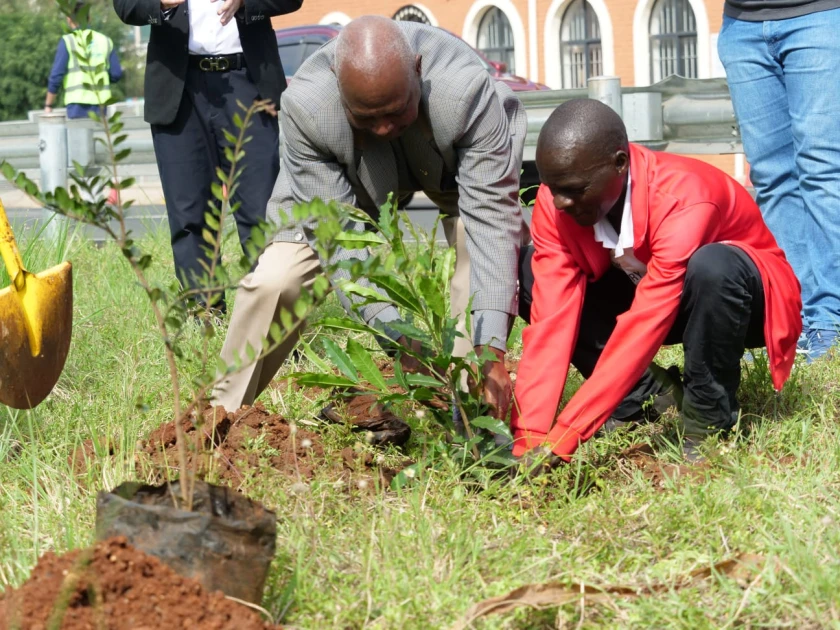
Athletics Kenya (AK) President Lt. Gen. (Rtd) Jackson Tuwei (left) participates in a symbolic tree-planting ceremony in a major boost to environmental sustainability ahead of the upcoming Nairobi City Marathon.

Audio By Vocalize
In a major boost to environmental sustainability
ahead of the upcoming Nairobi City Marathon on June 7, 2026, a high-level
coalition of sports, science, and infrastructure leaders gathered at the Haile
Selassie Expressway terminal to launch a dual-pronged climate initiative.
Led by Athletics Kenya (AK) President Lt. Gen. (Rtd)
Jackson Tuwei, the delegation participated in a symbolic tree-planting ceremony
to mark an expanding partnership aimed at tackling urban air pollution and
accelerating Nairobi's green canopy goals.
The ceremony joined together key global and local
leaders, including Dr. Philip Osano (Chief Operating Officer of CIFOR-ICRAF),
Yu Fukai (Chief Executive Officer of Moja Expressway Limited), and Niall
O’Connor (Centre Director of the Stockholm Environment Institute (SEI) Africa).
The cornerstone of this year's sustainability drive
is the strategic installation of four specialized air quality control sensors
directly along the Nairobi Expressway infrastructure, which serves as the
competitive backbone of the marathon route.
Deployed by SEI Africa in partnership with Moja
Expressway and Athletics Kenya, these sensors are positioned at critical zones
including Jomo Kenyatta International Airport (JKIA), Uhuru Park, ABC Place in
Westlands, and Museum Road.
Lauding the partnership for delivering unprecedented,
data-driven insights into urban athletics, Gen. Tuwei emphasized the borderless
nature of climate advocacy:
A good and clean environment has no boundaries, and
we must work together as a team to achieve common good on climate change and
clean air," Tuwei stated.
The tree-planting initiative represents the event's
permanent legacy. The exercise directly supports the Nairobi City Marathon’s
ambitious environmental target to plant 5,000 trees annually, transforming the
sporting event into a year-round catalyst for urban forestry.
“Greening of sporting venues is key, and we are also
glad to help the Nairobi City Marathon in realizing their dream of planting
5,000 trees annually,” said Dr. Osano.
O’Connor reaffirmed that data transparency is vital
to protecting both elite runners and everyday citizens:
We are happy to always assist Athletics Kenya in
providing and installing the air quality sensors and helping in analysing the
data,” O’Connor noted.
Join the Discussion
Share your perspective with the Citizen Digital community.
No comments yet
This discussion is waiting for your voice. Be the first to share your thoughts!