
Menstrual Hygiene Day: Stakeholders advocate for menstrual dignity for women in prison

Audio By Vocalize
Yet behind the walls of Lang'ata Women's Maximum Security Prison, hundreds of women continue to navigate the same menstrual health challenges experienced by women everywhere, often with fewer resources and less visibility.
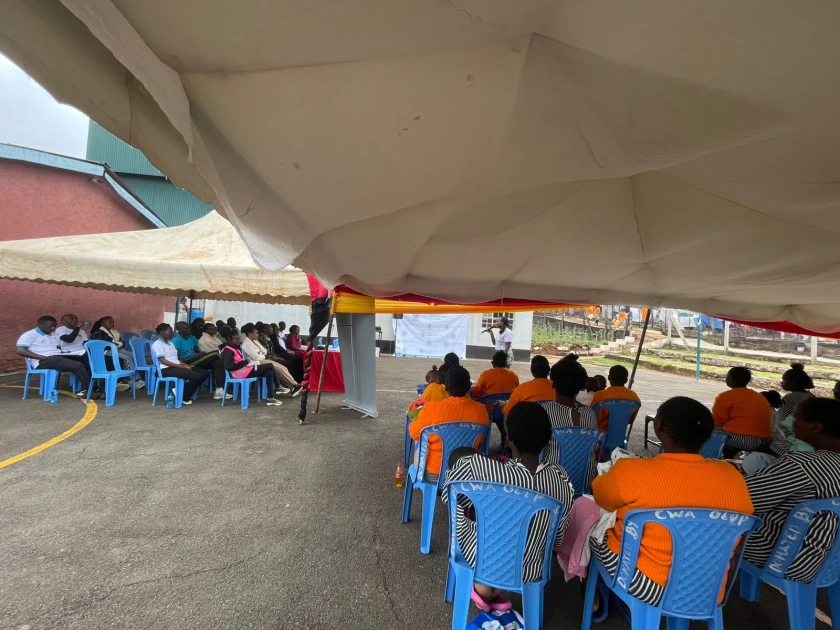
For Menstrual Hygiene Day 2026, the Kenya Youth Parliament for Water (KYPW) sought to change that narrative by bringing menstrual health education, sanitary products, and advocacy directly to women living in the correctional facility.
But beyond the donation of sanitary pads, organizers say the bigger goal is finding lasting solutions.
According to KYPW member Roy Okola Otieno, the event was designed not only to support incarcerated women but also to amplify conversations that are often ignored.
The organization chose Lang'ata Women's Prison because women in correctional facilities are frequently invisible in menstrual hygiene discussions despite facing many of the same challenges experienced by women outside prison walls.
"These are women who have been separated from society, and often they are left out of conversations about menstrual health," said Roy.
For prison authorities, addressing the needs of women in custody requires support from the wider community.
During the event, Maureen Ngote Inspector of Prisons called on organizations, youth groups, women's groups, and well-wishers to continue engaging with correctional facilities.
She explained that overcrowding remains one of the institution's biggest challenges, creating pressure on housing and available resources.
The facility also accommodates children who live with their mothers during their early years. According to Ngote, ensuring adequate supplies such as milk, clothing, and other necessities requires continued support from external partners.
"They also want to be loved. They also want to be remembered. They are still women and they are still mothers," she said.
Ngote further urged society to prepare for the successful reintegration of women after release, noting that many return to communities ready to rebuild their lives and contribute positively to society.
That call for inclusion aligns closely with KYPW's advocacy agenda.
According to KYPW member Stephen Gill, sustainable change will require policy reforms that guarantee consistent access to menstrual hygiene products in correctional institutions.
He noted that while discussions often focus on donations, long-term solutions require institutional commitment.
The organization hopes to spark conversations around making sanitary products more accessible and prioritizing menstrual health within correctional facilities.
Advocates argue that access to menstrual hygiene products should be viewed as a basic necessity rather than a privilege.
For many women, menstrual dignity extends beyond having access to pads.
It also includes access to clean water, private sanitation facilities, menstrual health information, and freedom from stigma.
These were issues explored during the educational sessions held at the prison.
Participants learned about menstrual cycles, proper hygiene practices, safe disposal methods, and the use of different menstrual products.
For Amina Chizi Ngome, one of the event's most important lessons was the need for continuous learning.
She described the experience as enlightening, noting that new menstrual health technologies and innovations continue to emerge.
"As women, it is important that we keep learning because things are always changing," she said.
Amina defines menstrual dignity as more than simply having sanitary products.
To her, it means having access to the products needed during menstruation, sufficient water for hygiene, and the confidence to go about daily life knowing that one's needs are adequately met.
Her definition points to a broader solution that extends beyond donations.
Experts increasingly argue that addressing period poverty requires a comprehensive approach built on four pillars: product access, water and sanitation services, menstrual health education, and social inclusion.
Together, these interventions offer a blueprint for sustainable menstrual dignity within correctional facilities.
Advocates are now calling for regular partnerships between correctional institutions, civil society organizations, manufacturers, and government agencies to establish reliable menstrual product supply systems.
They are also encouraging more organizations to support children living with incarcerated mothers and to invest in water, sanitation, and hygiene infrastructure.
Perhaps most importantly, they are urging society to challenge the stigma associated with both menstruation and imprisonment.
One message remains clear: menstrual dignity should not depend on a woman's location, income, or circumstances.
Whether in schools, workplaces, communities, or prisons, every woman deserves access to the products, information, water, and support needed to manage her period safely and with dignity.
For the women of Lang'ata Women's Prison, the event was not simply about receiving sanitary pads.
It was about being seen, being heard, and being reminded that they remain part of the broader conversation about health, dignity, and human rights.
And for advocates, that may be the most important solution of all.
Join the Discussion
Share your perspective with the Citizen Digital community.
No comments yet
This discussion is waiting for your voice. Be the first to share your thoughts!