
Living costs, housing, job uncertainty fuel European youth anger
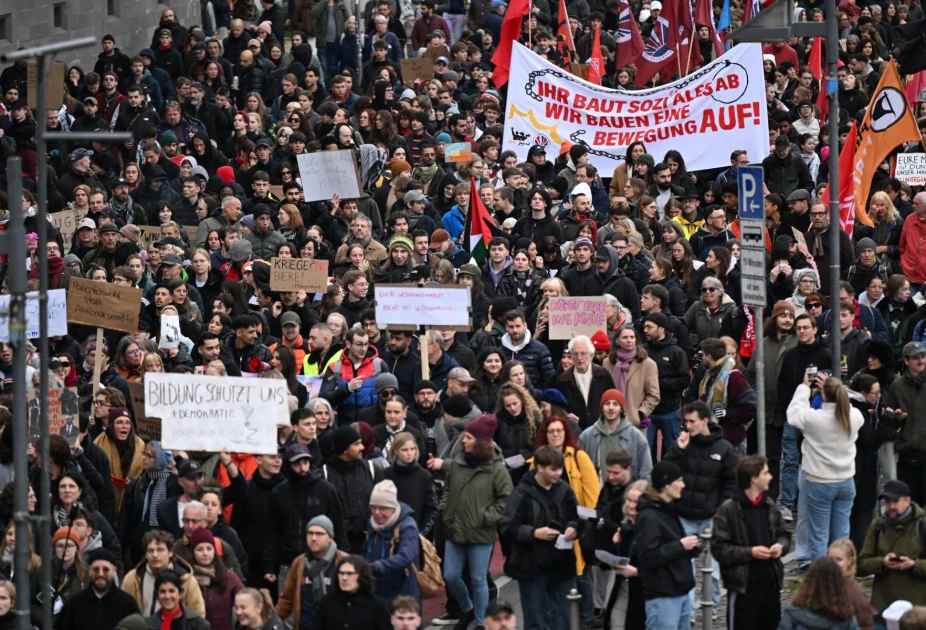
Protesters in Germany walk during a demonstration organised by "GenZ regelt!" on October 31, 2026.

Audio By Vocalize
While local grievances have fuelled the fire, the movements that brought hundreds of thousands to the streets of France, Belgium, Spain, Italy and Germany at the weekend are all linked by shared continent-wide issues such as sky-high housing costs, poor pay and the climate crisis.
- Schools, universities -
School and university students have found themselves at the front line of these protests.
The spark was lit in mid-September, when French high school students took to the streets to demand better and more facilities, and an end to an opaque university admissions system.
"It's a European movement but France served as the catalyst," said Sylvain Boulouque, a historian of social movements.
After weeks of rallies, the French protests drew at least 550,000 people on October 17, with the largely peaceful demonstrations swiftly eclipsed by episodes of looting, arson and clashes with the police.
Four days later in Greece, more than 10,000 people rallied across several cities, with some bearing placards with slogans written in both Greek and French.
"The problems are shared between various European countries," insisted one protester, Filippos Armen, a physics student at Thessaloniki's Aristotle University.
- 'Uncertainty' -
Across the continent, many people have found themselves face-to-face with "a model that has run out of steam", said Belgian sociologist Geoffrey Pleyers.
"What they're being offered is, at best, a job, and for many, a precarious one," said the specialist in social movements at the Catholic University of Louvain.
At the same time, their studies no longer guarantee the standard of living their parents enjoyed, as a result of high housing costs and the risks linked to the climate crisis.
- Rising rents -
In many of the protests, as in Spain, Portugal and Greece, housing is "a central element" because it is directly tied to purchasing power and "an ever-more unequal distribution of wealth", the researcher added.
On the other hand, political scientist Mariam Martinez-Bascunan argued that "discontent is fuelled more by uncertainty than by poverty".
Speaking to Spain's RTVE television, the professor at the Autonomous University of Madrid pointed to the "contagion effect" of images of protests in France and of tent encampments of housing rights activists in Portugal.
- 'Sacrificed' generation -
For Boulouque, "young people are acutely conscious of the weight of the debt and environmental problems" left by previous generations and have "the feeling of being sacrificed" as a result.
Boulouque, who also teaches in a high school, pointed to an unexpected side effect of the ban on mobile phones in French classrooms: "Students began to socialise again and lifted their heads to see just how far their working conditions have worsened".
In Germany, the possible reintroduction of military service at a time of tensions with Russia has also led many young people to join the protests.
- Inequalities -
The youth protests have struck a nerve with the wider public, at a time when Europe is gearing up for a wave of key elections in Spain, France, Italy and Greece over the coming year.
The French students were joined by the yellow vest movement, which organised a previous round of protests against the cost of living in 2018-19, while in Italy, drivers and farmers opposed to the high price of petrol joined the young demonstrators at Friday's rallies.
Another shared grievance is the widespread feeling of not being listened to, which is leading to an increasing "distance" and "dissociation" between ordinary people and the state, said Pleyers.
On top of that is the sense that society has become unequal and unfair.
"Young people whose parents live comfortably have a more comfortable life and, conversely, those who come from more precarious backgrounds have a much harder life today," Pleyers added.
Join the Discussion
Share your perspective with the Citizen Digital community.
No comments yet
This discussion is waiting for your voice. Be the first to share your thoughts!