
Kenya pushes digital accessibility and inclusive AI transformation in Africa

Audio By Vocalize
Speaking at the opening of the 7th Inclusive Africa Conference in Nairobi, Cabinet Secretary for Information, Communications and the Digital Economy William Kabogo and inABLE Executive Director Irene Mbari-Kirika urged governments, businesses and technology developers to place persons with disabilities at the centre of digital innovation and policy-making.
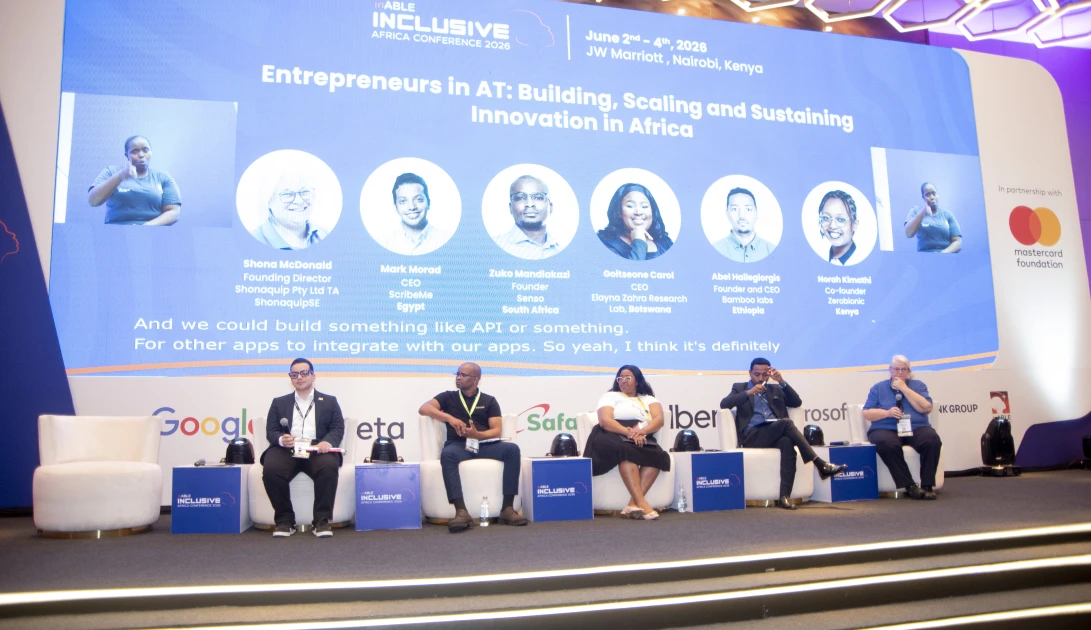
The three-day conference, themed "Accelerating Digital Accessibility and AI Solutions for Africa's Future," has brought together policymakers, technology companies, development partners, disability advocates and innovators from across the continent to discuss how Africa can build a more inclusive digital economy.
Kabogo said accessibility can no longer be treated as a specialised concern, noting that technology increasingly shapes how people access education, healthcare, government services, employment and economic opportunities.
"Digital transformation and digital inclusion must advance together," he said. "We cannot speak of a successful digital economy if sections of our population remain unable to access the opportunities that technology creates."
The Cabinet Secretary highlighted Kenya's ongoing investments in digital infrastructure under the Digital Superhighway Programme, which has seen more than 30,000 kilometres of public fibre optic infrastructure deployed across the country to connect schools, hospitals, government institutions and communities.
He also pointed to the government's Jitume Digital Hubs Programme, which has established more than 270 hubs equipped with over 17,700 devices, including facilities specifically designed for learners who are blind, deaf and hard of hearing.
According to Kabogo, accessibility must also remain central to the delivery of public services, particularly as more than 23,000 government services become available through the eCitizen platform.
"A public service that a citizen with a disability cannot use is not yet a complete public service," he said.
The Cabinet Secretary further underscored the role of artificial intelligence in improving access to education, healthcare and public services for persons with disabilities, while cautioning that AI systems must be developed responsibly to avoid creating new barriers.
"Our Kenya National Artificial Intelligence Strategy treats inclusion not as a footnote but as a guiding principle," he said.
His remarks were echoed by Irene Mbari-Kirika, who challenged delegates to confront a critical question facing Africa's digital transformation agenda.
"As Africa's digital economy expands rapidly, are we building a digital economy that truly serves everyone, or are we leaving over 80 million Africans with disabilities behind?" she asked.
Mbari-Kirika argued that digital accessibility represents one of Africa's most significant untapped economic opportunities. Citing World Bank estimates, she noted that excluding persons with disabilities can cost countries between three and seven per cent of GDP, while the global spending power of persons with disabilities and their families exceeds US$18 trillion annually.
She highlighted persistent accessibility gaps across key sectors, including education and banking.
Drawing from a recent assessment of the websites of Africa's leading banks, she revealed that every institution evaluated had critical accessibility shortcomings, including issues related to keyboard navigation, colour contrast and non-text content.
"That is the scale of the gap we are working to close," she said.
Mbari-Kirika also stressed the transformative potential of AI-powered accessibility tools, including real-time sign language translation, AI-assisted navigation for visually impaired users and automated captioning services.
However, she warned that AI products developed without accessibility considerations risk deepening existing inequalities.
"Accessibility must be embedded from the outset in every AI product, every policy and every procurement decision," she said. "Inclusive AI is essential in ensuring that the future of technology works for everyone."
The conference also highlighted efforts to develop a harmonised African Digital Accessibility Standard for ICT products and services. Led by inABLE in partnership with the African Organisation for Standardisation and GIZ, the initiative aims to establish continent-wide standards that will make digital products and services more accessible across African markets.
Kabogo noted that momentum is growing at the continental level, pointing to discussions held during the recent Connected Africa Summit in Nairobi, where African ministers endorsed stronger collaboration on digital accessibility.
Both speakers called for greater investment in assistive technologies, local innovation and digital skills training for young people with disabilities, arguing that accessibility should be viewed not as a matter of charity or corporate social responsibility, but as a strategic business and development priority.
"An accessible digital Africa is a better Africa for all of us," Mbari-Kirika said.
Join the Discussion
Share your perspective with the Citizen Digital community.
No comments yet
This discussion is waiting for your voice. Be the first to share your thoughts!