
Fuel crisis: Everything Gov’t says it has done to cushion Kenyans so far

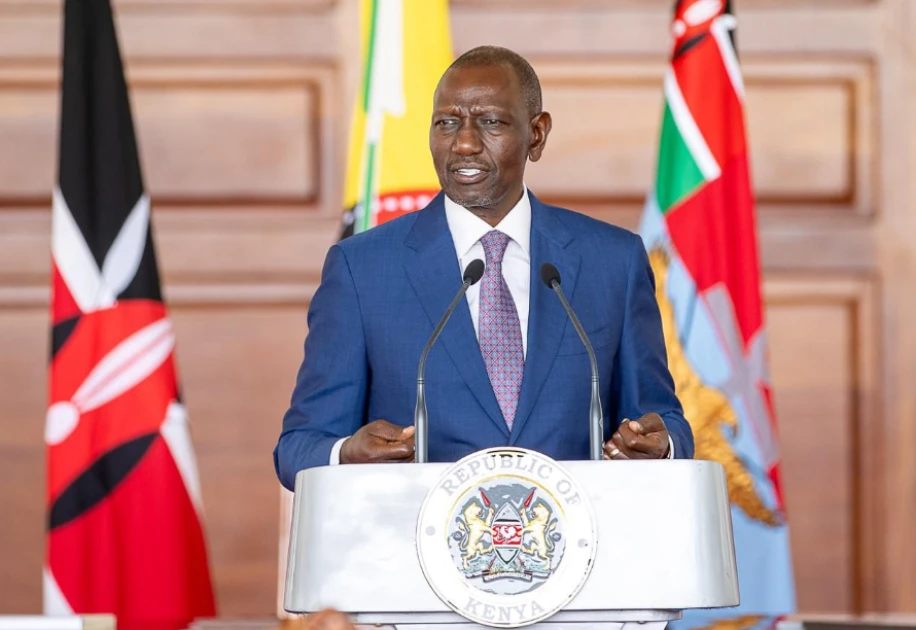
President William Ruto speaks when he awarded charters to KAIST and KEMRI universities at State House Nairobi on May 14, 2026. PHOTO | PCS

Audio By Vocalize
President William Ruto now says the government has spent more than Ksh.28 billion in fuel stabilisation measures and tax relief interventions in an effort to cushion Kenyans from the effects of the ongoing global fuel crisis.
In a national address delivered from State House, Mombasa, on
Friday following talks with transport sector stakeholders, the President
defended his administration’s handling of soaring fuel prices, insisting that the
crisis was global in nature and beyond Kenya’s control.
Ruto attributed the crisis to disruptions in the Strait of
Hormuz following the escalation of conflict involving Iran in February this
year, saying the shock had triggered steep increases in global fuel prices.
“Within just weeks, global fuel prices rose sharply, with
prices increasing by 54.4 per cent for Super Petrol, 118.5 per cent for Diesel,
and 126.4 per cent for Kerosene,” said the President.
The Head of State noted that because Kenya imports nearly all
its fuel from the Gulf region, the country inevitably felt the impact of the
global supply shock.
Ruto however maintained that the government had moved
aggressively to shield consumers from the full impact of the crisis through a
series of interventions.
“The government of Kenya has not stood by. We have undertaken
several consequential interventions,” he said.
According to the President, the government used the Petroleum
Development Fund to stabilize prices during the April-May and May-June 2026
pricing cycles, spending Ksh.13.74 billion directly on fuel subsidies.
He further revealed that the government, in collaboration with
Parliament, reduced Value Added Tax (VAT) on petroleum products from 16 per
cent to 8 per cent, sacrificing Ksh.14.43 billion in tax revenue to ease
pressure on households and businesses.
“In the April-May 2026 pricing cycle, the government utilised
Ksh.6.04 billion in fuel stabilisation and also forewent Ksh.6.41 billion in
VAT revenue,” Ruto stated.
The President said the interventions led to reductions of
Ksh.19.67 per litre for Super Petrol, Ksh.40.25 per litre for Diesel and
Ksh.115.03 per litre for Kerosene during the April-May cycle.
For the current May-June cycle, Ruto said the government spent
another Ksh.15.72 billion on stabilisation measures and VAT relief.
“As a result, Super Petrol prices were reduced by Ksh.15.87
per litre, Diesel by Ksh.44.89 per litre, and Kerosene by Ksh.78.62 per litre,”
he said.
Ruto argued that without the government interventions, pump
prices would have been significantly higher.
“Without government intervention during this cycle, Super
Petrol would today have retailed at Ksh.230.12 per litre instead of Ksh.214.25;
Diesel would have retailed at Ksh.277.75 instead of Ksh.232.86,” he said.
The President disclosed that the total amount committed by the
government across the two pricing cycles now stands at Ksh.28.19 billion.
“These interventions have protected millions of Kenyans from
even more severe economic hardship,” he added.
Ruto also announced a further Ksh.10 reduction in diesel prices beginning the June-July pricing cycle to provide additional relief to
consumers and stabilize transport costs.
The President also defended the government-to-government fuel
importation framework, saying it had guaranteed uninterrupted fuel supply and
helped stabilize the Kenya shilling by easing pressure on foreign exchange
demand.
“Without it, the country’s situation would be far worse
today,” said Ruto.
Join the Discussion
Share your perspective with the Citizen Digital community.
No comments yet
This discussion is waiting for your voice. Be the first to share your thoughts!