
France's desperate pivot to Kenya as its grip on West Africa weakens
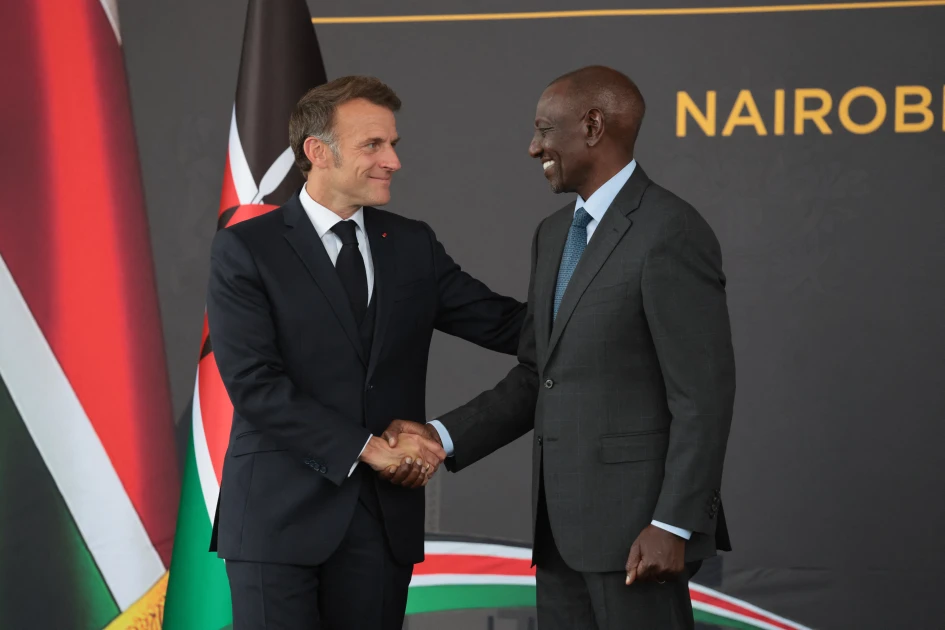
France's President Emmanuel Macron (L) shakes hands with Kenya's President William Ruto (R) ahead of the Africa Forward: Africa- France Partnerships for Innovation and Growth Summit in Nairobi, on May 10, 2026. Photo by LUDOVIC MARIN / AFP

Audio By Vocalize
The mega event, which France and Kenya co-hosted and was attended by over 30 Presidents and Heads of governments across the continent, was a success in whatever metric you use.
French President Emmanuel Macron was the star of the party and was on an obvious charm offensive in Nairobi.
Macron, who has a year left in his presidency, chose Kenya, the first Anglophone country to host the summit, in a move meant to showcase a "renewed partnership" with Africa.
This was an obvious, desperate move by France, whose grip on West Africa has been handicapped as its former colonies rise against its firm, suffocating grip in the region.
Its military has been expelled from the Sahel region and replaced by Russian armies and mercenaries
So France is desperate to look for new ground.
How France’s House of Cards Fell
The story of France's collapse in West and Central Africa is one of hubris meeting history. For six decades after independence, Paris maintained what its architects called “la Françafrique,” an informal but iron-clad sphere of influence that kept former colonies within France's strategic, economic, and military orbit.
The colonies were independent in name. In almost every meaningful sense, they were not.
The reckoning arrived with a cascade of coups and expulsions that no French strategist had war-gamed.
French troops withdrew from Mali, Burkina Faso, and Niger in 2022 and 2023 after military juntas in these countries severed defence agreements with the former colonial power.
The last French troops left Mali and the Central African Republic in 2022 and Burkina Faso in 2023.
France then began withdrawing jets and troops from Chad at the end of 2024 after the country's military leader cut military ties. Senegal made a similar request in November 2024 and ratified it in 2025.
Burkina Faso, Mali, and Niger, led by military juntas, established the Alliance of Sahel States (AES) in September 2023 as an organisation of collective defence.
In March 2025, the AES countries also announced their withdrawal from the Organization Internationale de la Francophonie, the body that promotes the French language and fosters cooperation among French-speaking nations.
Six countries sitting on millions of square kilometres all took off at a tangent. Billions of euros in investment, military infrastructure, and strategic positioning all evaporated in the span of thirty months.
France's withdrawal from the Sahel marked the end of a decade-long military engagement.
The expulsions reflected deep anti-French sentiment fueled by perceptions that France's military presence had failed to improve security while perpetuating neo-colonial economic relationships.
The Architecture of Control over Money, Minerals and Manufactured Dependence
To understand why African populations cheered when French troops departed, one must first understand the machinery that kept them there.
The centrepiece of France's post-colonial domination was, and largely remains, a currency system that is arguably without parallel in the history of post-independence statecraft.
After World War II, the French President Charles de Gaulle began la Françafrique, France's informal sphere of influence in Africa.
France granted independence to most of its West and Central African colonies peacefully in the 1960s, a weird form of independence in which they lacked sovereignty.
In December 1958, the CFA franc became the currency of the Communauté Financière Africaine (African Financial Community).
In 1960, President Charles de Gaulle made CFA membership a precondition for decolonisation in French West and Central Africa. In other words, the price of independence was the surrender of monetary sovereignty.
The mechanics of control were ingenious in their structural cruelty. The CFA franc still functions according to the same principles and purpose established during the colonial period.
It is rigidly pegged to the French currency, the franc and by extension, to the euro.
The French government's direct control over monetary and exchange rate policy was exercised through its representation in the organs of the CFA countries and French central banks, with what became an implicit veto power, and the obligation for the latter to deposit half of their foreign exchange reserves with the French Treasury since the mid-2000s.
Over the years, the implications have been profound. CFA countries cannot devalue their currency when their exports become too expensive on world markets, a standard tool used by China, the United States, and others to manage competitiveness.
Their currency value is locked to the euro, a currency designed for wealthy European economies, not developing African nations. All CFA banknotes and coins are still produced at Chamalières, France, by the Bank of France.
When Paris wanted to reset the terms, it simply did so. In 1994, France devalued the CFA franc, raising the parity rate from 50 CFA francs per French franc to 100, a halving of value overnight.
CFA member governments imposed wage freezes and layoffs in the wake of the devaluation, leading to widespread unrest.
Senegalese President Abdou Diouf had promised citizens during his 1993 campaign that the franc would not be devalued. When it was, he had no recourse. Paris had decided.
The mineral extraction regime was equally lopsided. In Niger, the jewel of France's uranium empire, the arrangement was a masterclass in extractive colonialism dressed in the language of cooperation.
After Niger was granted independence from France in 1960, contracts were created granting France exclusive rights to mining and mineral exploitation.
Since mining began at the Air Mountains, over 100,000 tonnes of uranium have been mined, with France importing up to 50 per cent of its uranium supply from Niger.
Niger provides one in three French households with electricity, yet 90 per cent of Niger itself is without electricity. The country that powered France lived in the dark.
Over decades, the French company Orano earned tens of millions of euros by negotiating tax reductions in Niger. In 2014, the president at the time, Mahamadou Issoufou, signed a new agreement to lower taxes on mining activities and was indirectly offered a presidential jet by the company in return.
Any leader who wished to part from this unequal trade partnership with the former colonial power found themselves deposed.
This was the French neo-colonial system in its fullest expression. A currency that kept monetary policy in Paris, military bases that kept compliant governments in power, and resource contracts that kept African wealth flowing north, all held together by a web of corrupt elite relationships that France maintained and defended as "cooperation."
The Language of Condescension
If the structural architecture of Françafrique was the body of French neo-colonialism, its spirit was paternalism, expressed most vividly in how French leaders spoke about and to Africans.
In January 2025, when French troops were being expelled from country after country, Macron told French ambassadors in Paris that Sahel nations had only remained sovereign because of the deployment of French forces.
"I think someone forgot to say thank you. It does not matter, it will come with time," Macron said. "Ingratitude, I am well placed to know, is a disease not transmissible to man."
Chad's acting foreign minister described the remarks as showing "a contemptuous attitude towards Africa and Africans," adding that French leaders "had to learn to respect Africans."
He noted the key role played by African and Chadian soldiers in the liberation of France during World Wars I and II, which "France has never truly recognised."
Senegal's Prime Minister Ousmane Sonko lashed back directly: "France has neither the capacity nor the legitimacy to ensure Africa's security and sovereignty."
He reminded Macron that African soldiers, "often forcibly mobilised, mistreated and ultimately betrayed," had deployed during World War II to defend France.
"If they had not," Sonko suggested, "France would perhaps still be German today."
French leaders’ paternalistic attitude towards Africans
The pattern is not new and is not limited to Macron. France and its leaders have consistently adopted a subtly paternalistic attitude tinged with scorn and condescension in matters of African diplomacy.
Macron himself had publicly suggested to African leaders: "Build a solid army, establish security around the state, impose transitional justice so that you don't have war criminals still in charge or on the ground" — sounding, critics observed, more like a teacher speaking to an incompetent pupil than a national leader engaging a peer.
The habit proved impossible to break, even on African soil. At the Africa Forward Summit in Nairobi on Monday, Macron interrupted a youth-focused session and called the disruption "a total lack of respect."
A former Zimbabwean MP, Fadzayi Mahere, challenged him directly on X: "Respectfully, I don't believe that it's courteous or appropriate for you to come onto our Continent and talk down at people like this.
They are not your kids. Don't be condescending. Imagine if a guest of the state did the same in your country? Would it fly?"
The Pivot East with Kenya as the New Frontier
Rejected in West Africa, France has pivoted pretty fast to the east, with Kenya as its focus. Enter the Africa Forward Summit.
The summit was widely seen as a bid by Paris to repair economic and security ties and counter rising anti-French sentiment across parts of Africa.
The intention was obvious, given Kenya's strategic location along the Indian Ocean. French calculations are informed equally by growing concerns about global supply chains and maritime security. The shift is driven as much by economic motivations as by defence and security.
By the year 2026, at least 140 French companies were operating in Kenya, up from 40 in 2013. France is the fifth-largest provider of foreign direct investment in Kenya, supporting about 46,000 direct jobs. France and Kenya also signed a defence cooperation agreement in April 2026.
The transactional kinship between Macron and Ruto seems to smooth out the Kenyan courtship. The two leaders may share the same diplomatic goals, focusing on climate change funding and security, as well as a preference for neoliberal privatisation.
Ruto's election campaign in 2022 touted a "hustler nation," a focus on enabling small businesses. Macron has acted as a businessman-diplomat abroad, pushing small businesses as a solution for underdevelopment.
Macron has demonstrated the relationship's importance with pointed diplomatic gestures; he has invited Ruto to the G7 summit in France in June, while excluding South African President Cyril Ramaphosa.
In France's transactional diplomatic calculus, Nairobi has displaced Pretoria as the preferred African interlocutor.
Does France Stand a Chance? The Kenyan Calculus
The question of whether France can genuinely reset its Africa relationship or whether it is simply attempting to transplant its old model onto new, Anglophone soil is the defining question of this summit.
This is even as Macron chimed, “I do believe in the future of Africa and that of your country, William. I am the leader of a country that wants to be part of that future and wants to invest here. This balanced, generous and equal partnership is precisely how we will build and shape our common future.”
The summit is likely to intensify debate over sovereignty, accountability, and whether the relationship is truly balanced.
Since 2024, Kenya has faced deadly waves of political unrest, with citizens protesting against President Ruto's unpopular policies (tax), including crackdowns on demonstrations and restrictions on press freedom.
If Kenya were to allow French forces permanent residence in the country, this could further inflame tensions, as the government braces for potential protests ahead of the country's budget season.
Kenya’s diplomatic position and its chosen path
Kenya's own position, however, is more ambivalent than the critics suggest. President Ruto has been deliberate in framing this as an assertion of Kenyan agency, not a submission to French patronage.
Ruto declared that Kenya is "neither facing West nor East" — "we are facing forward, across the globe, provided that what we do is in the best interest of Kenyans."
For many African governments, Kenya holds structural advantages that its West African counterparts never had. It has no CFA franc to trap it in the French monetary orbit.
It has no history of French military basing that has made "partnership" indistinguishable from occupation. Its negotiating position is, at least in theory, cleaner.
The test will be whether the terms of the investment and security arrangements being signed this week reflect that difference or whether the same old architecture is rebuilt under new flags.
A Continent Watching
Beyond Nairobi, the Africa Forward Summit is being watched closely for what it signals about the broader reordering of power on the continent.
Kenya hopes its relationship with France will elevate its influence across Africa, allowing it to rival the diplomatic weight of South Africa, which hosted the G20 summit in November 2025.
By transcending the classic divide between French and British Africa, Nairobi can present itself as a continental leader and as a diplomatic city.
That calculation may prove correct. But it carries its own risks, mainly the possibility that in seeking to be a bridge between the old France and a new Africa, Kenya becomes the next stage for a relationship that has always, in the end, served one party more than the other.
History may not repeat itself identically in East Africa, but a continent that has lived through Françafrique knows its rhythms well enough to recognise the music even when it changes instruments.
France is betting that Nairobi is a fresh start. A young Africa, or at least a significant part of it, suspects it is simply the next chapter of the same old story.
Join the Discussion
Share your perspective with the Citizen Digital community.
No comments yet
This discussion is waiting for your voice. Be the first to share your thoughts!