
CS Kagwe defends Tea Levy, affirms it will protect farmers
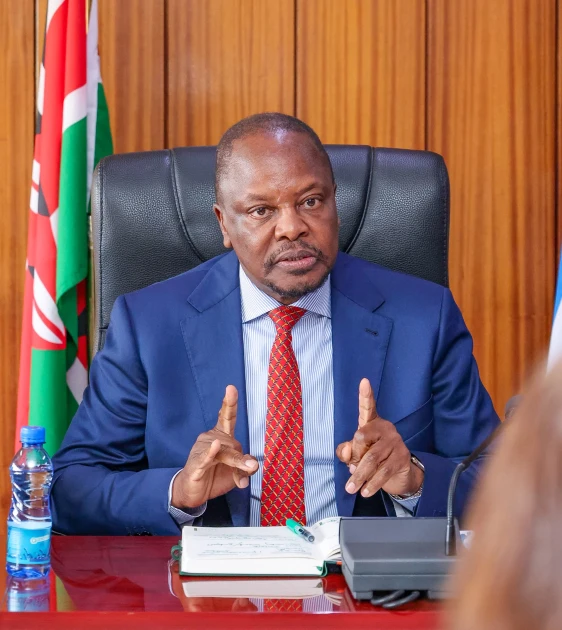
Agriculture Cabinet Secretary Mutahi Kagwe speaking to the National Assembly Departmental Committee on Agriculture and Livestock on May 13, 2026.

Audio By Vocalize
Appearing before the National Assembly Departmental Committee on Agriculture and Livestock, CS Kagwe asserted that the levy was designed to create sustainable funding for marketing and modernizing Kenya’s tea industry, dismissing fears that it would hurt farmers.
He also argued that resistance from international buyers was proof that Kenya was finally moving to protect the identity and value of its tea in the global market.
“Parliament passed this levy for a reason. Kenyan tea is globally known, but in many markets, there are no geographical indicators to show it is Kenyan tea. Some countries are selling Kenyan tea as their own. That is exactly why they are opposing this levy,” CS Kagwe said.
The CS dismissed calls to scrap the levy despite complaints raised by some international buyers and some stakeholders within the tea sector.
Kagwe was questioned on complaints from Pakistan-based buyers regarding the levy, but he maintained that backing down would amount to surrendering Kenya’s strategic interests.
“Going back would be a huge mistake. All countries that trade seriously in tea charge levies to develop their markets. Tea is a business, not a biblical Samaritan activity. It must be supported by funds,” CS Kagwe said firmly.
He added that Kenya’s levy remains lower than those charged by competing tea-exporting countries and emphasized that the government would continue engaging stakeholders to improve implementation systems after complaints that payment mechanisms were inefficient.
The CS further insisted that Kenya must aggressively push for direct tea sales and geographical indicators in export markets so that Kenyan tea is recognized and sold as a premium Kenyan product rather than blended and rebranded elsewhere.
“All reforms must protect the determination and identity of Kenyan tea,” CS Kagwe said.
The committee session also focused on the Ministry’s broader Ksh.79.06 billion budget estimates for the 2026/27 financial year, representing about 2.7 percent of the national budget.
He outlined the Ministry’s priorities under the Bottom-Up Economic Transformation Agenda (BETA), including fertilizer subsidy expansion, irrigation, commercialization of agriculture, climate-smart farming and livestock transformation.
Kagwe added that agriculture remains central to Kenya’s economy, contributing 22.5 percent to GDP and employing more than 40 percent of the country’s labour force.
The CS highlighted the government’s value-chain approach targeting food security, import substitution and export growth. Priority export crops include tea, coffee, avocado, mangoes, vegetables, pyrethrum and nuts.
He also defended the government’s controlled rice importation policy, saying imports remain necessary to safeguard consumers against shortages even as local production expansion remains a key ministry priority.
Meanwhile, the Ministry proposed a major budget realignment to move livestock-related resources currently domiciled under the State Department for Agriculture to the State Department for Livestock Development, arguing that livestock mandates should be fully managed under one institution.
The session underscored the government’s push to aggressively reform Kenya’s agriculture sector through commercialization, accountability and value addition — with tea reforms emerging as one of the administration’s most fiercely defended economic strategies.
Join the Discussion
Share your perspective with the Citizen Digital community.
No comments yet
This discussion is waiting for your voice. Be the first to share your thoughts!