
Court declines to withdraw petition challenging Kenya-US health deal
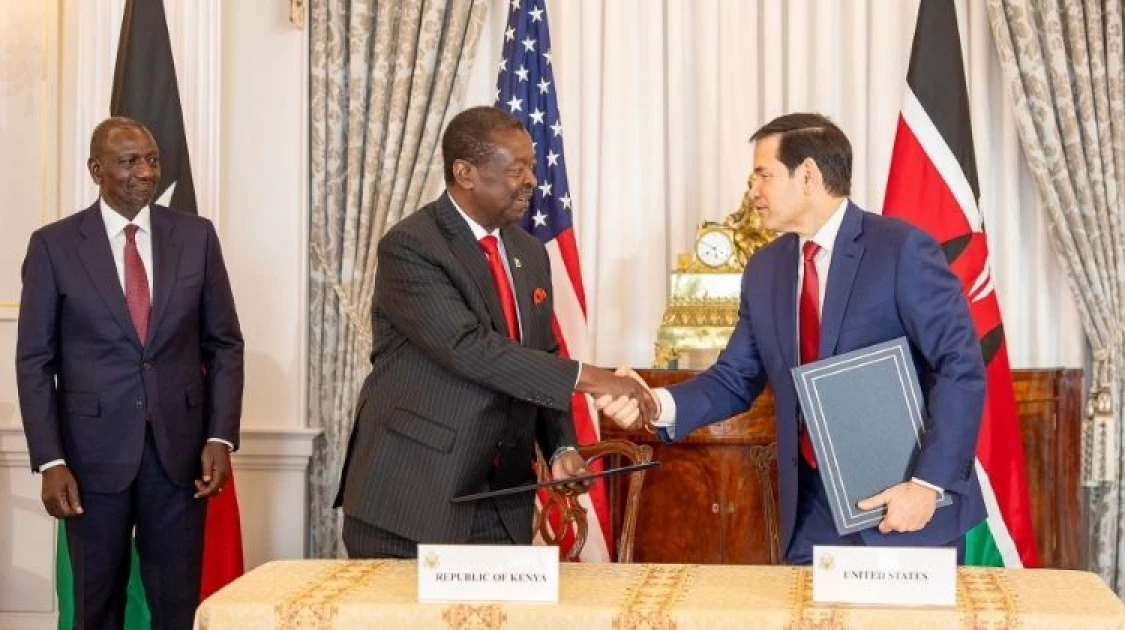
President William Ruto (left) witnesses the signing of Kenya-USA health deal signed by Prime CS Musalia Mudavadi and US Secretary of State Marco Rubio on December 4, 2025. Photo/PCS

Audio By Vocalize
The application to have the case withdrawn had been filed by the Consumer Federation of Kenya (COFEK).
Justice Patricia Nyaundi upheld an objection raised by Katiba Institute against COFEK’s application to withdraw Constitutional Petition No. E809 of 2025.
The petition questions the constitutionality of the health data-sharing deal between the Kenyan government and the United States, with concerns raised over privacy rights, data protection, and public participation.
COFEK had informed the court that it had entered into a consent agreement with the government and sought to withdraw the matter.
However, Katiba Institute, through its lawyer Joshua Malidzo, opposed the move, arguing that constitutional violations cannot be settled through consent if the alleged breaches still exist.
Malidzo told the court that constitutional petitions filed in the public interest are not the exclusive property of the original petitioner and may be pursued by any member of the public where issues of constitutional accountability arise.
He further submitted that there can be no private compromise over alleged constitutional violations affecting the public, insisting that the court retains the ultimate duty to safeguard the Constitution.
In her ruling, Justice Nyaundi agreed, holding that courts must retain control over constitutional petitions filed in the public interest and that a notice of withdrawal may be declined where sufficient constitutional questions remain for determination.
The judge noted that Okiya Omtatah had already expressed willingness to continue prosecuting the matter alongside his own Petition No. E816 of 2025, making it necessary for the court to allow the case to proceed to conclusion.
The consolidated petitions are now scheduled for hearing on May 25, 2026, before Justice Nyaundi.
The Kenya–United States Health Cooperation Framework, signed in Washington in December 2025, drew mixed reactions across the country.
At the centre of the debate was a major shift by the US government to channel more than Ksh.200 billion in health funding directly through Kenyan government systems for a period of five years.
The new Government-to-Government (G2G) model replaced the long-standing donor-driven structure that relied heavily on NGOs and external implementing partners.
Under the agreement, US contributions will depend on Kenya increasing both national and county health budgets annually.
Kenya is expected to allocate Ksh.10 billion in FY 2026/27, Ksh.20 billion in 2027/28, Ksh.35 billion in 2028/29, and Ksh.50 billion in 2029/30. By 2031, the government will also take over health commodities and human-resource costs currently funded by the US, estimated at USD 141 million.
President William Ruto even assured the country that the deal will not take advantage of Kenyans or short-change the country, arguing that it is anchored on solid legal ground and guided by the principle of security and the interests of the people of Kenya.
“Nobody and no government will take advantage of the people of Kenya or the government of Kenya as long as I am President," he said.
Join the Discussion
Share your perspective with the Citizen Digital community.
No comments yet
This discussion is waiting for your voice. Be the first to share your thoughts!