

Kenyan start-up aiming to generate carbon credits from thin air
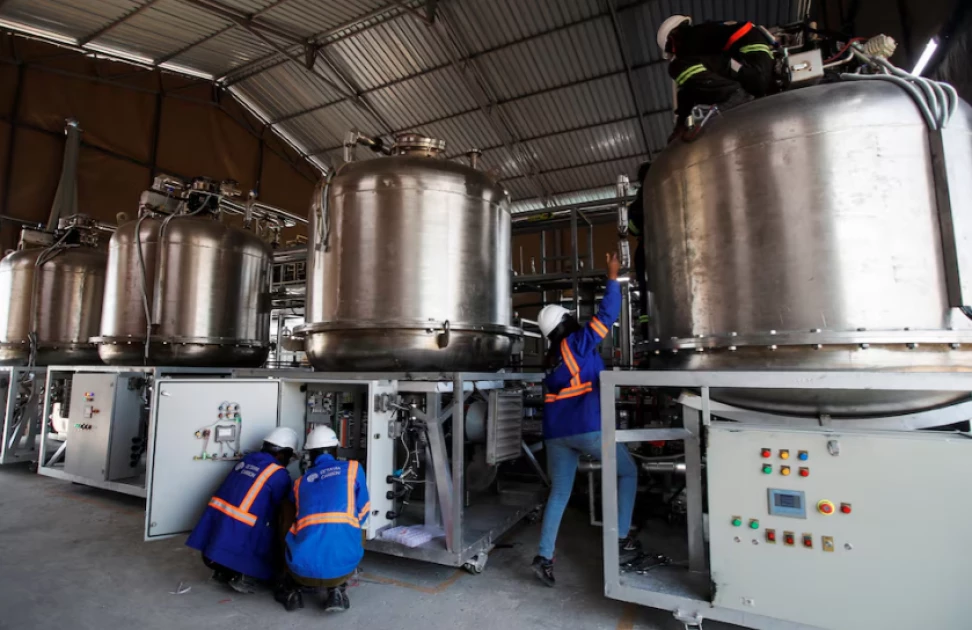
Workers regulate Direct Air Carbon capture machines used to filter carbon dioxide at Octavia Carbon, a Direct Air Carbon Capture (DAC) company that captures CO2 using a chemical process and stores it underground, in Kikopey area of Naivasha in Nakuru County, Kenya February 27, 2025. REUTERS/Monicah Mwangi

Audio By Vocalize
In the scrublands of central Kenya, technicians monitor four
large metallic tanks where steam heated by the Earth's crust is used to pull
carbon dioxide from the air in an effort to limit global warming.
Sitting astride the Great Rift Valley, a tectonic scar running around 7,000 kilometres (4,300 miles) down Eastern Africa, Kenya generates almost half its energy from geothermal plants, which spew out an abundance of excess heat and cheap energy.
That makes it well-positioned to pioneer the use of Direct
Air Carbon Capture, said Hannah Wanjau, an engineer at Octavia Carbon, which
designed and built the machines.
DACC is an energy-intensive process that sucks air across a
chemical filter, which, when saturated with the greenhouse gas, is heated in a
vacuum to release the CO2, which can be bottled or stored underground.
East Africa's most developed economy also benefits from a
surfeit of scientists and engineers thanks to the government's focus on and
investment in universal education.
Octavia harnesses Kenya's excess geothermal steam to operate
its machinery in a cost-effective manner, while basalt rock formations are
conducive to storing the carbon dioxide safely for long periods, said Wanjau.
"We've already seen the effects of climate change, so
we want something that's going to work very fast and remove huge amounts of
CO2," she said.
Each of Octavia's prototype machines captures about 10 tons
of CO2 per year, akin to around 1,000 trees, which it can trade as carbon
credits sought by businesses and governments to offset their harmful emissions.
Around seven to nine billion tons of CO2 will need to be
removed from the atmosphere every year by the middle of this century if the
world is to prevent global temperatures exceeding a 1.5 degrees Celsius (2.7
degrees Fahrenheit) rise above pre-industrial levels, according to a report
co-authored by researchers at the University of Oxford.
Action to date has fallen far short of the deep emissions
cuts that would achieve the goal set out by world leaders at the 2015 Paris
climate accord. Last year was the first to breach 1.5 °C of warming.
"Critics would be right to point out that what we
currently do is a drop in the ocean," said Octavia Carbon's co-founder, Martin Freimüller, who plans to commission a 1,000-ton per year plant by next
year.
"But the point is that scaling from 1,000 tons (of
carbon dioxide) to a billion tons, still starts with 1,000 tons."
Greenpeace and other environmental campaign groups say the
carbon capture industry is used by oil and gas companies as a form of
"greenwashing" to justify slowing the transition from fossil fuels to
clean energy solutions.
However, the United Nations Intergovernmental Panel on
Climate Change says that while reducing the use of fossil fuels remains a top
priority, carbon capture will be necessary to reduce residual emissions from
sectors that are hard to decarbonise, like cement and steel production.
Octavia has struck a deal with Cella Mineral Storage, a New
York-registered start-up, which means Kenya could become the second country in
the world, after Iceland, to inject air-captured CO2 below ground early next
year.
Octavia has already contracted some $3 million of carbon
credits, roughly half of which has been prepaid, for around 40% of the lifetime
capacity of the planned DACC plant, Freimüller said.
"The world often thinks about Africa still as a hapless
victim of climate change," he said, referring to the increasing intensity
of the floods and droughts affecting the continent.
Octavia Carbon wants to show the world that Africa can also
help fix the problem, he said.
"Technology made in Kenya and developed in Kenya, for
the use of the world."
Leave a Comment