
OPINION: Enact and Enforce the Persons Living with Disabilities Act, 2025
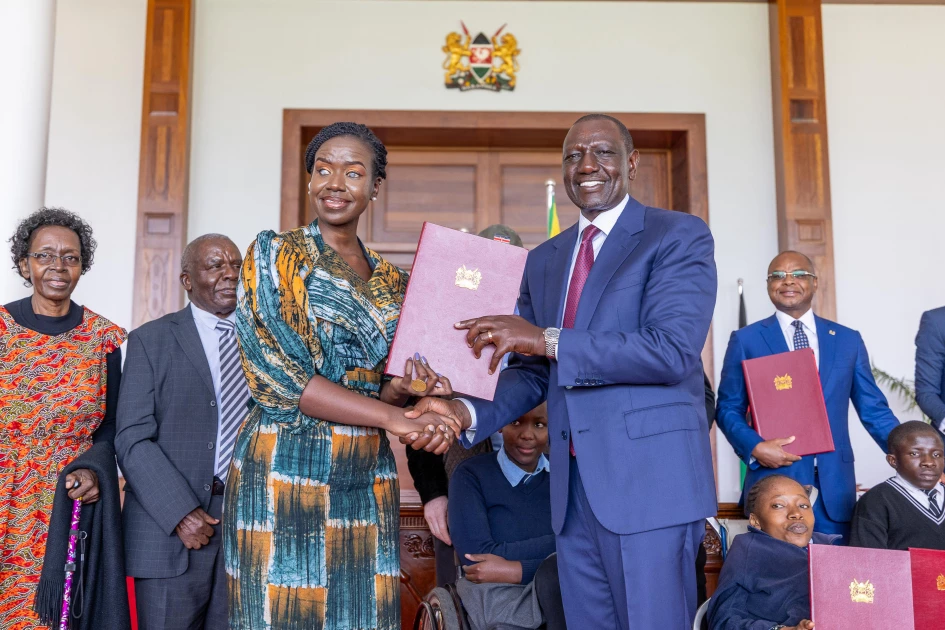
President William Ruto with Nominated Senator Crystal Asige after he assented to the Persons with Disabilities Bill on 08/05/2025

Audio By Vocalize

The Constitution of Kenya, 2010, acknowledges the rights of persons living with disabilities (PLWDs), mandating inclusive policies in education, health and governance. Article 54 (1)(e) and (2) of the supreme law provide the legal foundation for these rights.
It is the responsibility of the state to progressively implement this principle by enacting and enforcing appropriate laws, policies and regulations.
Since independence, Kenya has made legislative strides, including the enactment of the Persons with Disabilities Act, 2003 and the constitutional provisions under Article 54. However, enforcement remains a persistent challenge.
In 2022, the Parliamentary Committee on National Cohesion and Equal Opportunity, through its audit inquiry report, revealed that compliance with Article 54(2) regarding the representation of PLWDs in public institutions was significantly below expectations.
The committee recommended that public institutions revise their internal human resource policies to meet a minimum threshold of 5% job opportunities for PLWDs.
It also urged the National Council for Persons with Disabilities (NCPWD) to: Initiate amendments to the Persons with Disabilities Act, 2003, to align with the 2010 Constitution; Undertake comprehensive registration of PLWDs in its database; Promote PLWD participation in decision-making processes and Challenge cultural stereotypes through public awareness campaigns and education programs.
Additionally, public institutions were advised to formulate and implement disability mainstreaming policies across all areas of the workplace.
The recent assenting of the Persons Living with Disabilities Act, 2025 by H.E. President Dr. William Samoei Ruto should mark a transformational shift in addressing the long-standing marginalisation of PLWDs in Kenya.
However, government efforts must go beyond symbolism. Policy gaps and weak enforcement mechanisms remain major obstacles to the actualisation of disability rights.
Historically, across regimes, the absence of clear guidelines and regulations, sometimes due to socio-economic or political interests, has hindered the implementation of progressive laws.
The resulting stagnation undermines the very intent of constitutional provisions and parliamentary acts aimed at promoting effective governance. The long-overdue PLWDs Act, 2025, must avoid falling into the same trap.
Kenya can draw lessons from countries like South Africa, the USA, Canada, Sweden and Japan, which have successfully institutionalised frameworks for protecting PLWDs.
These nations have emphasised strong enforcement, intersectional inclusivity and digital accessibility, critical pillars for meaningful inclusion in a modern society.
The PLWDs Act, 2025 primarily seeks to address the historical and structural exclusion of persons with disabilities, many of whom have faced legal invisibility, institutional neglect and cultural stigma for decades.
Though often stated but rarely internalised: disability is not inability. No one chooses to become disabled, and causes range from natural (genetic or medical) to superficial (accidents, conflict or neglect).
Tragically, disability in Kenya is still associated with stigma, curses or bad omens. Many children with disabilities remain hidden at home, denied fundamental rights such as education and healthcare.
The enforcement of this new law has the potential to eliminate systemic barriers in education, economics, politics and civic participation.
This law champions inclusivity by ensuring that PLWDs have representation in public decision-making. It promotes equality through mandated quotas, reflecting the Constitution's spirit of equal opportunity for all. It also fosters affirmative action to ensure that the unique needs of PLWDs are prioritised in public policy.
As we commend the President's commitment to PLWD inclusion, sustainable progress will require more than legislation.
It will depend on: A cultural shift in societal attitudes, Adequate funding, Strong political goodwill and Empowerment of PLWDs at the grassroots level.
The pivotal role played by the National Gender and Equality Commission (NGEC) in championing disability reforms is commendable.
Independent commissions like NGEC must be supported through adequate resources and shielded from undue political interference.
Civil society and advocacy groups must also remain vigilant in promoting disability rights and public awareness.
Dennis Wendo - Integrated Development Network – Public Benefits Organisation (PBO)
Email: idn.kenya@gmail.com / info@idnkenya.org
Join the Discussion
Share your perspective with the Citizen Digital community.
No comments yet
This discussion is waiting for your voice. Be the first to share your thoughts!