
Young frogs may camouflage selves as animal poo: study
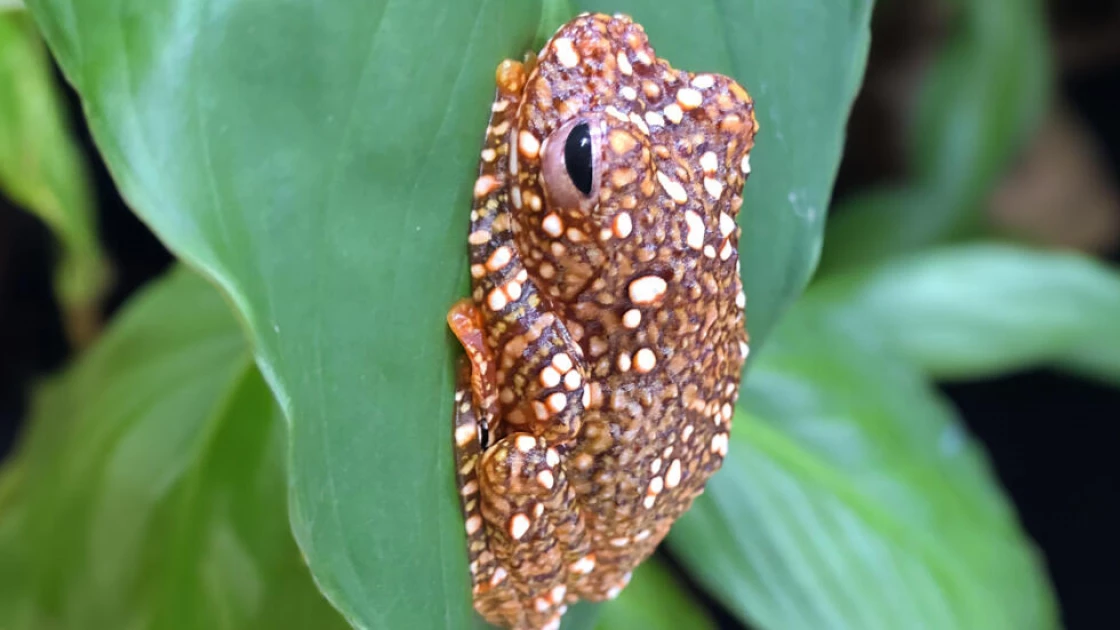
Researchers found juvenile Wallace's flying frogs likely camouflage as droppings © Samantha CLOER / Tiergarten Schönbrunn/AFP

Audio By Vocalize
A team of researchers studying juvenile Wallace's flying frogs -- which are bright red with small white dots -- made the findings thanks to an experiment at Vienna's Schoenbrunn Zoo, the zoo said on Thursday.
"The young frogs probably count on the fact that they will be seen but considered something inedible," University of Vienna researcher Susanne Stueckler said.
She and several others recently published their findings in the journal Behavioral Ecology and Sociobiology.
To test their hypothesis that the frogs were trying to escape predators, the researchers created differently coloured wax frog models and placed them in the zoo's rainforest house.
The house "contains a diverse community of avian predators that are well known to use colour vision to detect frogs as prey", the study notes.
It found that the attack rate was significantly greater for red than for green but was reduced by half when red models had white spots.
"We show that the unusual colour pattern of juveniles likely functions as a masquerade of animal droppings," the researchers said.
"(It may) function as anti-predator strategy... so that predators misidentified them as inedible objects," they added.
"To our knowledge, this is the first experimental exploration of a vertebrate masquerading as animal droppings."
The frogs' spots disappear after one year, "when individuals mature into adults and develop their iconic emerald green colour".
Wallace's flying frogs can glide 16 metres (52 feet) from tree to tree thanks to skins between their toes and appendages on their arms and legs.
Join the Discussion
Share your perspective with the Citizen Digital community.
No comments yet
This discussion is waiting for your voice. Be the first to share your thoughts!