
Worst DR Congo Ebola epidemic ever passes 7,000 cases
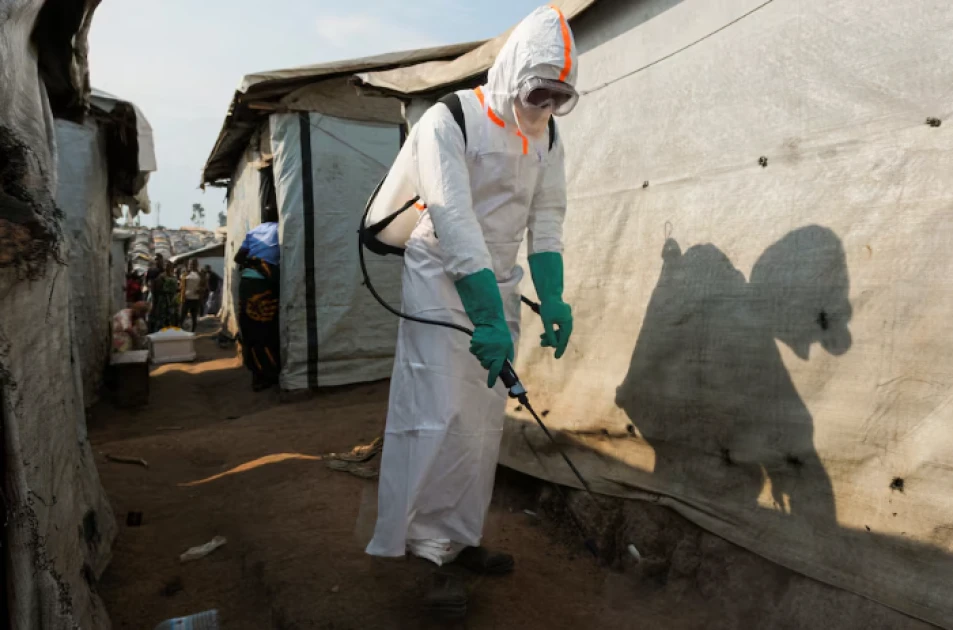
A health worker in full personal protective equipment (PPE) disinfects an area while preparing for the burial of suspected Ebola victims at the Kigonze displaced persons camp in Bunia, eastern Democratic Republic of Congo, on June 18, 2026, one month after the outbreak was declared. REUTERS

Audio By Vocalize
More than 7,000 Ebola cases have been recorded in the
Democratic Republic of Congo's worst outbreak of the deadly disease ever,
according to figures from the Congolese authorities.
Thought to have been spreading under the radar for weeks,
the DRC officially detected the latest outbreak in mid-May, with nearly 3,400
people killed in its 17th epidemic of the highly infectious virus.
It began in the northeastern Ituri province before spreading
to conflict-plagued, remote eastern and northern regions where armed groups
have roamed for decades, the presence of the state is weak and health
infrastructure is largely lacking.
Earlier this week the disease was confirmed to have spread
to a seventh province, South-Ubangi, which borders the Central African Republic
and Congo-Brazzaville.
According to the latest figures from the Congolese
authorities, 7,022 cases have been recorded since the beginning of the
epidemic, of whom 3,398 have died and 1,671 people have recovered.
Most of the recorded cases are in Ituri, where Ebola has
been detected in schools in the days after the post-summer holiday return to
classes, causing alarm among parents and health workers.
"We are very worried because we don't know which child
comes from which family or what the health status of the members of that family
is," Angele Magani, mother of a schoolboy in Bunia, Ituri's provincial
capital, told AFP.
"We are so scared, even though the school authorities
reassure us about the health measures that have been put in place," she
added.
Bunia school official Roger Mungimbo told AFP that
"there is a mandatory hand-washing system with soap, and we have also done
everything possible to have a maximum of 30 pupils per classroom."
"We regularly make the children aware that they must
not touch each other, must not greet each other and must wash their hands
regularly," he added.
Ebola, which has killed more than 15,000 people in Africa
over the last 50 years, is transmitted through contact with bodily fluids and
can cause severe internal and external bleeding and organ failure.
The current epidemic is caused by the Bundibugyo strain, for
which there is currently no approved vaccine or treatment. Several treatments
and vaccines are being tested.
Join the Discussion
Share your perspective with the Citizen Digital community.
No comments yet
This discussion is waiting for your voice. Be the first to share your thoughts!