
WildlifeDirect and KWS host watch party to empower future conservationists
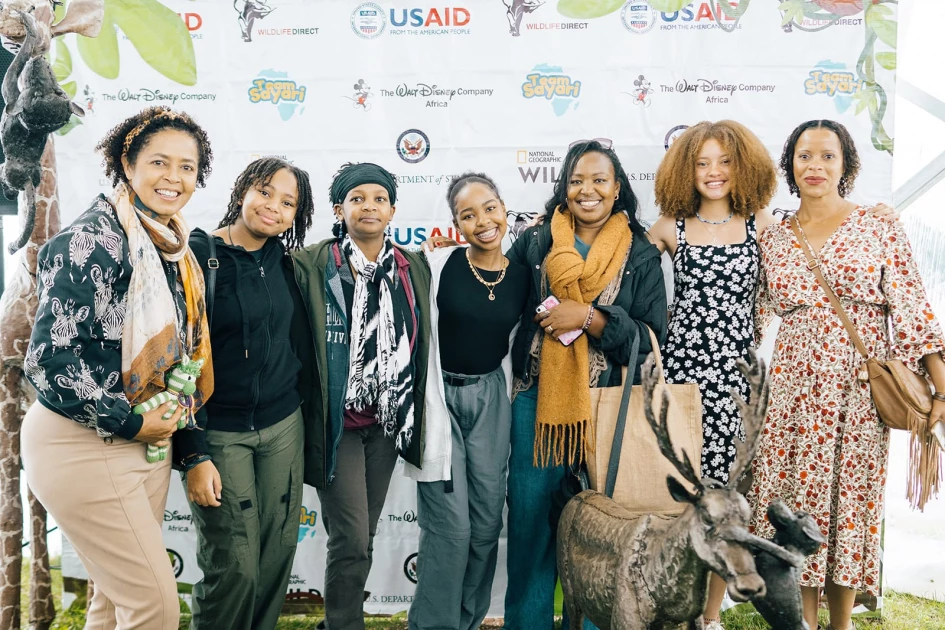
On the left is Paula Kahumbu, CEO of WildlifeDirect, with Team Sayari presenters and their parents during Team Sayari's Watch Party at Nairobi National Park. PHOTO| COURTESY

Audio By Vocalize
In Kenya, the International Children in Conservation Outreach, supported by Kenya Wildlife Service (KWS) in collaboration with private stakeholders, has shifted focus to planning for tomorrow, today. This initiative aims to empower young conservationists across East Africa using film.
While celebrating two years of groundbreaking work on the 'Team Sayari and Nature Positive Kids Outreach Program,' WildlifeDirect, in partnership with KWS, hosted a Team Sayari Watch Party in Nairobi, Kenya. This event featured a screening of the captivating “Wild in the City” episode filmed in the heart of Nairobi National Park.
The project aims to inspire and catalyze behavioural change in children, intending to have a lasting impact on the conservation of species-rich landscapes and generate meaningful economic development opportunities for communities in East Africa.
"We are immensely proud of the achievements of Team Sayari and the positive impact it has had on young people across East Africa," said Paula Kahumbu, CEO of WildlifeDirect. "This watch party is a celebration of empowerment and dedication to protecting our planet."
Among those gracing the watch party were conservation educators and conservation leaders who have been instrumental in the program's success.
Various development, implementation, and production partners have collaborated to create a twenty-part television series aimed at inspiring children aged 7 to 12 to become conservation leaders through educational content.
According to WildlifeDirect, the series, featuring 14 child presenters from across Africa, has so far reached over 12,000 children in 200 schools and 4 conservation hubs in Kenya, Rwanda, and Tanzania.
The program has inspired children to participate in conservation activities such as tree planting, plastic recycling, and waste management.
“We have noticed a behavioural change in learners. Learners have become responsible. Among them, we have been able to identify leaders,” said Mwanaidi Mwasina, school patron at Kwale School for the Mentally Challenged.
Additionally, 232 teachers across East Africa have received conservation education training and supplemental materials, including Fact Sheets, a Teacher’s Guide, and access to the National Geographic Society Resource (NGS) database, to enhance learning and increase teachers' environmental awareness. Furthermore, 79 schools have been awarded grants of USD 500 each to carry out various conservation projects, aiming to instill conservation practices among children.
Join the Discussion
Share your perspective with the Citizen Digital community.
No comments yet
This discussion is waiting for your voice. Be the first to share your thoughts!