
WHO chief in DR Congo for talks on Ebola reponse
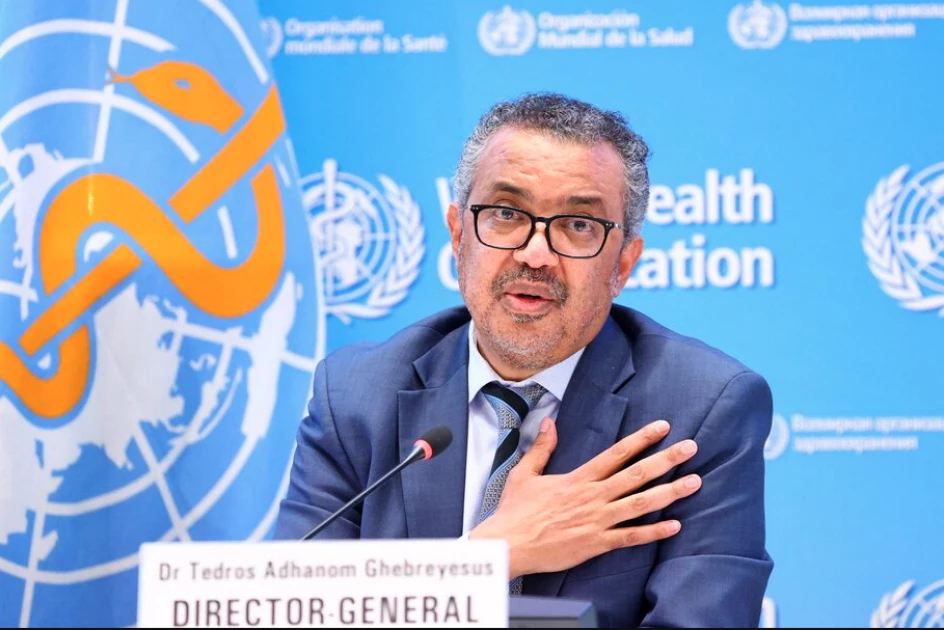
Tedros Adhanom Ghebreyesus, Director-General of the World Health Organization (WHO), speaks during a news conference in Geneva, Switzerland, December 20, 2021. REUTERS/Denis Balibouse

Audio By Vocalize
DR Congo declared its 17th Ebola outbreak on May 15 and at the weekend the WHO warned that it was spreading at an "exceptional" pace, urging a scaling-up of the health response.
There have been 3,874 confirmed cases and 1,751 deaths since the start of the outbreak, the world health body said.
The deadliest outbreak was between 2018 and 2020, with nearly 2,300 deaths out of 3,500 recorded cases.
WHO director general Tedros Adhanom Ghebreyesus arrived in the DRC capital, Kinshasa, on Tuesday, and was due to meet Tshisekedi on Wednesday, a spokesman told AFP, without giving further details.
Tedros was previously in the country at the end of May in the northeastern province of Ituri, where nearly 90 percent of Ebola cases have been identified.
The current outbreak has been caused by the Bundibugyo variant of the virus, for which there is currently no vaccine or treatment.
The five provinces in eastern DRC affected have a weak state presence and healthcare infrastructure is largely lacking.
"The outbreak is unfortunately still expanding beyond the capacity of the response," WHO spokesman Tarik Jasarevic told reporters in Geneva on Saturday.
"We need more support in terms of finances, but also other resources to scale up all areas of response: treatment capacity, field investigation teams, safe burial teams and community workers."
Ebola is spread by contact with bodily fluids and causes a haemorrhagic fever. It has killed more than 15,000 people in Africa in the last 50 years.
On Tuesday, Canada gave the go-ahead to US pharmaceutical giant Moderna to begin clinical trials of a vaccine against the Bundibugyo strain of Ebola.
The vaccine, said by the WHO as "the most promising" -- the rVSV Bundibugyo -- will also be developed by Singapore-based Hilleman Laboratories.
At the end of July, a volunteer received the first dose of another vaccine against Bundibugyo, developed by Britain's Oxford University using the same technology as the AstraZeneca Covid-19 vaccine.
Several initiatives also aim to rapidly test treatments against the Bundibugyo strain, including the antiviral drugs remdesivir and obeldesivir, as well as a monoclonal antibody called MBP134.
Join the Discussion
Share your perspective with the Citizen Digital community.
No comments yet
This discussion is waiting for your voice. Be the first to share your thoughts!