
When immigration status becomes a weapon; A Congolese national’s search for elusive justice
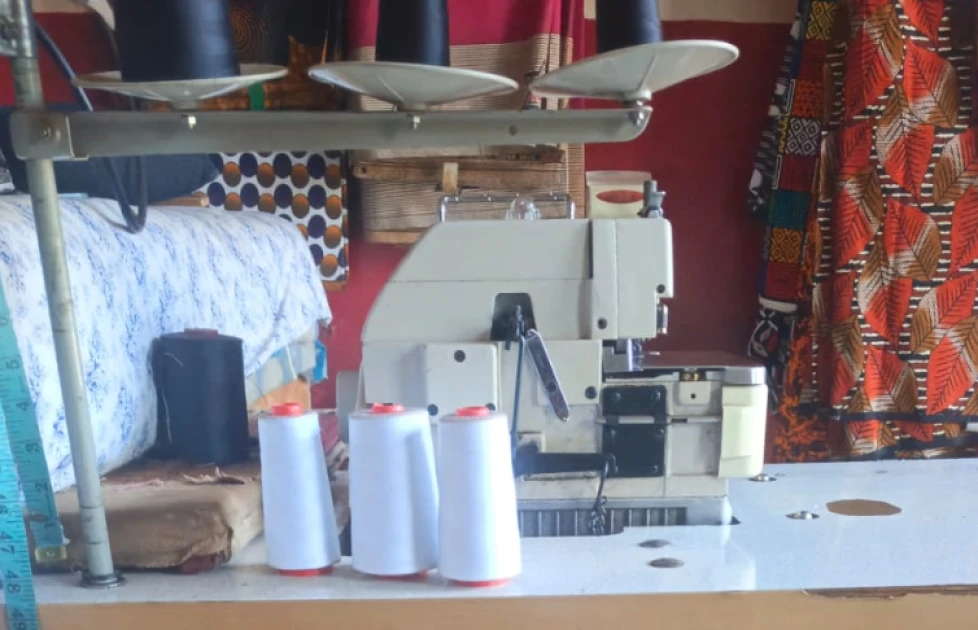
Image shows Jean's work station. Photo: Handout

Audio By Vocalize
He had been told there was work waiting for him in Nairobi as a tailor. With his skills, he expected to earn a living, support his family and build a future. But the journey did not unfold as promised.
Instead of Nairobi, Jean found himself in western Kenya, in unfamiliar surroundings and uncertain circumstances. The work he had been promised was not what he expected.
The place where he was taken to live offered little comfort. At one point, he recalls sleeping in a rat-infested house where rainwater came through the roof. He endured.
For migrants moving across borders in search of work, the journey from opportunity to vulnerability can be a short one.
Across Africa, established migration corridors connect people to employment opportunities in neighbouring countries and beyond.
The Uganda-Kenya corridor is one such route, facilitating the movement of people, goods, skills and labour across borders.
But for workers who cross without the right documentation, the search for opportunities can also become a journey into uncertainty.
For Jean, the absence of documentation would eventually shape how he viewed work, the police and his ability to seek justice.
“You are not Kenyan.” He heard those words repeatedly during moments of conflict.
To Jean, they became more than a reminder of his nationality. They became a reminder about the power he believed he lacked.
Years later, he would build a life in Kenya through tailoring. He would acquire land, establish a private business and support relatives across borders.
But before obtaining Kenyan identification documents in 2022, he lived with the uncertainty of being undocumented. That vulnerability became clear when he was exploited by people he trusted.
At one point, Jean was contracted by a pastor to make clothes for his wedding. The pastor paid part of the money upfront. But as the wedding day approached, he asked Jean to release the clothes before completing the payment, promising to settle the balance later.
Jean agreed. He says he trusted the pastor and believed that, as people of faith, they would honour their agreement.
But when Jean later went to collect the balance, he says the response was unexpected. “You are not Kenyan. You will not take me anywhere,” Jean recalls being told. The words unsettled him.
A similar situation unfolded with another client who was also preparing for a wedding. The client had not completed payment for the clothes, but with the wedding day approaching, Jean says he again released the garments, trusting that the outstanding balance would be paid later.
This time, when he returned to ask for the money, the disagreement turned violent. Jean says he was assaulted. Here reported the matter to the police.
The matter was eventually addressed, but Jean says he received only a fraction of the money involved. During the dispute, he recalls being told again that he was not Kenyan and could not take the matter anywhere.
The experience deepened a fear that had already begun to take root: that his status as a foreigner and, at the time, his lack of documentation could be used against him whenever he sought to enforce his rights.
For Jean, the issue was not simply the money he had lost. It was the message he says he repeatedly received: that because he was not Kenyan, his ability to demand justice was somehow limited.
“I thought, even if I am not Kenyan, I have no right to do anything here,” he recalls.
That fear would later resurface in his own tailoring business.
Jean had invested in fabric, including ‘kitenge’, and employed a young man to help him sell the stock. When Jean travelled to Kampala to restock his business, he says the employee sold some of the material but failed to account for the money.
When Jean confronted him, he says he was once again told that he was not Kenyan and could not take the matter anywhere. This time, Jean went to the police again.
The employee was arrested and some of the missing fabric was recovered. Jean was given the option of pursuing the matter in court. He chose not to.
“Life is like this,” he said.
Jean's decision cannot, by itself, prove that undocumented migrants generally avoid justice because of their immigration status.
But it illustrates a deeper question: what happens when people who may be vulnerable to exploitation do not feel safe enough to report it?
The difficulty of finding migrants willing to speak publicly became part of this investigation.
Several undocumented migrants approached for this story declined to be interviewed on the record, citing fears of arrest, deportation or retaliation.
Their silence cannot be treated as proof of abuse, but raises a question that extends beyond whether migrants have rights on paper: what happens when the people most vulnerable to exploitation are also the least able to report it?
For people living with uncertainty over their immigration status, seeking help can carry its own psychological burden. A police station, immigration office or other authority may appear less like a source of protection and more like a potential threat.
Matthew Mbuvi, a psychological first-aid practitioner, says people who have experienced displacement, violence, exploitation or prolonged insecurity may first need safety, empathy and practical support before they are able to navigate complex systems or seek redress.
“Psychological first aid is the first human, practical support that you can give to someone who is in distress,” says Mbuvi.
He says such support may involve listening without judgement, helping a person access immediate basic needs and linking them to appropriate services, including documentation and legal support.
“It is important to try to get into their shoes,” he says. “Try to empathise with their situation so that you are able to understand what they are going through.”
For migrants who have experienced prolonged insecurity, reporting abuse may therefore involve more than overcoming a legal barrier. It may also require overcoming fear.
That gap between rights on paper and access to justice in practice is at the heart of the experience of many migrant workers, says Elijah Rottok, an advocate and Senior Human Rights Officer at the Kenya National Commission on Human Rights.
According to Rottok, undocumented status does not erase a person's fundamental rights.
Kenya's Constitution protects the rights of “every person,” not only citizens. Article 29 protects individuals from torture and cruel, inhuman or degrading treatment. Article 47 guarantees the right to fair administrative action, while Article 50 provides the right to a fair trial.
“For workers, Article 41 guarantees the right to fair labour practices, reasonable working conditions and fair remuneration,”Rottok adds.
In principle, therefore, a worker's immigration status should not give an employer permission to exploit them or deny them payment for work already performed. But Rottok says the reality can be very different.
“Complaints received by human rights organisations commonly involve wage theft, confiscation of identity documents, physical assault, psychological abuse and extortion.”
In cases of wage theft, he says, employers may threaten to report workers to immigration authorities rather than address the labour dispute.
The result, he argues, is a climate in which immigration status can become a tool of control.
A worker who has not been paid may hesitate to complain. A person who has been assaulted may fear approaching the police. A migrant whose documents have been confiscated may worry that seeking help could lead to arrest or deportation.
The vulnerability, Rottok argues, is structural.
When migrants lack documentation, they may be pushed further into informal employment, where labour protections can be difficult to enforce. Fear of authorities can make reporting abuse harder, while those who exploit workers may operate with a sense of impunity. The scale of the problem is also difficult to establish.
Kenya has no reliable official figure for the number of undocumented migrants living and working in the country. That absence of data makes it difficult to measure the full extent of their vulnerability or determine how many may be unable or unwilling to report exploitation.
The United Nations estimates that Kenya hosted nearly one million international migrants in 2024. But there is no comparable official figure showing how many people live and work in the country without valid immigration documents.
Without reliable data, undocumented migrants can remain largely invisible in official labour and migration statistics. Their experiences may not be fully reflected in complaint records, labour surveys or justice data.
The people who are most afraid to report abuse may therefore be the least likely to appear in the data used to measure it.
Jean's experience unfolds within that wider uncertainty.
A 2025 International Labour Organization (ILO) assessment examining access to complaints and remedies for migrant workers in Kenya and Uganda identified gaps in the legal and institutional systems intended to protect migrant workers and provide avenues for redress.
The findings raise a question that extends beyond Jean's experience. It is not enough to ask whether migrant workers have rights.
The deeper question is whether they know those rights, trust the institutions responsible for protecting them and feel safe enough to use them.
For Jean, the law may have existed on paper. But for a long time, he did not believe it belonged to him.
His story also reveals another side of migration — one often missing from conversations focused on borders, immigration status and enforcement.
Jean is not only a migrant who once faced vulnerability. He is a skilled tailor, an entrepreneur, an employer and an economic contributor.
Through his business, he has sold clothes, employed others, bought land and supported relatives across borders.
Every month, he sends money to family members. Some live in Uganda, while others remain in the Democratic Republic of Congo.
His journey reflects what migration experts describe as the migration-development nexus.
Migration is often discussed through statistics: the number of people crossing borders, the number of migrants without documents or the number of workers moving from one country to another.
But migration also involves skills, businesses, family networks and financial support.
Jean's tailoring skills have allowed him to create an economic life in Kenya. At the same time, his earnings support people beyond Kenya's borders. This is the less visible side of labour migration.
Yet the same systems that enable people to move in search of work can also expose them to exploitation.
Across the region, migrant workers may encounter low wages, delayed payments, wage theft and poor working conditions. In some sectors, they may also face discrimination based on nationality.
The ILO's decent work framework emphasises rights at work, fair remuneration, safe working conditions, non-discrimination and social protection.
For migrant workers, these protections are particularly important because work and living conditions can overlap.
Domestic workers, for example, may live in the same places where they work. In other sectors, workers may depend heavily on an employer for accommodation, food or transport. That dependence can make it harder to leave abusive situations.
Jean's own journey began with information passed from one person to another. He was promised work in Nairobi.
The reality he encountered was different. But today, he is no longer the young man who arrived uncertain of where he would sleep or whether the work he had been promised would exist.
His sewing machine, his fabric and his business represent more than income. They are evidence of a migrant who has created value despite the insecurity surrounding his early years in Kenya.
He has since moved from western Kenya to the Rift Valley, where he continues to run his business. A move he once feared when he was undocumented is now part of his life. He also visits his family in the Democratic Republic of Congo.
His journey complicates the way migrants are often portrayed. They are not simply victims or statistics. They are workers. They are entrepreneurs. They are employers. They support families and contribute to local economies. They also have rights.
For Jean, documentation eventually brought a greater sense of security.
But his experience raises a larger question: should protection from exploitation depend on whether a worker possesses the right papers?
Kenya's Constitution says fundamental rights belong to every person. Yet many migrants continue to live as though those rights are conditional.
For Jean, the needle has always been a tool of survival.
But his story asks whether survival should be the highest ambition available to a migrant worker or whether the systems around migration can finally allow people to live, work and seek justice with dignity.
Join the Discussion
Share your perspective with the Citizen Digital community.
No comments yet
This discussion is waiting for your voice. Be the first to share your thoughts!