
U.S sanctions open new front of pressure on Sudan’s army amid growing concerns for civilians
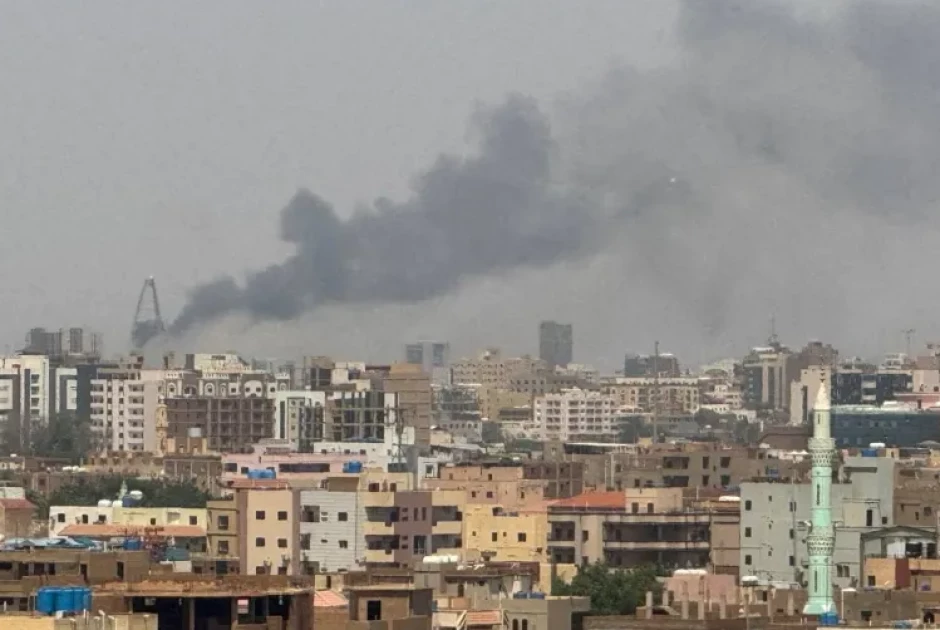
Plumes of smoke rise during clashes between the paramilitary Rapid Support Forces and the army in Khartoum, Sudan, September 26, 2024 [File: Reuters]

Audio By Vocalize
Additional U.S. sanctions on Sudan came into effect on July 20, 2026, following Washington’s accusation that the Sudanese army had used chemical weapons during the war that has continued since April 2023.
According to the official notice published in the U.S. Federal
Register, the new measures were imposed under the Chemical and Biological
Weapons Control and Warfare Elimination Act after the U.S. administration
determined that Sudan had failed to meet the conditions required to avoid a
second round of sanctions.
The measures include restrictions on Sudan’s access to loans
and financial assistance, as well as Washington’s opposition to providing it
with financing through international financial institutions, alongside tighter
restrictions on certain exports and U.S. economic transactions.
The sanctions add to the political and economic pressure on
the authority led by army commander Abdel Fattah al-Burhan in Port Sudan since
the 2021 military coup, at a time when regional and international initiatives
aimed at ending the war continue to falter.
In the Kenyan capital, Nairobi, the Sudanese Declaration of
Principles forces held a meeting to review developments in the conflict, the
course of the political process, and the mediation efforts under consideration.
They announced that they were working to formulate a unified
vision to coordinate local, regional, and international pressure to halt the
fighting, protect civilians, and deliver aid.
The participating forces reaffirmed their rejection of a
military solution and called for a Sudanese-owned political process that
addresses the roots of the crisis while preserving the country’s unity and
sovereignty.
The alliance includes civil and political forces opposed to
the war, including the Somoud coalition and the Sudan Liberation Movement led
by Abdel Wahid Mohamed Nour.
The political moves and U.S. sanctions coincided with
continued reports of civilian casualties in airstrikes in areas of Kordofan.
Human rights and local sources reported that army aircraft
bombed the Jabra area in North Kordofan, using Antonov aircraft to drop barrel
bombs, killing and injuring people and causing damage to civilian areas.
Sudanese human rights organisations have warned that the use
of unguided explosive weapons in populated areas significantly increases the
likelihood of civilian casualties.
The Jabra airstrikes come amid a broader escalation of
military operations in North Kordofan, where human rights and humanitarian
organisations have documented multiple attacks in recent weeks targeting
civilians, vehicles, and vital facilities, amid the widening scope of the
confrontation between the army and the Rapid Support Forces.
In El Obeid, the capital of North Kordofan, fears are mounting
that the city could become the scene of a large-scale confrontation amid
military build-ups, reciprocal attacks, and the deterioration of essential
services.
Local accounts and civil activists say that security and
military checkpoints affiliated with the army and allied forces have imposed
restrictions on residents leaving the city and prevented some families from
departing via roads leading to neighbouring areas.
The reports have raised fears that hundreds of thousands of
civilians could remain inside a city at risk of becoming the scene of major
battles and be used as human shields, while the army has issued no official
clarification regarding the reasons for, or scope of, the restrictions.
The Tasis coalition had announced the opening of safe
corridors for civilians in El Obeid, expressing its readiness to receive
international organisations on the ground.
The United Nations says Sudan’s crisis has become one of the
world’s largest humanitarian crises, with more than 30 million people in need
of assistance during 2026, while the Kordofan region is witnessing new waves of
displacement as fighting expands and insecurity persists.
The simultaneous developments—from U.S. sanctions to the
Kordofan airstrikes and restrictions imposed on civilian movement in El
Obeid—indicate that the war is entering a phase in which international pressure
is increasingly intertwined with the risk of expanding military operations,
with no immediate signs that either side of the conflict is prepared to accept
a political settlement to halt the fighting.
Join the Discussion
Share your perspective with the Citizen Digital community.
No comments yet
This discussion is waiting for your voice. Be the first to share your thoughts!