
U.S-funded Laikipia Ebola facility draws resistance as protest date nears
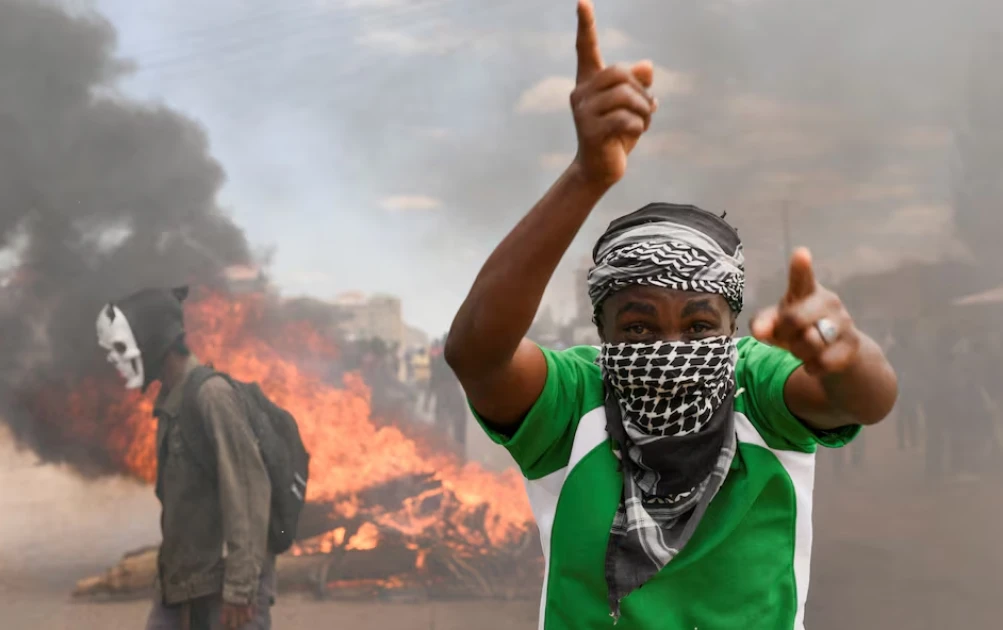
A demonstrator gestures as they erect a barricade during a protest against a U.S.-backed Ebola quarantine plan for a 50-bed facility at a Kenyan air force base intended to host Americans exposed to Ebola, in Nanyuki town, in Laikipia County, Kenya, June 1. REUTERS/John Muchucha

Audio By Vocalize
Public opposition is mounting ahead of planned demonstrations on June 25 against a proposed United States-funded Ebola treatment and research centre in Laikipia County, with critics citing concerns over transparency, sovereignty and foreign influence.
The planned 50-bed
facility at Laikipia Air Base has sparked protests in recent weeks, drawing
resistance from residents, activists and civil society groups who have
questioned both the purpose of the project and the government's handling of the
initiative.
According to the
document, demonstrations first erupted in Nanyuki on June 1, with two people
reportedly killed during the unrest.
A second round of
protests on June 9 also turned deadly when 17-year-old Sylvester Muigai Ndung'u
was allegedly shot during clashes between protesters and police. Witnesses
claimed the teenager was shot in the head.
The Kenya National
Commission on Human Rights (KNCHR) has accused police of using excessive force,
including live ammunition and arbitrary arrests during the demonstrations.
The report further
claims that construction activities and the arrival of US military aircraft
continued despite a High Court order temporarily suspending the project.
The controversy
intensified after photographs surfaced showing police officers wearing uniforms
resembling those used by the British Army Training Unit Kenya (BATUK), which
operates in Nanyuki.
However, the
British High Commission denied any involvement, saying the uniforms had been
"misappropriated" and that no BATUK personnel participated in the
protests.
Opponents of the
project argue that the choice of Laikipia as the facility's location has
revived long-standing grievances over land ownership and the presence of
foreign military interests in the region.
The document links
current opposition to historical distrust of Western interventions in Africa,
particularly in the health sector.
It also points to
perceptions in parts of Africa, including the Democratic Republic of Congo,
where some communities have questioned international responses to Ebola
outbreaks and viewed them through a political rather than purely medical lens.
Critics fear similar concerns could fuel resistance to the Laikipia project.
Questions have
also been raised about the agreement governing the proposed facility. Civil
society organisations have demanded disclosure of details including land
arrangements, project costs, legal protections for foreign personnel and the
framework for research and treatment activities.
According to the
document, the High Court has directed the government to release some of this
information, although campaigners say compliance has been limited.
With fresh
demonstrations expected on June 25, the debate over the proposed Ebola centre
continues to draw national attention, highlighting broader concerns about
public participation, government transparency and the role of foreign partners
in major projects.
Join the Discussion
Share your perspective with the Citizen Digital community.
No comments yet
This discussion is waiting for your voice. Be the first to share your thoughts!