
UK responds to uniform misuse as questions linger over teen's death during Nanyuki protests
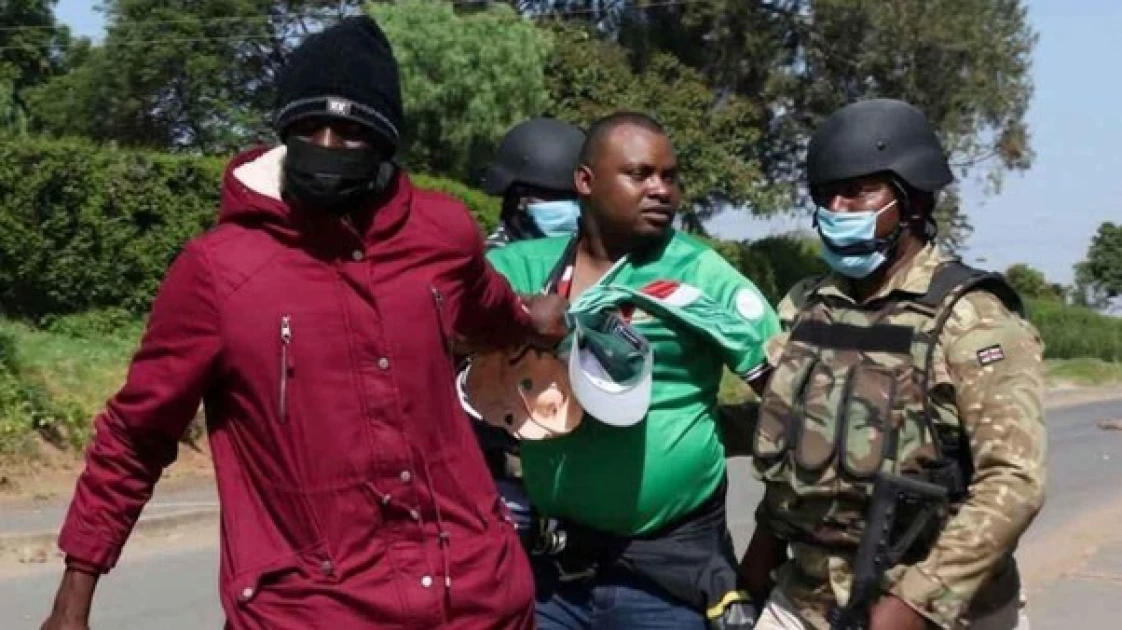
An officer sporting a British army uniform and another in plain clothes detain a protester during demos in Nanyuki over an Ebola quarantine facility. [Photos/Monicah Mwangi/Reuters]

Audio By Vocalize
The death of a 17-year-old boy during anti-Ebola facility protests in Nanyuki has sparked fresh debate after the British High Commission sought clarification from the Kenyan government over the alleged misuse of a British military uniform by a police officer.
Sylvester Muigai
Ndung'u was killed during demonstrations on June 9 that turned violent as
police clashed with protesters opposed to a proposed Ebola quarantine facility
at Laikipia Air Base.
Witnesses claimed
the teenager was shot in the head during the confrontations. However, police
have maintained that the cause of death will be established through a
post-mortem examination, with local authorities confirming that investigations
remain ongoing.
The protests were
triggered by opposition to a planned 50-bed Ebola treatment and quarantine
centre linked to the United States government.
The facility was
intended to receive American citizens affected by the Ebola outbreak in the
Democratic Republic of Congo.
Residents raised
concerns over the potential public health risks of hosting the facility and
questioned the transparency of the approval process.
A court last month
suspended the opening of the centre following a petition filed by local
residents, although reports indicate that construction has continued. President
William Ruto has defended the project, arguing that halting it would be
"inhuman."
The controversy
widened after photographs emerged showing police officers wearing uniforms
resembling those used by the British Army Training Unit Kenya (BATUK), which is
based in Nanyuki.
In response, the
British High Commission said no BATUK personnel had participated in the
protests or been authorised to undertake domestic policing duties.
The Commission
stated that the uniform appeared to have been "misappropriated" and
clarified that the officer captured in the images was not a British soldier.
The UK mission
subsequently sought clarification from Kenyan authorities and requested an
apology over the unauthorised use of attire associated with the British
military.
The swift response
from the British government has attracted criticism from some commentators and
human rights advocates, who argue that greater urgency has been directed toward
addressing the misuse of a military uniform than establishing the circumstances
surrounding the teenager's death.
Critics contend
that while questions about the uniform prompted an immediate diplomatic
response, investigations into Ndung'u's death have yet to yield public
findings.
The incident has
also renewed scrutiny of foreign military presence in Kenya and the oversight
of security operations during public demonstrations.
The Kenya Human
Rights Commission has accused police of using excessive force during the
protests, including the use of live ammunition and arbitrary arrests.
Authorities have not publicly responded to the allegations, citing ongoing
investigations.
As inquiries
continue, questions remain over both the origin of the military uniform worn by
the officer and the circumstances that led to Ndung'u's death during the
demonstrations.
Join the Discussion
Share your perspective with the Citizen Digital community.
No comments yet
This discussion is waiting for your voice. Be the first to share your thoughts!