
Trust deficit raising cost of doing business, Kenya’s private sector warns

Audio By Vocalize
Business leaders and policy experts meeting in Nairobi ahead of the inaugural Trust Summit said that declining confidence in public institutions, businesses, and governance systems carries tangible financial consequences, including higher borrowing costs, increased compliance expenses, and slower investment flows.
Prof. XN Iraki of the University of Nairobi’s Faculty of Business and Management Science said businesses operating in low-trust environments incur additional costs to manage uncertainty.
“When people trust each other, businesses spend less on contracts, audits and security,” Iraki said.
When trust breaks down, those costs ripple across the economy through higher interest rates, increased bureaucracy and slower growth, he added.
The warning comes as Kenya prepares to host the inaugural Trust Summit in Nairobi from October 21 to 23. Organisers are positioning trust as a critical economic asset rather than merely a social or political ideal.
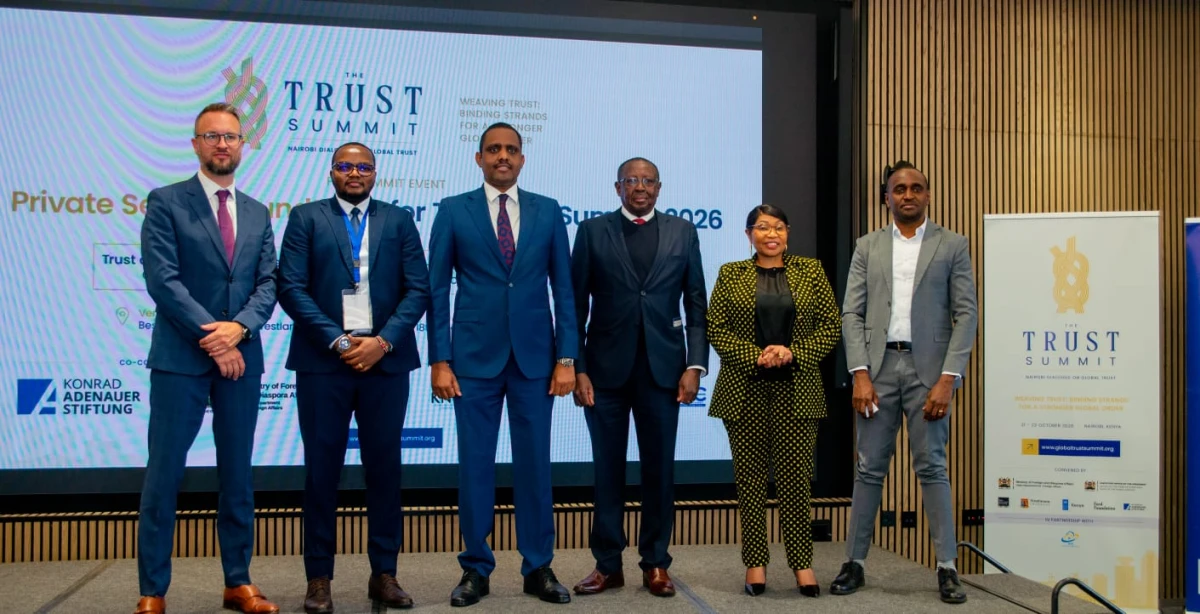
The summit’s private-sector roundtable brought together business and policy stakeholders to examine how stronger institutional trust could support investment, regional trade, digital commerce, and economic resilience.
The issue is particularly significant for Africa, where perceptions of institutional and political risk often influence the cost at which governments and businesses access capital.
Research cited in the summit’s concept note estimates that African countries pay about $75 billion annually in additional interest costs due to risk premiums linked to perceptions of institutional trust. The same research indicates that low-income countries attract less than one per cent of global foreign direct investment despite having substantial demand for productive capital.
For investors, predictability matters. Capital is less likely to flow into markets where institutions, regulations and governance frameworks are viewed as unreliable, or where risks are perceived to be high.
Mathias Kamp, Country Director of the Konrad-Adenauer-Stiftung Kenya Office and co-convener of the Trust Summit, said infrastructure investment alone cannot drive growth if the institutions responsible for delivering results are not trusted.
“Trust is a prerequisite for investment and economic growth,” Kamp said.
Organisers say the summit is designed to move beyond discussion and generate measurable outcomes. Among the initiatives planned is a Regulatory Trust Index, a public dashboard that will track trust levels, regulatory confidence and key benchmarks over time, providing a measurable framework for assessing progress in rebuilding institutional trust.
A joint task force comprising the State Department for Foreign Affairs, Strathmore University and the Open Government Partnership will also be established to monitor, verify and publicly report progress on commitments made during the summit.
The summit is expected to produce a Nairobi Statement on Global Trust, an assessment of Africa’s trust landscape and policy recommendations covering democratic governance, international cooperation, economic trust and information integrity in the digital age.
Lucy Muchoki, Partnership Director at the Kenya National Chamber of Commerce and Industry, said the focus must now shift from recognising the importance of trust to implementing practical measures that can rebuild it.
“Trust is not simply about reputation; it has direct economic value,” Muchoki said.
The conversation comes at a time when confidence in major institutions is under pressure globally. According to the 2025 Edelman Trust Barometer, global trust in government stands at 52 per cent, compared with 62 per cent for business.
For Kenya, organisers view the summit as both an economic and diplomatic opportunity, positioning Nairobi as a hub for dialogue on rebuilding confidence between governments, businesses and international institutions in an increasingly uncertain global environment.
Mustafa Ibrahim, Deputy Director-General and Head of the Policy, Research and Strategic Analysis Directorate at the State Department for Foreign Affairs, said governments and businesses share responsibility for restoring trust.
Governments, he said, must provide stable and predictable policy environments, while companies should uphold strong corporate governance and ethical leadership.
"Confidence in institutions has come under strain, economic uncertainty has risen, geopolitical tensions persist, and rapid technological change is reshaping how governments, businesses and citizens interact," he said.
Ultimately, the debate is no longer whether trust matters, but what its absence costs economies. For Kenya’s private sector, that cost is increasingly measured in higher capital costs, reduced investment, slower business activity and diminished competitiveness in regional and global markets.
Join the Discussion
Share your perspective with the Citizen Digital community.
No comments yet
This discussion is waiting for your voice. Be the first to share your thoughts!