
This wonder woman Margaret Nyakang’o
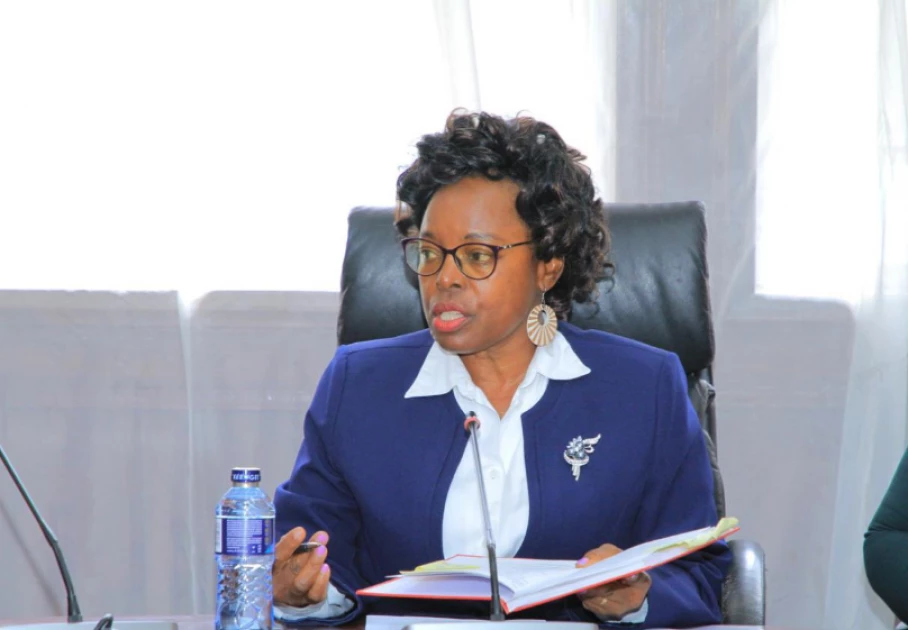
Controller of Budget Margaret Nyakang'o during a past function. PHOTO | COURTESY

Audio By Vocalize
Yet by law, no shilling leaves the Consolidated Fund or a county revenue fund without her approval.
The woman who holds that office, CPA Dr Margaret Nyakang'o, has become one of the most talked-about public servants in the country.
Her story now tests whether Kenya's independent institutions can survive contact with the power they are meant to check.
An Accountant's Path to a Constitutional Office
Nyakang'o is a career accountant and financial manager who rose through the ranks of public and institutional finance.
She was chosen as the best candidate from fifteen applicants, and succeeded Agnes Odhiambo, the first holder of the office, whose eight-year non-renewable term ended in August 2019.
President Uhuru Kenyatta appointed her in December 2019, making her only the second person to hold the post since the Constitution of 2010 created it.
The office was designed as a hard brake on public finance excess. Kenya's constitution-makers, in light of former runaway public expenditures, wanted an independent officer who could stop unlawful withdrawals before the money left the public purse.
Nyakang'o has taken that duty seriously. Her regular reports on how national and county governments spend their money have become required reading for journalists, legislators and activists, and they often make uncomfortable reading for ministers and governors.
Truth-Telling and Its Price
Her reports have not been polite. She has flagged pending bills, excessive spending on travel and hospitality, and counties that fail to spend development money while overspending on salaries.
Before a parliamentary panel, she also explained a quirk in the budget process. She said her own salary was budgeted at three times what she is actually paid, and that the same was true for all state officers.
Such inflated allocations, she suggested, create room for spending outside formal payrolls.
When her reports reach the public, tension ensues. She almost paid a high price for this when, in December 2023, she was arrested in Mombasa and charged in court with fraud.
The charges stem from an old dispute. Her troubles trace back to a civil row between a businesswoman and a Sacco society, in which Nyakang'o was not even named as a party.
She was charged alongside ten others in a case dating back to 2016, and the file was resubmitted in 2022, after which the Office of the Director of Public Prosecutions (ODPP) directed that charges be brought.
The timing raised eyebrows. The arrest came soon after her public disclosures about fiscal irregularities.
A petition by West Mugirango MP Stephen Mogaka argued the arrest was a knee-jerk reaction with ulterior motive, coming in the wake of her exposés. Martha Karua called it intimidation and harassment.
The courts stepped in. The High Court issued conservatory orders temporarily stopping her prosecution.
Those orders were later extended until the petition is heard and determined. The DPP has maintained that the office confers no immunity from prosecution for alleged criminal acts, as has the Leader of Majority, Kimani Ichungwa. She has not been convicted, and the substance of the charges has never been tried.
Funds That Nobody Watches
Her latest intervention has set off the sharpest debate yet. During a Citizen TV interview in mid-September 2026, Nyakang'o explained that her office cannot see how money is spent in several funds.
She named the Social Health Insurance Fund, the National Infrastructure Fund, the Sovereign Wealth Fund, the Primary Healthcare Fund, and the Affordable Housing Levy, saying they are not part of the Consolidated Fund.
The National Infrastructure Fund has drawn particular attention.
The Controller has joined a High Court challenge arguing that the law creating it was designed to bypass her constitutional oversight of withdrawals and to allow borrowing and guarantees without prior parliamentary approval.
The Fund has not been suspended, but the report says the court ordered the Treasury to disclose certified accounts and keep filing quarterly reports as the case proceeds.
The government has not taken the remark kindly. Health Cabinet Secretary Aden Duale called it inaccurate, insisting that funds created by Acts of Parliament already have legal mechanisms governing how money is withdrawn, managed and audited. That is a fair point.
The Auditor-General and Parliament do have roles. But audits happen after money is spent, and the Controller's job is to guard the gate before money leaves.
A country that relies only on after-the-fact audits will keep discovering its losses years too late.
Support has come from across the political and legal divide. Former Law Society of Kenya president Faith Odhiambo called the gap a constitutional red flag and warned that money that bypasses the Treasury bypasses the people's control.
The National Assembly's Committee on Constitutional Implementation Oversight has proposed amending the Public Finance Management Act to allow the Controller to report on funds and levies that currently fall outside her mandate
Not Only the Government
It would be too simple to cast this only as a contest between one honest officer and a hostile national executive.
Her office has also clashed with county governments. Murang'a County asked a court in April 2026 to hold her in contempt over bursary approvals.
The episode shows how she is squeezed from both sides. National ministries dislike her scrutiny, and so do governors who want to spend freely.
Protecting the Controller
The deeper lesson is that Kenya has built an institution with real duties but thin protection.
Several reforms would help, and none of them depends on the goodwill of any one administration.
The first and most urgent is closing the legal gap on funds and levies. Parliament should amend the Public Finance Management Act so that every fund financed from public money, whether from taxes, levies or asset sales, reports to the Controller of Budget, and withdrawals require her approval or are at minimum monitored and reported on.
The committee's proposal is a good start. It should move quickly, and no new fund should be created without this safeguard.
Second, the office needs stronger security of tenure and protection from harassment. The Constitution already gives independent officers protection from removal except through a defined process, but the 2023 arrest showed that criminal charges can be used as a pressure point.
Parliament and the courts should develop a clear rule that prosecutions of holders of independent offices are approved at the highest level of the prosecution service, with written reasons.
This must not amount to immunity, because no officer should be above the law. It is a safeguard against selective and timed prosecutions.
Third, the Controller's reports need legal weight. At present, they are widely read and easily ignored. Parliament's budget and oversight committees should be required to table a formal response to each Controller's report within a set period.
Ministries and counties named for breaches should have to answer in writing, and repeated offenders should face consequences, including personal surcharge for accounting officers who breach the law.
Where a report points to possible crime, the Ethics and Anti-Corruption Commission and the DPP should be required to say publicly whether they acted and why.
Fourth, the office needs financial and operational independence. The Controller should have a guaranteed budget that cannot be revoked in retaliation, and direct real-time access to exchequer and county accounts.
A proposed amendment to the Controller of Budget Act would give her office greater access to national and county exchequer accounts and strengthen monitoring of public funds. Real-time digital access would turn oversight from a monthly ritual into a daily discipline.
Finally, the public has a part to play. Constitutional offices survive when citizens understand and defend them.
Civil society groups, professional bodies such as the Institute of Certified Public Accountants of Kenya, the media and ordinary taxpayers should read these reports, quote them, and ask their representatives what was done about them.
An officer who speaks into silence can be worn down. One whose findings are debated at the ward, in the pulpit and in parliament is far harder to intimidate.
A Test for the Republic
Nyakang'o's term, like her predecessor's, is non-renewable, so the question extends beyond her.
Whoever follows her will inherit either a strengthened office or an exhausted one. What Kenya does now will decide which.
She has been accused, criticised, and taken to court. She has also, by explaining plainly what her office cannot see, given the country a map of where its accountability gaps lie.
The right response to a smoke alarm is to check for fire rather than to attack the alarm. If the funds are properly run, opening their books to the Controller costs nothing.
If they are not, Kenyans deserve to know before the money is gone.
Join the Discussion
Share your perspective with the Citizen Digital community.
No comments yet
This discussion is waiting for your voice. Be the first to share your thoughts!