
Cement wars: Ruto, Obasanjo revisit Lafarge’s controversial exit from Kenya
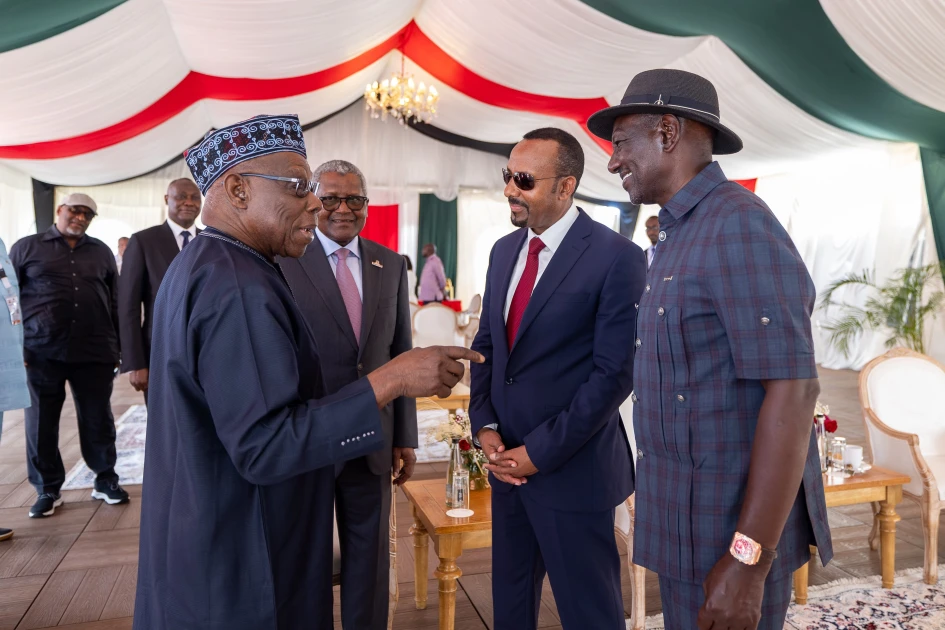
President Ruto speaks with Former Nigerian President Olusegun Obasanjo in Lamu during Dangote Lamu refinery groundbreaking ceremony on Wednesday September 30, 2026. PHOTO | PCS

Audio By Vocalize
Intrigues in the cement manufacturing business in Africa came to the forefront during the Lamu refinery groundbreaking ceremony, with leaders laying the blame at the doorstep of former French investor Lafarge.
Former Nigerian Head of State Olusegun Obasanjo said the
company's investment in Africa was not done in good faith, while President
William Ruto celebrated the takeover of the industry by Kenyans and East
Africans in the country.
Obasanjo waded into the murky cement wars that dogged the
continent, placing former large-scale foreign investor Lafarge at the centre of
the dispute.
For decades, the French firm was a giant of African cement,
with its footprint spread across the continent. In Kenya, it was the force
behind Bamburi Cement, which dates back to 1951. Later, after Lafarge merged
with Swiss giant Holcim in 2014, its African assets were consolidated under one
roof.
Then came a challenger from Nigeria. Aliko Dangote grew from
a single Nigerian plant into a continental cement powerhouse. And according to Obasanjo, Lafarge was not pleased.
“The people who really didn't want Aliko to succeed in the
cement business were people called Lafarge, and they put every obstacle on
Aliko's way, just as they are still doing to us today. The experience of
Senegal was the one that was traumatic,” said Obasanjo.
That experience was in Senegal. Dangote completed a
five-million-tonne plant there, but for two years it could not produce a single
bag. Obasanjo says Lafarge instigated a legal fight to keep it shut.
“For two years he could not do anything. Lafarge instigated
some law. They went to court, Aliko won, and Aliko had to pay 12 million
dollars to be able to operate his cement factory, two years after it had been
completed. Lafarge wanted to get Aliko not to produce cement in Africa. They
wanted to monopolise. Lafarge is now out of Africa,” Obasanjo stated.
Back home in Kenya, Lafarge's story ended differently.
President Ruto says that in 2023, the government imposed a levy on
imported cement, and the firm chose to walk away instead of investing more.
“In 2023, I made the same decision that we are not going to
be importing cement when we have all the material in Kenya. And we put a levy
on the import of cement, and Lafarge, who were investors in Kenya, left. Today the
cement industry in Kenya is controlled by East Africans, Kenyans and my good
friends from Tanzania,” he said.
Ruto says the French firm was not keen on expanding its
operations in Kenya, seeking instead to continue with the importation of raw
material that was available in Kenya.
“In fact, the person who drove Lafarge from Kenya is sitting
right here, that young man there called Adan. They could not agree to put more
money into expanding their facilities in Kenya. They wanted to continue importing
clinker from elsewhere. I am very happy that Bamburi Cement, under the new
management, are now putting up a new facility to expand cement production in
Kenya,” said Ruto.
Dangote first announced a 400-million-dollar cement plant in
Kenya in 2013. He later eyed limestone in Kitui, but by 2018 the project had
been dropped.
Speaking ahead of the groundbreaking, Dangote blamed bribe
demands during the Uhuru Kenyatta administration, saying his company does not
pay bribes.
Dangote Cement's chief executive now gives a different
reason, saying there is no limestone deposit in Kenya that is big enough, clean
enough or close enough. For now, he says, Kenya is not in the company's
medium-term plans.
Join the Discussion
Share your perspective with the Citizen Digital community.
No comments yet
This discussion is waiting for your voice. Be the first to share your thoughts!