
The Kenyan SME growth playbook: Building businesses with stronger digital capability #AD
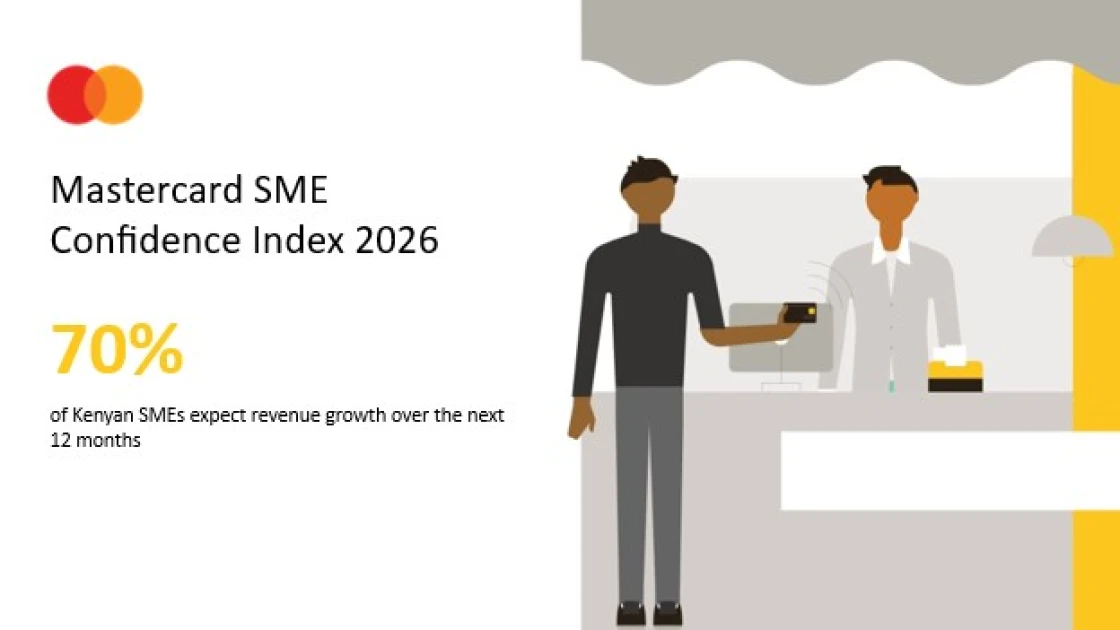
The Mastercard SME Confidence Index 2026

Audio By Vocalize
Kenya’s small and medium-sized enterprises are ambitious.
For years, they have shown the ability to be adaptable and innovative, using technology to solve problems and propel growth.
Today, that adaptability is translating into one of the most digitally enabled SME ecosystems on the continent.
Mastercard’s 2026 SME Confidence Index captures that momentum. It found that 66% of Kenyan SMEs are confident about their business outlook, and 70% expect their revenues to grow over the next 12 months.
Even more telling is how businesses are getting ready for that growth. Already, 95% accept mobile payments, which account for 41% of transaction volume, and 39% accept online payments.
What these numbers reveal is the confidence Kenyan SMEs feel about what digital tools can do for their businesses. These entrepreneurs are asking questions that take their business to the next level; questions push the boundaries of growth that digital tools can provide. Questions about what comes next. And the answer for them is not simply more technology.
The answer is better infrastructure, better insights and better access to the tools that can turn transactions into growth.
Moving beyond the hardware barrier
One of the biggest opportunities for SMEs is also one of the simplest. It is making payments easier and more affordable to accept.
Traditional payment terminals have served larger merchants well for decades, and the opportunity now is to put the same capability in the hands of the smallest businesses without the upfront cost of hardware.
This is why the industry is moving toward more flexible forms of acceptance.
Tap on Phone, for example, enables a smartphone to function as a payment acceptance device, allowing businesses to accept contactless cards and mobile wallets without a separate payment terminal.
Mastercard has made the technology available in more than 115 markets globally, with small businesses and micro-merchants among its core use cases.
In Kenya, Mastercard is also working with Safaricom to expand payment acceptance across the M-PESA ecosystem, aiming to reach more than 636,000 merchants.
The collaboration brings together M-PESA’s extensive merchant network and Mastercard’s payment infrastructure to help businesses serve customers through more seamless and secure digital payment experiences.
The significance goes beyond convenience. When payment acceptance becomes easier to access, SMEs can spend less time thinking about how to take a payment and more time thinking about how to grow the business.
From accepting payments to understanding customers
That is a significant shift in mindset. The value of digital payments is no longer confined to moving money from one place to another.
Transaction data can help businesses understand what customers are buying, when they are buying and how their behaviour is changing.
With the right tools, those insights can support better inventory decisions, more targeted marketing and stronger customer relationships.
This is where Kenya’s existing digital maturity becomes an advantage. A merchant that has spent years building a mobile-payment business now has the opportunity to build on that foundation with more sophisticated tools for understanding customers and managing the business.
The challenge is ensuring those tools reach SMEs in forms that are simple, affordable and genuinely useful.
Turning growth ambition into access to capital
Digital adoption also has a part to play in the question that has shaped small business growth for generations, which is access to finance.
In Mastercard’s 2026 SME Confidence Index, 44% of Kenyan SMEs sought external funding in the past year. Among those seeking funding, 46% were looking for credit to grow their businesses, compared with 13% seeking finance to maintain current operations.
This is an important distinction. Kenyan entrepreneurs are not simply looking for capital to survive. Many are looking for resources to expand.
Mastercard is working with financial institutions to turn these needs into practical tools for day-to-day business growth.
In Kenya, our collaboration with I&M Bank has brought Business and World Business Credit Cards to market, giving businesses greater control over employee spending, expense tracking and cash flow, while in Tanzania, our collaboration with NMB Bank has introduced the Business Debit Traders card along with the SME World Business Credit Card, designed to support SMEs with secure domestic and cross-border payments and lower-cost access to trade-related transactions.
Yet access to affordable finance remains a structural challenge. The International Finance Corporation estimates that the finance gap for Kenyan MSMEs is equivalent to nearly 21% of GDP, underscoring the scale of the opportunity to connect viable small businesses with appropriate financing.
Digital transactions can form part of the answer. A business that increasingly operates through formal digital channels creates a more visible record of its commercial activity.
Over time, that information can help financial institutions better understand a business’s cash flow and performance and develop financial products that are more closely aligned with how SMEs actually operate.
This is why the next phase of financial inclusion should not be limited to access to a payment account. It should be about giving businesses the financial tools, data and services they need to turn activity into opportunity.
Helping SMEs compete beyond Kenya
For many Kenyan businesses, growth will increasingly mean looking beyond the domestic market.
The country’s entrepreneurs are already deeply connected to regional and global commerce, whether through importing inventory, paying international suppliers, selling online or receiving money from customers and suppliers abroad.
That ambition sits alongside the need for stronger financial tools. The opportunity is to make cross-border trade as straightforward for a Kenyan business as selling down the street.
Mastercard Move is designed to support that growth. It enables seamless money movement across more than 200 countries and territories and more than 150 currencies, supporting business payments, supplier payments and marketplace payouts.
Through our collaboration with KCB Bank Kenya, Mastercard is also connecting Kenyan businesses and consumers to wider markets through solutions including e-commerce payments and cross-border remittances.
The five-year collaboration spans Kenya and the wider East African region, with payment solutions being rolled out across Rwanda, Burundi, South Sudan, Tanzania and Uganda.
There is a larger principle here. Kenyan businesses should not have to choose between the convenience of local digital payments and the reach of global commerce. The infrastructure should increasingly connect the two.
Digitalisation needs to be matched by resilience
The optimism reflected in the SME Confidence Index exists alongside real pressure. Inflation is the most significant of these pressures, with 77% of Kenyan SMEs feeling its weight on their operations.
Yet 62% identified technological progress and digitalisation as a positive driver. That contrast tells us something important about how entrepreneurs are responding to uncertainty.
They are not standing still. They are looking for ways to operate more efficiently and respond more quickly.
But as more businesses move online, security becomes a bigger part of running it. Mastercard’s global research on small-business cybersecurity found that 46% of the businesses surveyed had experienced a cyberattack on their current business, and nearly one in five of those attacked went on to file for bankruptcy or close.
For Kenyan businesses, digital growth cannot be separated from resilience. That includes protecting payment credentials, strengthening authentication, using tokenisation, and applying intelligence to identify suspicious activity without creating unnecessary barriers for legitimate customers.
Building the infrastructure around the entrepreneur
One lesson from Kenya’s digital transformation is that adoption happens fastest when technology is built around the way people already live and work.
Mobile money succeeded because it met consumers where they were. Digital payments expanded because they solved practical problems for merchants and customers.
The next generation of SME solutions needs to follow the same principle.
That means designing for the realities of a Kenyan entrepreneur. A business that sells both in person and online, accepts several payment methods, works from a smartphone, serves customers across borders and needs access to capital without the complexity of traditional corporate financial management.
Our collaborations across Kenya are built around that reality. Through a 10-year agreement with Diamond Trust Bank, we are advancing digital payment solutions across Kenya, Uganda and Tanzania.
And through our broader work with financial institutions and technology partners, we are helping expand the payment and financial infrastructure available to businesses.
The point of all of this is simple: to give entrepreneurs the tools that remove friction, strengthen resilience and create new paths to growth.
What the modern Kenyan SME looks like
Consider a small Kenyan retailer that began by taking payments through mobile money. Today, that business may also accept cards and online payments, reach customers through social platforms and use digital tools to manage sales and customer relationships.
The next step is not simply to add another payment option. It is to use the digital infrastructure already in place to make the business more competitive.
A simpler payment experience converts more customers, and better data shows where demand is heading. A digital transaction history demonstrates business performance to a lender, cross-border capability opens new markets, and stronger security lets the entrepreneur grow digitally without taking on unnecessary risk.
That is the evolution worth aiming for: businesses with more capability in their hands.
The Kenyan SME growth playbook
The 2026 SME Confidence Index tells a compelling story.
Kenyan SMEs are optimistic: 66% are confident about the year ahead and 70% expect revenue growth.
They are digitally mature: 95% accept mobile payments.
They want better customer experiences: 80% prioritise simple, seamless and user-friendly payment methods.
They want better intelligence: 70% see data, analytics and insights as a key growth requirement.
And they are ready to invest in expansion: 44% sought external funding, with 46% of those seeking credit to grow their businesses.
The foundations are already there. Our responsibility as technology providers, banks, fintechs and other ecosystem partners is to build on them.
That means making payment acceptance more accessible. It means turning transaction activity into useful business intelligence.
It means connecting entrepreneurs to appropriate financial services and enabling them to participate in regional and global commerce. And it means making security an integral part of the digital experience rather than an obstacle to it.
Kenyan SMEs have already demonstrated that they can adopt new technology quickly and use it to solve real problems. Now the opportunity is to move from adoption to acceleration.
The next chapter of Kenya’s SME story will not be defined simply by how many businesses go digital. It will be defined by what those businesses are able to achieve once they do.
Build the right infrastructure around Kenya’s entrepreneurs, and their ambition can do the rest.
Join the Discussion
Share your perspective with the Citizen Digital community.
No comments yet
This discussion is waiting for your voice. Be the first to share your thoughts!