
The Deepfake Era: Can East Africa still trust what it sees?
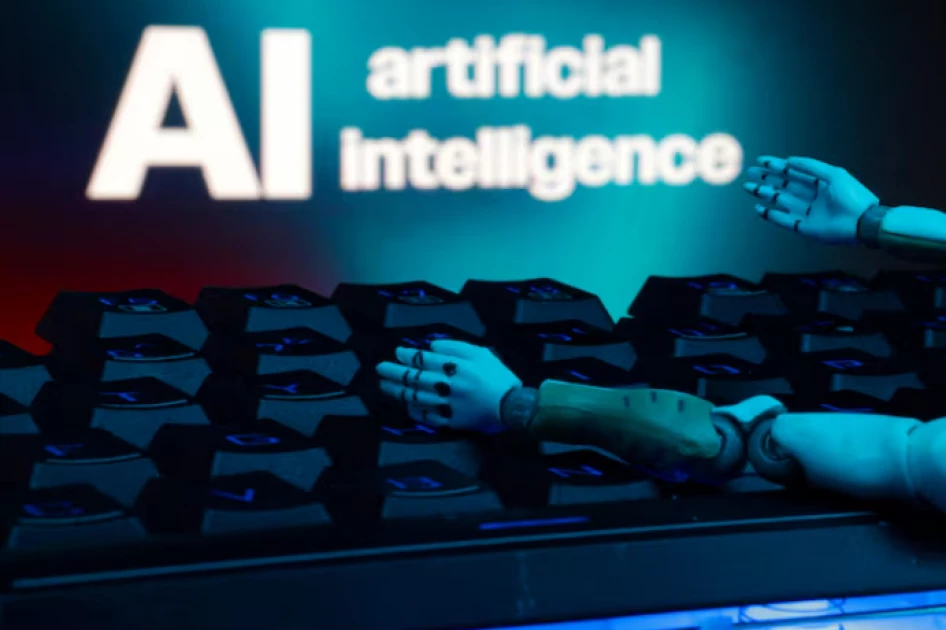
A message reading "AI artificial intelligence", a keyboard, and robot hands are seen in this illustration taken January 27, 2025. REUTERS/Dado Ruvic/Illustration/File Photo

Audio By Vocalize
Artificial intelligence is changing that.
Today, AI tools can generate convincing images of events that never happened, clone a person’s voice or create videos showing people saying and doing things they never did.
As these technologies become cheaper and more accessible, East Africa faces a fundamental question: Can we still trust what we see and hear?
The implications go far beyond technology. They strike at the heart of how societies establish truth and, ultimately, trust.
From misinformation to manufactured reality
Misinformation is not new. Rumours, propaganda and manipulated information existed long before social media.
What generative AI changes is the speed, scale and sophistication with which false content can be created.
Previously, misinformation might involve taking a genuine photograph or video out of context. Now, the event itself can be fabricated.
Someone does not need to misquote a public figure when technology can generate a convincing video of that person apparently making the statement.
The question therefore shifts from “Is this information accurate?” to something more fundamental: “Did this actually happen?”
For East Africa, where WhatsApp, TikTok, Facebook, X and other digital platforms increasingly shape public conversation, the consequences could be significant.
Trust travels through people
Deepfakes are often framed as a technology problem. They are equally a human trust problem.
A video may arrive through a family WhatsApp group, be reposted by a friend or appear alongside hundreds of comments insisting it is genuine.
Who shares information can influence whether we believe it.
A convincing fake does not have to fool everyone. It only needs to reach the right communities through sources they already trust.
False information can also travel faster than institutions can verify it. By the time a newsroom, company or public institution establishes that something is fabricated, thousands of people may already have seen, shared and formed opinions about it.
In the deepfake era, the contest is increasingly between speed and verification.
Journalism faces a new trust test
Few institutions are more exposed than the media.
AI means newsrooms must increasingly verify not only where photographs, videos and recordings came from, but whether what appears in them ever happened.
That creates a difficult tension. Audiences expect news immediately. Verification takes time.
A newsroom that moves too slowly risks losing the story to social media. One that moves too quickly risks publishing fabricated content and damaging the very trust on which journalism depends.
If audiences begin doubting photographs, videos and recordings, trusted journalism becomes more important, not less.
The threat goes beyond politics and media
Businesses are vulnerable too.
Imagine a finance officer receiving a voice note that sounds exactly like the chief executive authorising an urgent payment. Or a fabricated video appearing to show a company leader announcing a closure, acquisition or product recall.
The content may only need to appear credible for a few minutes to trigger financial loss or reputational damage.
Governments and public institutions face similar risks. During elections, emergencies or periods of social tension, a fabricated statement attributed to a public official could spread before authorities have time to respond.
Deepfakes therefore cannot be treated simply as a communications problem. They are becoming an institutional risk.
What happens when we stop believing anything?
Perhaps the greatest threat is not that people will believe every fake.
It is that they may begin believing nothing.
As awareness of AI manipulation grows, genuine evidence can also be dismissed as fabricated. An authentic recording can be labelled AI-generated. A real photograph can be called fake. Genuine video evidence can be disputed simply because convincing deepfakes exist.
That creates an environment in which truth itself becomes negotiable.
For societies already confronting fragmented trust, this could deepen divisions. People may retreat further towards information from individuals and communities that reinforce what they already believe.
Trust will increasingly depend on verification
East Africa’s response cannot rely on fact-checkers alone.
Media organisations need stronger verification systems. Businesses and public institutions need protocols for authenticating sensitive communications. Technology platforms will face growing pressure to identify manipulated content. Schools and universities need to strengthen digital and AI literacy.
Citizens also have a role: question before sharing, check the source and do not treat virality as proof of truth.
Technology will continue to evolve. Our ability to establish trust must evolve with it.
Because in the deepfake era, the question is no longer simply whether we can believe our eyes.
It is whether our institutions, media and citizens can help us determine what is real, who is credible and what deserves our trust.
These questions will form part of the wider conversation at The Trust Summit 2026, taking place in Nairobi from 21–23 October 2026 under the theme “Weaving Trust: Binding Strands for a Stronger Global Order.”
Join the Discussion
Share your perspective with the Citizen Digital community.
No comments yet
This discussion is waiting for your voice. Be the first to share your thoughts!