
‘Sponsor!’ Uhuru Kenyatta’s shadow looms over Ruto govt as campaigns intensify
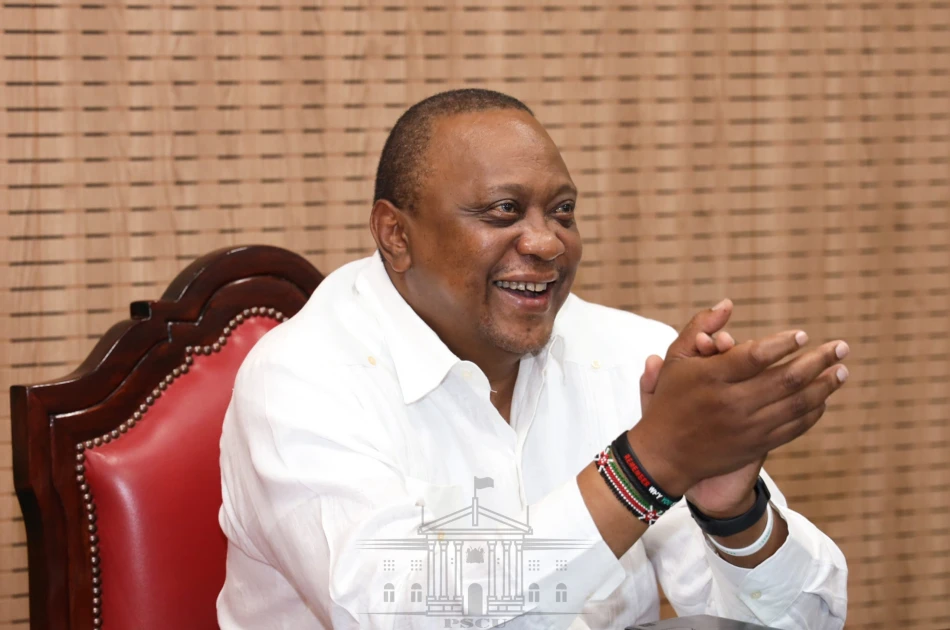
File image of former president Uhuru Kenyatta. Photo: State House

Audio By Vocalize
Barely a week passes without a Kenya Kwanza principal invoking his name, not as an elder statesman to be courted, but as an unseen hand allegedly bankrolling the very opposition that threatens President William Ruto's re-election.
The accusation has become so routine that it now functions less as news and more as a running subplot of the 2027 campaign: Uhuru the sponsor of Jubilee and Linda Mwananchi, Uhuru the puppeteer, Uhuru the financier of bloggers against the government.
"Give Sifuna enough money"
The latest and most direct salvo came from Ruto himself.
Addressing residents in Bungoma after the Kenya Music Festival concert, the president mocked Uhuru's record on affordable housing, universal health coverage and education, then challenged him to properly fund the politicians he was allegedly bankrolling rather than leaving them to "collect fuel money" from ordinary Kenyans.
Days earlier in Eldoret, he had gone further, describing Nairobi Senator Edwin Sifuna and other opposition figures as Uhuru's "proxies" sent to compete with him.
Ruto is not alone. Senate Majority Leader Aaron Cheruiyot has accused the Linda Mwananchi convoy of being financed by "that retired man."
ODM's Junet Mohamed has claimed Uhuru played a role in the internal ODM fractures that followed Raila Odinga's death, alleging the former president was funding the Sifuna faction to weaken Ruto ahead of 2027.
Deputy party leader Wycliffe Oparanya and other ODM figures aligned with the Ruto pact have echoed the claim, while a section of Western-Kenya leaders around presidential aide Farouk have pointed the finger the same way, even as ODM chairperson Gladys Wanga insists there is no turning back from the party's pact with UDA.
Nandi Senator Samson Cherargei has added his own colourful framing, describing Sifuna as a political newcomer being "fattened for a big slaughter," hyped by the opposition and the media only to be discarded later.
Sifuna has denied all of it, repeatedly and specifically. On Citizen TV, he said flatly that Uhuru "does not provide financial assistance, maybe just encouraging us," insisting Linda Mwananchi survives on small M-Pesa paybill donations from ordinary Kenyans rather than the patronage of "two people sitting and saying we have five million shillings each."
Jubilee's own executive director has made the same denial, arguing that if Uhuru were to fund any party, it would be his own.
The deep anxiety
The funding allegation, whether or not it is ever substantiated, is doing real political work, for Kenya Kwanza.
It lets Ruto reframe an opposition built from genuine public grievance over the cost of living, taxation and governance as a mercenary project engineered by a bitter former boss rather than an organic movement.
That framing matters because Sifuna, Gachagua and the wider United Opposition have spent much of 2026 positioning themselves as a youth-driven, crowdfunded alternative to money politics, precisely the kind of grassroots legitimacy Ruto himself claimed in 2022 against a "dynasty."
But the deeper anxiety is structural, not rhetorical. Uhuru retains three assets no other opposition figure can match: a still-functioning party machine in Jubilee, residual command of a slice of the Mt Kenya vote, alongside Gachagua’s DCP, that Ruto needs to neutralize to forestall landslide negative vote, and, crucially, actual money and networks accumulated over a decade in State House.
Whether or not a single shilling has changed hands with Sifuna, the mere plausibility of Uhuru's involvement is what unsettles Kenya Kwanza, because it suggests the opposition's disparate factions, Gachagua's United Opposition, Kalonzo's Wiper-led opposition bloc, Sifuna's Linda Mwananchi, and Jubilee, might be coalescing around a common financier and, eventually, a common candidate.
That is the nightmare scenario for State House: not depending on a single charismatic challenger, but a Kenyatta-brokered coalition wide enough to replicate the 2002 formula of anti-incumbent unity.
Fattened for whom?
Moses Kuria's "fattened for slaughter" remark, delivered on live television, is worth dwelling on because it complicates the simple Kenya Kwanza-versus-opposition narrative.
Kuria did not merely accuse Uhuru of funding Sifuna; he suggested the funding itself was a trap — that Gachagua and Uhuru have already settled on Kalonzo Musyoka as their preferred 2027 candidate.
He also claimed that Sifuna's high-profile "Linda Mwananchi" tours are building a profile he will never be allowed to cash in.
If true, it implies Uhuru's interventions in opposition politics are less about elevating Sifuna personally than about using him, his energy, his youth appeal, his crowdfunding model, as a mobilizing tool ahead of a succession that has already been decided elsewhere.
Kalonzo's camp has publicly welcomed such talk, a sign that the rivalry Kuria described is real and live within the opposition's own ranks, not just an invention of Kenya Kwanza propaganda.
That internal contest, over who ultimately benefits from Uhuru's patronage, real or alleged, may matter more for 2027 than the funding question itself.
Installing Matiang'i: a formal, structural move?
If the funding allegations are the noisy, deniable part of Uhuru's shadow politics, his decision to install Fred Matiang'i as Jubilee's deputy party leader and endorse him as the party's 2027 presidential candidate is the opposite: a formal, minuted, structural act.
The party's National Executive Committee, chaired by Uhuru, unanimously approved Matiang'i's application and designated him to represent Jubilee within the United Opposition coalition, "given that former President Kenyatta is not available at all times," as Secretary-General Jeremiah Kioni put it.
Uhuru has since travelled to Kiambu, Murang'a and Narok to physically stand beside Matiang'i at delegate meetings, an unmistakable signal of succession within his own party.
The choice of Matiang'i is deliberate on several levels. As Uhuru's former Interior Cabinet Secretary, he carries the technocratic, security-establishment credibility Uhuru himself wants associated with his legacy, a contrast to the populist, insurgent energy of Gachagua or Sifuna.
Installing him as deputy party leader also gives Uhuru a loyalist with formal standing inside the United Opposition table, ensuring Jubilee is not simply absorbed into Gachagua's structures but negotiates from its own institutional base.
Jubilee vice-chairman David Murathe has been explicit that the party will back whoever the coalition ultimately fields, even if it is not Matiang'I, but for now, Jubilee needed "a presidential candidate," and it has one.
The endgame
None of Kenya's opposition principals, Gachagua, Kalonzo, Sifuna, or Matiang'i, has yet been anointed as the 2027 flagbearer, and that ambiguity could be Uhuru's leverage.
As long as no single figure consolidates the anti-Ruto vote, the former president remains indispensable in the shadows, and his endorsement could be fought for by several opposition camps who are now competing.
His interest could be less in personally re-entering politics than in ensuring that whoever eventually emerges owes him, and that Jubilee, and by extension Mt Kenya's political weight, is not written out of the settlement.
For Ruto, the strategic logic of relentlessly naming Uhuru is equally clear: strip the opposition of its "people's movement" credibility by recasting it as recycled dynasty politics, force Uhuru either to publicly deny involvement (which he has largely avoided doing himself, leaving it to Sifuna and Jubilee officials) or be dragged further into a fight he may prefer to wage from the shadows.
Either way, with less than a year to the 2027 general elections, Kenya's most consequential political conversation is increasingly being conducted about a man who no longer occupies State House, which is, in itself, the clearest evidence of how much his shadow still matters.
Join the Discussion
Share your perspective with the Citizen Digital community.
No comments yet
This discussion is waiting for your voice. Be the first to share your thoughts!