
Soil degradation threatens food security as IGAD moves to act
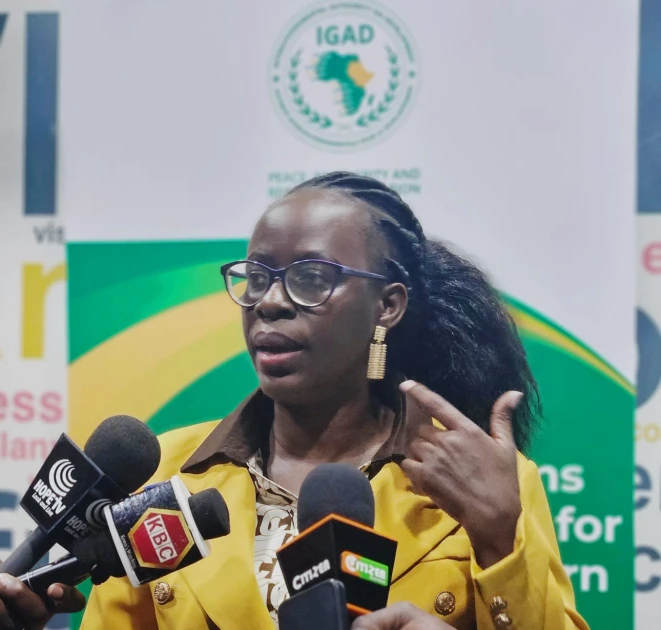
Sylvia Henga, IGAD's Policy and Food Security Expert, addresses journalists during the inaugural Steering Committee and Technical Committee Meeting of the IGAD Soil Health and Fertilizer Hub in Nairobi.

Audio By Vocalize
The Intergovernmental Authority on Development (IGAD) has officially launched the operationalisation of its Soil Health and Fertiliser Hub, bringing together experts, policymakers and development partners in Nairobi to address declining soil fertility and rising food insecurity across the region.
The inaugural meeting of the Hub's Steering Committee and Technical Committee marks a major step in implementing the Africa Fertilizer and Soil Health Declaration adopted in Nairobi in May 2024.
Speaking during the meeting, IGAD Food Systems Resilience Programme Coordinator Dr. Senait Regassa said the Hub was established to help member states collaborate on solutions to soil degradation, fertilizer access and sustainable food production.
"We are here today for an inaugural meeting of the technical and steering committees of the IGAD Fertilizer and Soil Health Hub. This platform brings together member states to share knowledge, experience and identify areas where regional collaboration is needed to solve challenges that cannot be addressed by a single country working alone," she said.
Dr. Regassa noted that many countries in the IGAD region are grappling with degraded soils, high fertilizer costs and the effects of climate change, all of which threaten agricultural productivity and food security.
She explained that improving soil health would enable soils to retain moisture longer, improve nutrient availability and increase resilience to climate shocks, ultimately boosting food production.
According to Dr. Sylvia Henga, IGAD Policy and Food Security Expert, the region is currently facing an alarming food security situation, with approximately 62.3 million people experiencing food insecurity.
"The IGAD region continues to face multiple challenges including climate change, desert locust invasions, invasive species, the effects of COVID-19 and disruptions linked to the Ukraine conflict. These have all had significant impacts on food security," she said.
Henga emphasized that agriculture remains the backbone of the region's economy, supporting livelihoods, employment and economic growth.
"Without healthy soils, there is no agriculture. Soil is the foundation of food production, yet it is increasingly being degraded through nutrient depletion, salinity, acidity and climate-related impacts such as flooding and waterlogging," she added.
She said the Hub adopts a broader soil health approach that goes beyond fertilizer use by incorporating soil biology, chemistry, physics and the protection of beneficial microorganisms that support crop growth.
The initiative will also focus on policy reforms, research, soil testing services, digital technologies, groundwater management and improving access to agricultural inputs for women and youth.
Meanwhile, Assistant Director of Agriculture in Kenya's State Department for Agriculture Evelyne Heyi noted that traditional approaches to soil fertility management are no longer sufficient in the face of changing environmental conditions.
"Years ago, soil fertility management focused largely on applying DAP fertilizer. But with the current changes, we have realized DAP alone is not sufficient. It is suitable in some areas and for certain crops, but in other places it can worsen soil acidity. We are here today to determine what needs to be done to make our soils healthier so farmers can once again achieve high productivity," she said.
The meeting is expected to develop a roadmap for the Hub's activities over the next two years and strengthen regional cooperation on sustainable soil management.
Delegates will also undertake a learning visit to a soil health initiative in Kenya to explore best practices that can be replicated across the IGAD region as countries seek to improve agricultural productivity, climate resilience and food security.
Join the Discussion
Share your perspective with the Citizen Digital community.
No comments yet
This discussion is waiting for your voice. Be the first to share your thoughts!