
Shawry for Trees: Too Early For Birds pays homage to Kenyan icon Wangari Maathai
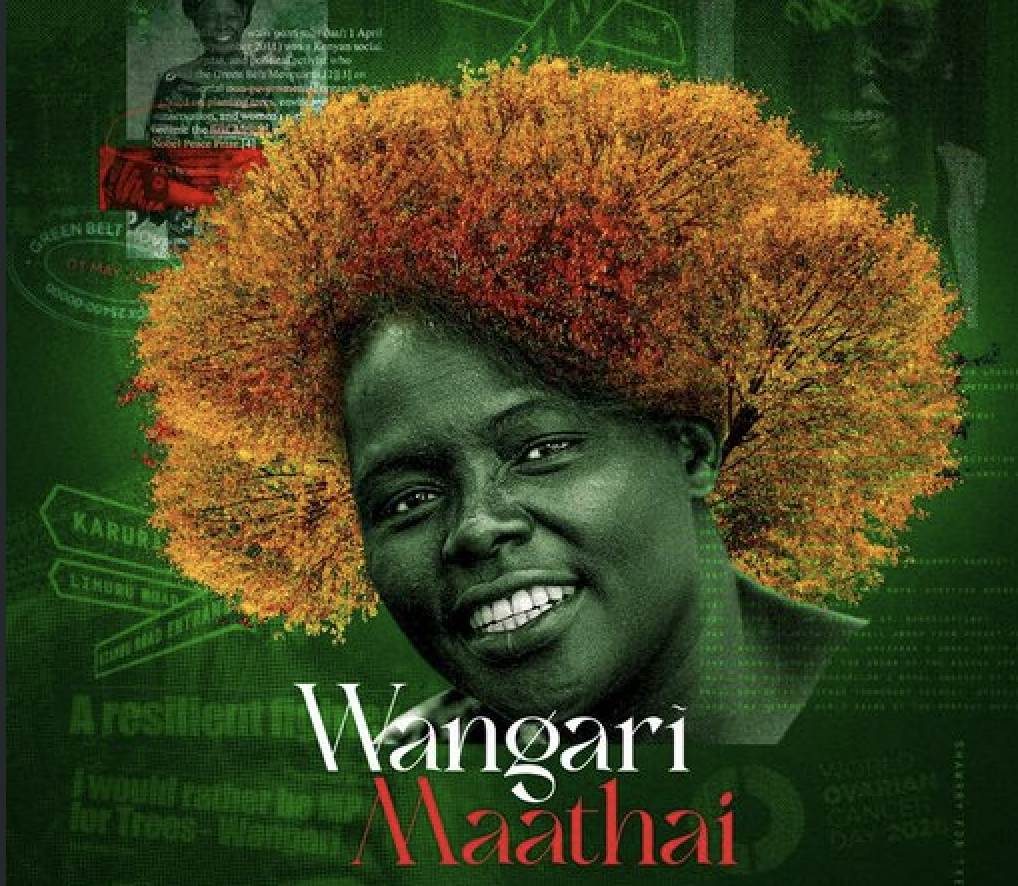
A Wangari Maathai poster by Too Early for Birds.

Audio By Vocalize
Dates, names, timelines always felt boring, like stories that belonged to another world, not mine.
But sitting in the audience watching Shawry for Trees: The Roots of a Revolutionary by Too Early For Birds, I realised something: history is not boring when it is told right. In fact, it can feel like it’s happening right in front of you.
This wasn’t just a play. It was an experience.
From the moment it begins, the story pulls you into the life of Wangari Maathai not as a distant icon, but as a young girl growing up in Nyeri.
Curious. Fearless. Always asking questions. We see her connection to the land early on, planting crops like ngwaci and nduma, grounding her story in something deeply personal and cultural.
And then there is the Mugumo tree.
In Kikuyu culture, it is more than just a tree; it is sacred, a place of worship. The play uses it as a powerful symbol, reminding us that for Wangari, the fight for the environment was never just political; it was spiritual.
As the story unfolds, we watch her grow into different roles: a wife, a mother, a leader. But what makes this play powerful is that it does not sugarcoat her journey. It shows the pain. The resistance. The moments she is silenced, dismissed, and reduced simply because she is a woman.
Even today, those struggles feel painfully familiar. In 2026! Come on.
Women are still fighting to be taken seriously in leadership.
Still being told they don’t belong in positions of power. Still being paid less. Watching this global, historical icon go through it on stage feels less like history and more like a mirror of our present.
Then comes her activism, and this is where the play truly comes alive.
We see the birth of the Green Belt Movement, starting with something simple: planting trees. Just seven at first. But those trees carried names, meaning, and purpose. They were not just about the environment; they were about resistance.
Yet she faced backlash.
“Trees don’t vote,mbona tukosane?” they asked.
That line hits hard because it reflects a mindset we still see today where development is often placed above sustainability. Where protecting the environment is treated as an afterthought.
One of the most powerful moments is the protest against the construction of a 60-storey building at Uhuru Park, a $200 million project that threatened to take away the public green space.
Watching that scene, you begin to understand just how much bigger Uhuru Park once was and how much Wangari fought to protect it.
“Let’s become a nuisance,” she says. That line stays with you.
Because her activism was not about being liked, it was about being heard.
The play also does not shy away from the brutality she endured. We watch her get arrested. Jailed at 52. Beaten. These words may sound familiar or even traumatising to some of us after the bloody maandamanos we experienced over the last two years.
Her body growing weaker, aching knees, a hurting back, but her spirit refusing to break. At one point, a line echoes: “Scared people do stupid things.” In that moment, you realise that her fight was not just against systems, but against fear itself.
There are softer moments, too. Moments that remind us she was human.
Her children. Her son, Waweru. The personal losses she faced. The loneliness that sometimes comes with standing for something bigger than yourself. These scenes ground the story, making it deeply emotional and real.
And then there is the hummingbird story, a simple but powerful metaphor about doing what you can, with what you have, no matter how small it seems. It perfectly captures the essence of who Wangari Maathai was.
When the play touches on her Nobel Peace Prize win in 2004, it doesn’t feel like an ending, but a continuation. Because her work did not stop there. And neither should ours.
What makes Shawry for Trees stand out is that it refuses to sit in the past. It constantly reminds you that the issues Wangari fought for are still here with us.
Deforestation. Environmental degradation. Gender inequality.
We are still fighting.
Maybe that is what makes this play so powerful: it doesn’t just tell you about history. It challenges you to think about your role in shaping the future.
By the time the lights go off, you don’t just walk away entertained by the cast who did an amazing job; you walk away questioning yourself.
I walked in, not liking history. I walked out reflecting on the battles we are still fighting today, forests are still being cleared, women are still fighting for equal pay and a seat at the table, and leadership is still questioned when it wears a woman’s face.
I left feeling challenged and encouraged to speak up, to stand firm, and to fight for what is right, to be part of a generation that refuses to stay silent, and to be that one person who chooses to make this country work and change it for the better.
It feels like a call to action for all of us.
Join the Discussion
Share your perspective with the Citizen Digital community.
No comments yet
This discussion is waiting for your voice. Be the first to share your thoughts!