
As pump prices soar, Kenyans unearth old clips of Ruto's rosy promises to cut taxes on fuel
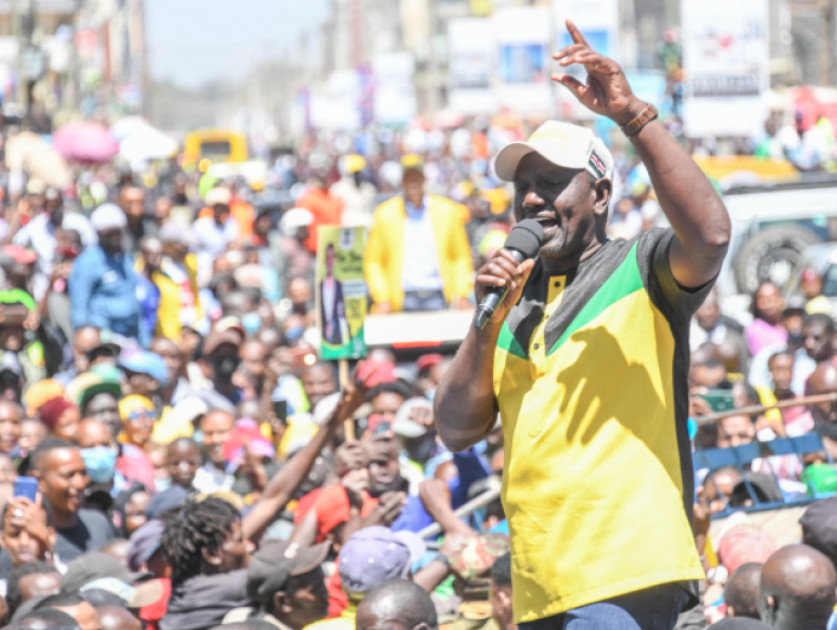
File photo of William Ruto addresses a campaign rally in Nairobi on January 12, 2021.

Audio By Vocalize
The price of petrol in Nairobi had gone up by Ksh.28.69 to Ksh.206.97 per litre, and diesel had shot up by an eye-watering Ksh.40.30 to Ksh.206.84 per litre.
The cost of living is about to shoot for the moon, and everything will cost more and all eyes, as expected, are on President William Ruto.
Kenyans were quick to recall the promises he made before he became a tenant of the house on the hill.
Kenyans were promised fuel at affordable prices, promises they heard and believed. Indeed, many are dusting off old campaign videos of the man now responsible for the promises and the current prices.
The Firebrand Deputy President
Cast your mind back to April 2022. Kenya was experiencing a biting fuel shortage and skyrocketing pump prices.
Then-Deputy President William Ruto was in full campaign mode, crisscrossing the country and presenting himself as the champion of the hustler, the ordinary Kenyan crushed under the weight of a callous government.
In a press briefing on April 4, 2022, Ruto called out President Uhuru Kenyatta for blaming the fuel shortage on Russia's invasion of Ukraine, dismissing the explanation as "escapist", saying it "had no basis."
It was a scathing statement, designed to cut to the heart of the incompetence of the administration he served as deputy president, but was now fighting.
"How come the fuel in Uganda is cheaper than the fuel sold in Kenya, and yet the fuel in Uganda goes through Kenya? That tells you that the kind of explanation given is escapist," he thundered.
The biggest promise that Kenyans probably celebrated then and are looking back at today and pinching themselves is the promise to remove VAT on fuel.
During the presidential debate, Ruto said he would cut the taxes that inflate the price of fuel to cushion Kenyans.
"I think the first thing we need to do is look at the taxes because 50% of the cost of fuel is taxes. There are 15 different taxes on fuel, and I think it’s time we looked at how else do we raise revenue…" candidate Ruto told the moderator Yvonne Okwara.
"Majority of the taxes in that bracket," he continued. "I do not have the specifics, but we need to interrogate these 15 different taxes, which ones can we put aside. Take, for example, VAT, I think we need to rethink VAT taxation on fuel."
The crowd cheered.
Back on the campaign trail, the charismatic politician was not done. Ruto blamed the rising cost of fuel then on corruption cartels and demanded to know why Kenya's fuel prices were high, implying deliberate profiteering and state capture were the real culprits.
On Labour Day, 2022, as President Uhuru Kenyatta told Kenyans that "this war we don't even understand has caused fuel and food prices to go up," Ruto was having none of it.
By June 30 of the same year, Ruto shot back: "This whole story about Ukraine is a lost cause... the challenge of cost of living is not too scientific. The challenge of the cost of living is increasing agricultural productivity, period." The crowds roared. The hustler had spoken.
Promises Made, Promises Forgotten, Expediency reigns
William Ruto's attacks on the Kenyatta administration were not merely rhetorical. They came bundled with solemn promises.
On the campaign trail, he vowed that once in power, he would address Kenya's economic challenges, blaming the high cost of living squarely on corruption and mismanagement, and promising to put the poor at the centre of his administration’s economic policy.
During the election campaign, Ruto promised to fix an economy afflicted by corruption and ineptitude, pledging to entrench good governance and the rule of law. He was particularly vocal about taxes.
"These people don't understand the damage they are doing to the people and economy of Kenya na hizi taxes wanaongeza usiku na mchana," he said at the Sugoi Roadside Market, lambasting the government's appetite for taxation. It was a powerful message made directly to struggling Kenyans, and they believed it, or so it seems, because they elected him.
In comes President Ruto, and suddenly the Russia-Ukraine war mattered
Then came the reckoning that governance is far more complicated than opposition rhetoric. Shortly after assuming the presidency in September 2022, Ruto lambasted the fuel subsidy policies of his predecessor, saying they "gobbled up billions of shillings with no impact" and were "prone to abuse" and "distort markets."
The Kenya Kwanza government's first order of business was to slash the Uhuru subsidies. A new sheriff was in town.
By late 2023, a remarkable transformation had taken place. President Ruto mentioned that the Russia-Ukraine war was one of the causes of the skyrocketing cost of living.
He cited "a serious situation caused by Covid, the big war in Europe, a huge drought caused by climate change" as some of the factors that had combined to raise commodity prices and weaken the shilling. The same Ukraine war he once called "a lost cause."
Nairobi Senator Edwin Sifuna was among the first prominent voices to call out the glaring contradiction: "When he was addressing the cost of fuel as Deputy President, the war in Ukraine, according to him, had no links whatsoever to the cost of living, nor was climate change. He singled out state capture and cartels. He told us he would destroy the cartels, but fuel is now retailing at over Ksh.200. What happened to that story?"
The numbers tell the story
The current fuel arithmetic is brutal and real. These are not figures from the Uhuru era that Ruto once thundered against. These are figures his own government has presided over.
To be honest, the price uptick has been occasioned by the US-Israel war on Iran, which has seen the Strait of Hormuz, a critical artery of the world's oil, closed, sending the price of oil shooting to an all-time high.
To his credit, the president and his administration moved to cushion Kenyans from the real shocks. To soften the blow, the government reduced VAT on petroleum products from 16% to 13%, and tapped into the Petroleum Development Levy Fund, deploying approximately Ksh.6.2 billion to stabilise pump prices. The same subsidy he once ranted about, saying it was "prone to abuse" under his former boss.
EPRA attributed the price surge to the average landed cost of imported Super Petrol shooting up by 41.53% between February and March 2026, driven by escalating international market prices, which are directly impacted by the Iran-Israel-US war.
Unforgettable Social Media records
Social media platforms are flooded with Kenyans re-sharing old videos of President Ruto and his allies openly blaming Kenyatta for Kenya's economic challenges, the same challenges Ruto's administration now faces, and to a worse degree.
The irony cuts both ways. On one hand, governing a commodity-import-dependent economy in a volatile global environment is genuinely difficult.
On the other hand, the ferocity of Ruto's past criticism and the absoluteness of his promises have left him with very little political cushion.
When you build your entire presidential campaign on the argument that high fuel prices are purely a function of domestic corruption and cartels, and then preside over fuel crossing the Ksh.200 mark, the chickens inevitably come home to roost.
The Price of Populism
President Ruto's journey from fuel price affordability crusader to fuel price increment presider is a cautionary tale about the dangerous gap between campaign populism and governing reality.
Global oil markets, exchange rate pressures, import costs, and geopolitical shocks do not bend to campaign rhetoric, a lesson every Kenyan leader is now being forced to learn.
There is a certain irony that stings sharper than the pump prices themselves. It is no longer a question of whether Ruto is eating humble pie. Clearly, he is.
The sarcasm is whether ordinary Kenyans, the hustlers he so passionately championed, will extend the same understanding he once refused to give Uhuru Kenyatta.
As the pump ticks past Ksh.206 per litre, that answer feels increasingly grim. It is a bitter turn-around to be subject to such prices, and the question on everyone's lips: Was he talking about what he only imagined he knew? He also brought on board the G-to-G fuel deal ostensibly to cushion Kenyans from unforeseen and obvious shocks. How come Kenyans remain so exposed to manageable external shocks?
Campaign, meet statecraft.
Join the Discussion
Share your perspective with the Citizen Digital community.
No comments yet
This discussion is waiting for your voice. Be the first to share your thoughts!